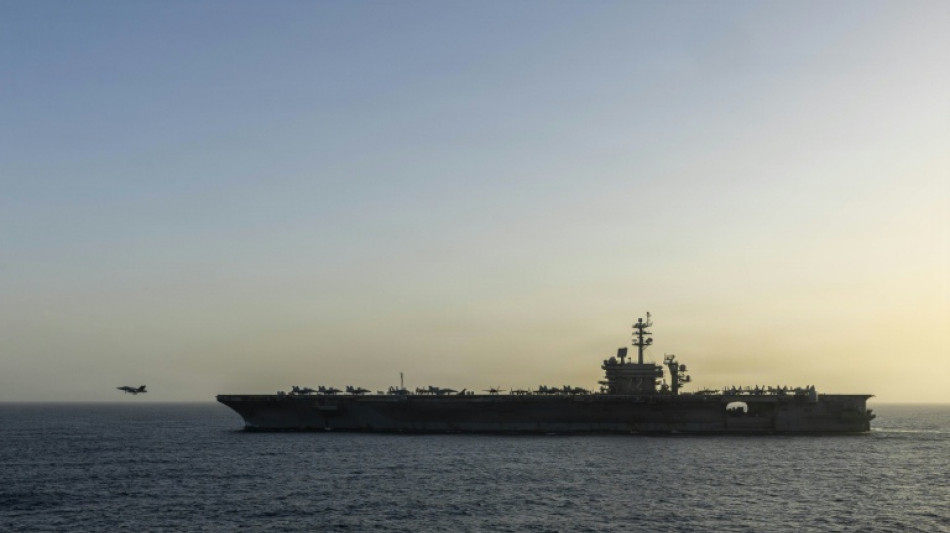
Iran defies Trump's blockade as oil prices soar / Photo: © US Central Command Public Affairs/AFP
Iran warned the United States on Thursday that its naval blockade was doomed to fail, after President Donald Trump signalled it could be enforced for months to come, in a confrontation wreaking havoc on global energy markets.
Oil prices soared to a four-year high, with Brent crude for June delivery up 7.1 percent to more than $126 dollars a barrel, and Iran's President Masoud Pezeshkian responded with a warning that the action would only further destabilise the region.
The United States imposed a blockade on Iran's ports, while the Islamic republic has maintained its stranglehold over the strategic Strait of Hormuz since the start of the Middle East war in February.
"Any attempt to impose a maritime blockade or restrictions is contrary to international law... and is doomed to fail," Pezeshkian said, in a statement that warned the blockade that began on April 13 would be "a disruption to lasting stability in the Persian Gulf".
Trump is expected to receive a briefing on Thursday on new plans for potential military action in Iran from Admiral Brad Cooper, the head of US Central Command, two sources with knowledge of US planning told news platform Axios.
This week Trump has reportedly told oil executives and national security officials to prepare for a long US blockade designed to force Tehran to surrender its nuclear programme, and, speaking to Axios, said: "They are choking like a stuffed pig. And it is going to be worse for them."
US Central Command (CENTCOM) said Wednesday in a social media post that it had reached a "significant milestone after successfully redirecting the 42nd commercial vessel attempting to violate the blockade".
It said there are "41 tankers with 69 million barrels of oil that the Iranian regime can't sell", estimating the value at more than $6 billion.
Trump faces domestic political pressure to end the war, which is unpopular even with much of his base, has increased costs for American consumers and has unnerved US allies.
Iran's economy is also suffering and the rial has fallen to historic lows against the dollar.
Iran has sought to extract a price for being attacked by exerting control over the Strait of Hormuz, the narrow waterway through which about one-fifth of global oil typically transits.
- 'The issue is always nuclear' -
Top US officials, including Vice President JD Vance, twice turned back last week from trips to Pakistan to negotiate with Iran.
US officials contend they do not know who is speaking for Iran, whether it is the hardline and increasingly empowered Revolutionary Guards or diplomats, after Israeli strikes killed a series of top leaders.
Tehran residents speaking to AFP journalists in Paris reported a sense of despair.
"Every time in recent years that negotiations have taken place, the economic situation of the people has only gotten worse. Sanctions have either started or intensified," a 52-year-old architect told AFP, speaking on condition of anonymity.
"The issue is always nuclear. There's no talk about people, the economy or freedom. People have the right to not even want to hear the word 'negotiation'," he said.
- 'Collapse' -
Iran proposed easing its chokehold over the Strait of Hormuz if Washington lifts its blockade and broader negotiations take place.
But the Trump administration has insisted that Iran's nuclear programme be on the table.
Iran's parliament speaker Mohammad Bagher Ghalibaf, who has emerged as a key figure since the start of the war, said Wednesday the US naval blockade of the country aimed to create division and "make us collapse from within".
Violence has continued on the war's Lebanese front, despite a recently extended ceasefire between Israel and Hezbollah, the Iran-backed armed group that drew Lebanon into the war by firing rockets at Israel. Israel responded with strikes and a ground invasion.
For the first time since the ceasefire began, the Lebanese army said on Tuesday that an Israeli strike had targeted its troops, wounding two soldiers in the south. Another strike on Wednesday killed a Lebanese soldier, it said.
"Israel must finally realise that the only path to security is through negotiations, but it must first fully implement the ceasefire in order to move on to negotiations," Lebanese President Joseph Aoun said.
A UN-backed report said Wednesday more than 1.2 million people in Lebanon were expected to face acute hunger due to the latest war.
burs/dc/ser
L.Graham--TNT