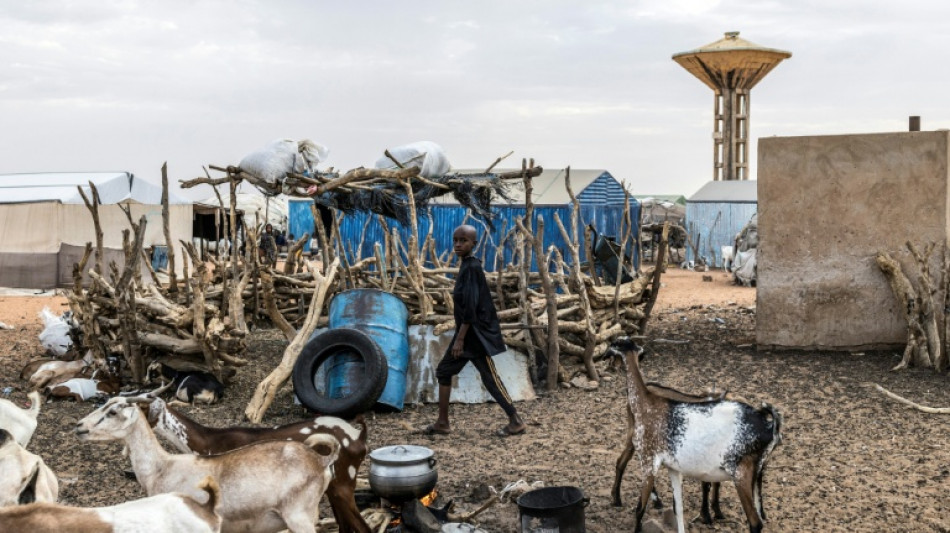
Mali faces advancing rebels in 'difficult' situation / Photo: © AFP
Jihadists and Tuareg separatists were advancing in northern Mali on Tuesday, three days after launching unprecedented attacks against the ruling junta, in what the government's Russian allies said remained a "difficult" situation.
Junta chief Assimi Goita has not appeared or spoken publicly since the coordinated dawn attacks on Saturday on strategic junta positions, including areas around the capital, Bamako.
The attacks were the largest in nearly 15 years and saw two former foes -- Islamist insurgents and Tuareg separatists -- join forces against the military junta and its Russian paramilitary backers, analysts say.
Defence Minister Sadio Camara -- seen as the mastermind behind the junta's pivot to Russia -- was killed in two days of fierce fighting between the army and Tuareg rebels of the Azawad Liberation Front (FLA) allied with the Al-Qaeda-linked jihadist Group for the Support of Islam and Muslims (JNIM).
Russia's defence ministry said on Tuesday that the rebels, who have captured a key town in the mostly desert north, were "regrouping" and the situation "remains difficult".
The fighting saw "attempts made to seize key facilities in the capital, Bamako -- first and foremost, the presidential palace", the ministry said.
It confirmed that mercenaries from Russia's Africa Corps, controlled by the government in Moscow and sent to back up the Malian junta, had been forced to withdraw from the northern town of Kidal, now under the armed groups' control.
The Kremlin, separately, said it urgently wanted peace and stability in Mali, which has battled more than a decade of jihadist violence and other conflict.
- Abandoned and withdrawn -
The large-scale attacks at the weekend raise questions about the junta's ability to tackle the armed groups, despite its insistence that its strategy, foreign partnerships and increased military efforts have stemmed the jihadist threat.
The notable absence of Goita, who seized power in 2020 pledging to combat the Islamic militants, has prompted uncertainty about the future of the country's military leaders.
A Malian security source told AFP that Goita was not taking any risks for "security reasons".
"The military leadership is currently drawing lessons from the prevailing situation," an elected official in Bamako said on condition of anonymity.
In a sign of the high tensions in the west African nation, the army has abandoned several positions in the northern Gao region, local sources told AFP on Tuesday.
Gao is the army's second-largest military stronghold after Kati, a garrison town near Bamako which is home to several senior junta officials and was targeted in the weekend attacks.
"The military have abandoned their position in Labbezanga, near the Niger border. They have withdrawn to Ansogo," a local politician told AFP on condition of anonymity.
As well as Kati, the simultaneous weekend attacks targeted the towns of Kidal and Gao in the north, and Sevare in the centre.
Two loud blasts were heard late on Monday near the airport on the outskirts of Bamako, an AFP journalist said.
The cause of the blasts could not immediately be identified.
"It wasn’t an exchange of gunfire and the explosions were coming from the area of Base 101 at the airport," a resident told AFP.
- Diversion? -
The attacks near the centres of Malian power have been seen by some analysts as a diversion to seize Kidal.
Kidal, a pro-independence stronghold, was controlled by Tuareg rebel groups for years before being retaken in November 2023 in an army offensive, supported by Russian mercenaries from Africa Corps' predecessor, the Wagner Group.
Central Mali, where Mopti is located, was also targeted and the security situation remained unclear on Tuesday.
The attacks are reminiscent of a crisis that rocked Mali in 2012, when Tuareg rebels joined forces with jihadists to capture strategic hubs in the vast, remote north.
That offensive was repelled by forces from former colonial ruler France, who have since left the Sahel country.
The alliance between the jihadists and Tuareg rebels eventually unravelled when they turned on each other and the jihadists drove the Tuareg separatists out.
The latest attacks are the result of a new alliance forged a year ago.
Although the two groups have different goals, according to experts, they are united against a common enemy -- the military junta that has ruled since 2020 and its Russian paramilitary backers.
C.Blake--TNT