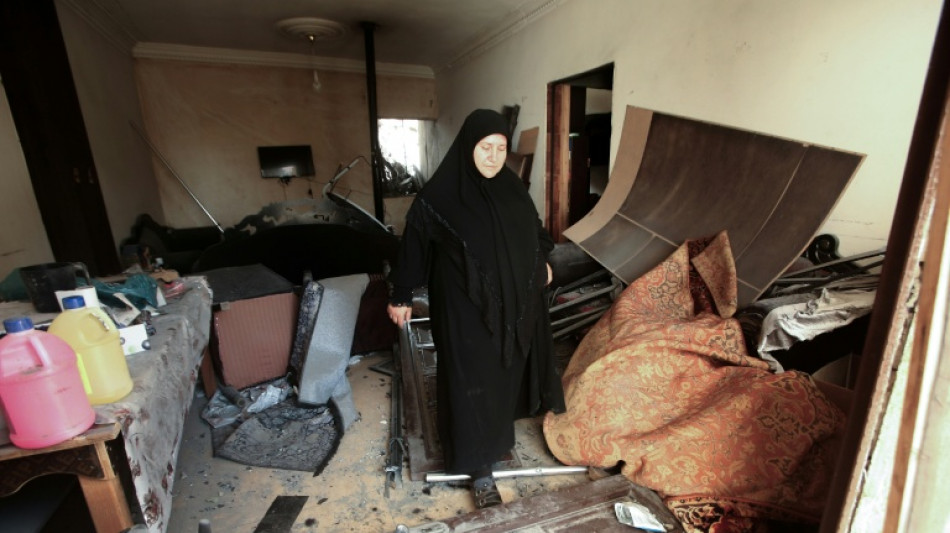
In south Lebanon's Nabatieh, residents fear a return to war / Photo: © AFP
Outside her gutted home in southern Lebanon's Nabatieh, Zainab Farran, who recently lost two members of her family in Israeli strikes, keeps her clothes packed in a car in case the temporary truce between Hezbollah and Israel does not last.
She returned to the city with her family as soon as the 10-day ceasefire agreed between Lebanon and Israel, which included the Lebanese militant group, went into force on Friday, only to find their home in ruins from Israeli bombardment.
"There is nothing left, no doors, no furniture," the 51-year-old woman said, stepping over the rubble of her charred living room and kitchen.
They had fled to Kfar Hatta village further north a day after Hezbollah drew Lebanon into the Middle East war on March 2 with rocket fire at Israel.
Farran and her family stayed with some relatives, while her daughter-in-law went to stay with her parents.
Death caught up to the latter earlier this month, when an Israeli strike on April 5 killed her along with her five-year-old daughter and four other family members.
With her home destroyed, Farran now sleeps at the house of her newly-widowed son, who stayed in Nabatieh working for an electrical company.
"We will wait and see if they will renew the truce," Farran said from her deserted neighbourhood, where several houses lie in ruins.
"If they do not renew it, we will see where to go... my stuff is still in the car."
Israeli strikes on Lebanon killed more than 2,300 people and displaced more than a million, most of them from the south, which Israel now occupies a portion of.
The truce is due to expire on Sunday.
- Preparing for the worst -
In the city surrounded by fields of buttercups, collapsed buildings and gutted shops follow one another, from bakeries to florists.
Few locals believe that the ten-day truce would be renewed.
"Nabatieh had 90,000 residents," mayor Abbas Fakhreddine told AFP.
"Only around 200 families remained by the end of the war."
Around 40 percent of residents came back during the truce, but only to check on their homes before leaving again as they are "worried for the future", Fakhreddine estimated.
Local authorities are preparing for the worst in the city that has seen more than its share of war, and a three-year Israeli occupation between 1982 and 1985.
Fakhreddine said they "stored some food supplies and diesel fuel for electricity generators, as a precaution in case, God forbid, the war returns again."
The city official received AFP in a temporary office because the municipal headquarters was destroyed by an earlier Israeli strike in 2024
Fakhreddine received AFP in a temporary office because the municipal headquarters was destroyed by an Israeli strike during an earlier 2024 war, killing his predecessor and 13 other people.
The mayor says Nabatieh lost around 100 people in the latest war, during which Israel struck the city 65 times.
In the so-called Nuns' Quarter, home to a Catholic school, seven people including a family of six were killed, buried under the rubble of a building.
An Israeli shell hit the kindergarten section, a blue school uniform was still visible in the neighbouring building.
"The strike happened two weeks ago," Sister Maria Wehbeh, the school's bursar, who came to assess the damage, told AFP.
"The school was also damaged in the previous war and we were unable to repair it," she said, referring to the 2024 conflict.
The school has around 1,200 students from Shia-majority Nabatieh and its surroundings.
- Alone in the market -
All over the city, portraits of Hezbollah's recent "martyrs" adorn the walls, alongside giant murals of the group's historic leaders, assassinated by Israel.
The historic marketplace, whose weekly market once drew traders from as far as neighbouring Palestine, before the creation of Israel, was completely destroyed by the latter's bombs in 2024.
An initiative to create a new, temporary market in the city wasn't even inaugurated before fighting once again took over.
Now, only a few small businesses are reopening in the city, like a chicken shop with a shattered storefront whose owner said his five employees have not come back.
During the war, just one small grocer kept his store open.
"The whole war, from beginning to end, I was open... I stayed alone in the market," said Abu Habib, 65, standing in front of his stalls of canned goods and bags of rice.
"People waited until strikes halted to come buy supplies then go straight back home."
The grocer is one of the few convinced the truce will be renewed.
"Both sides do not want to fight," he said.
T.Ward--TNT