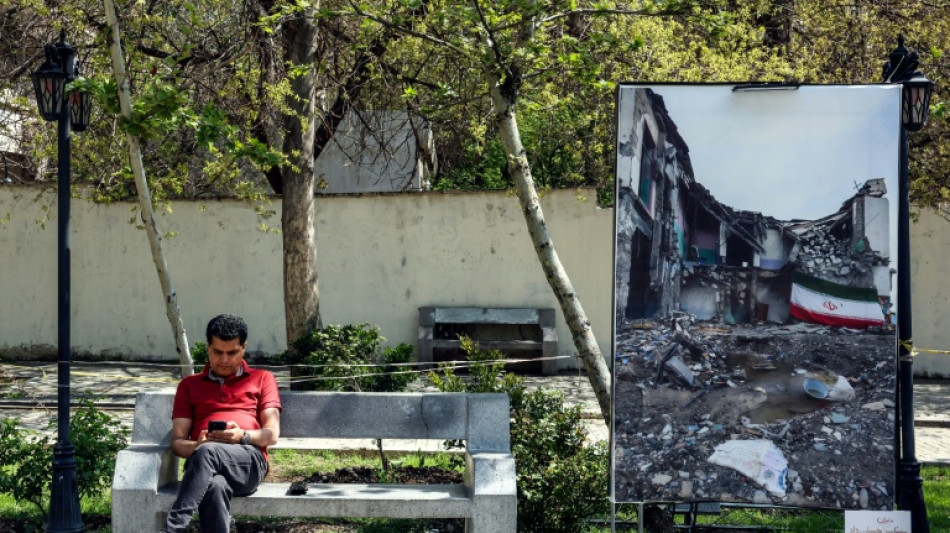
Trump says Iran agrees to hand over its enriched uranium / Photo: © AFP
US President Donald Trump said Thursday Washington and Tehran were "very close" to a peace deal and insisted that Iran had agreed to hand over its enriched uranium, a key sticking point in negotiations.
The United States had earlier threatened to resume airstrikes on the Islamic republic and maintain a naval blockade of its ports if Tehran refused to accept a deal to solve the conflict that broke out on February 28.
At the same time, a ceasefire came into effect between Israel and Lebanon -- a 10-day truce -- with Trump saying he expected the two countries' leaders at the White House within "four or five days."
Hezbollah has not said if it recognizes the ceasefire -- but a senior figure said it would respect it if Israeli attacks on the militants stopped.
But Israel's army said it was striking Hezbollah rocket launchers after fire from Lebanon shortly before the ceasefire was due to begin.
The prime ministers for both countries welcomed the ceasefire, which came days after the US and Iran agreed to a separate truce and as Pakistan pursued diplomatic efforts to arrange a new round of talks between foes Washington and Tehran.
On Thursday, Pakistan's powerful army chief Asim Munir met Iran's parliament speaker, Mohammad Bagher Ghalibaf, who led the Iranian delegation at the first round of talks last week, which ended without a deal.
Iran's UN ambassador later said Tehran was "cautiously optimistic" about peace talks with the United States, expressing hope for a "meaningful outcome."
US Defense Secretary Pete Hegseth said Thursday "if Iran chooses poorly, then they will have a blockade and bombs dropping on infrastructure, power and energy."
Trump later told reporters that "there's a very good chance we're going to make a deal" with Tehran.
"They've agreed to give us back the nuclear dust," he said, using his label for the enriched uranium stockpile that Washington says could be used for nuclear weapons.
Trump has offered no details about any transfer, and Iran has given no public indication it would surrender its stockpile.
- 'Indisputable' right to uranium -
Trump has insisted any deal with Iran must permanently block it from acquiring nuclear weapons.
He launched the war claiming Tehran was rushing to complete an atomic bomb, an assertion unsupported by the UN nuclear watchdog.
Washington has reportedly sought a 20-year suspension of Iran's uranium enrichment program, while Tehran has proposed suspending nuclear activity for five years -- an offer US officials rejected.
Tehran insists its nuclear program is peaceful.
Iran insisted Wednesday its right to enrich uranium was "indisputable", although the level of enrichment was "negotiable."
The US House of Representatives on Thursday rejected a Democratic effort to curb Trump's authority to wage war in Iran, with lawmakers wary of soaring costs, an unclear endgame and the risk of a wider conflict.
- 'An abyss' -
White House Press Secretary Karoline Leavitt had told reporters Wednesday further talks between the US and Iran "would very likely" be in Islamabad.
Pakistani foreign ministry spokesman Tahir Andrabi said no date had been set for the next round of talks.
US Vice President JD Vance, who led the first round, has said Iran is being offered a "grand bargain" to end the war and address the decades-old dispute over Tehran's nuclear program.
Israel's defense minister Israel Katz said Iran was "standing at a historic crossroads" and not pursuing a deal "leads to an abyss."
Shipping in the Strait of Hormuz, through which one-fifth of the world's crude oil normally flows, has been disrupted by Iran since the US-Israeli offensive began, and is now the focus of the US blockade.
Around 2100 GMT, Brent North Sea Crude had risen 3.24 percent to $98.01.
Washington has sought to escalate pressure on Tehran by blockading its ports, with US Central Command claiming to have "completely halted economic trade going into and out of Iran by sea" by turning back 13 vessels departing Iranian ports.
Maximizing pressure, Washington slapped fresh sanctions on Iran's oil industry on Wednesday, which Treasury Secretary Scott Bessent said targeted "regime elites."
The military adviser to Iran's supreme leader Mojtaba Khamenei also warned that Iran would sink American ships in the strait if the United States decides to "police" the key shipping channel.
burs-gw/jgc
P.Murphy--TNT