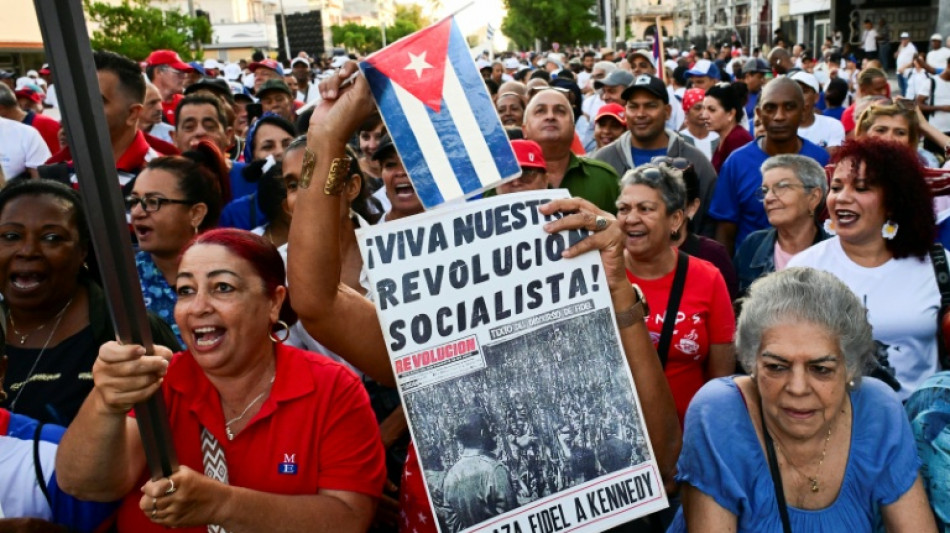
Cuba 'ready' for possible US attack: president / Photo: © AFP
Cuban President Miguel Diaz-Canel said Thursday his country was "ready" for a possible US attack on the communist island following months of mounting pressure from President Donald Trump.
"We don't want that (confrontation) but it is our duty to be ready to avoid it, and if it were unavoidable, to win it," Diaz-Canel told thousands of people attending a rally in Havana to mark the 65th anniversary of the failed US invasion of the island at the Bay of Pigs.
Cuba has been bracing for a possible attack following repeated warnings from Trump that Cuba is "next" after he toppled Venezuela's leader Nicolas Maduro and went to war against Iran.
Washington and Havana have held talks on de-escalating tensions but the discussions between the arch-foes have failed to make significant headway, according to US media reports.
Mariela Castro, daughter of late president Raul Castro, said Cubans "want dialogue" with Washington but "without putting our political system up for debate."
She said her 94-year-old father -- who oversaw a historic 2015 rapprochement with the United States under Barack Obama that Trump later reversed -- was indirectly involved in the talks.
Raul's grandson Raul Rodriguez Castro, a colonel, is reportedly among the negotiators.
Diaz-Canel admitted that the current moment was "very grave" but stressed Cuba's "socialist" nature, as proclaimed by Fidel Castro on April 16, 1961.
The 1961 Bay of Pigs invasion was launched two years after Castro's revolutionaries took control of the island and began nationalizing US-owned properties and businesses.
Between April 15 and 19, around 1,400 anti-Castro Cuban exiles in Miami, trained and financed by the CIA, landed at the Bay of Pigs, about 250 kilometers (155 miles) south of Havana.
Cuban forces repelled the invaders, inflicting a humiliating defeat on the Americans.
Six decades later, Washington now has Cuba again in its sights.
After Maduro's capture in Caracas Trump imposed an oil blockade of Cuba, aggravating the impoverished island's worst economic and energy crisis in decades.
Diaz-Canel rejected what he referred to as a US portrayal of Cuba as a "failed state."
Havana largely blames its woes on a US trade embargo imposed shortly after Castro's arrival to power, still in place today, and the more recent oil blockade.
"Cuba is not a failed state, it's a besieged state," he said.
Maria Reguiero, an 82-year-old attending the rally, said that like in 1961, Cubans were "ready to defend their sovereignty, whatever the price."
T.Bennett--TNT