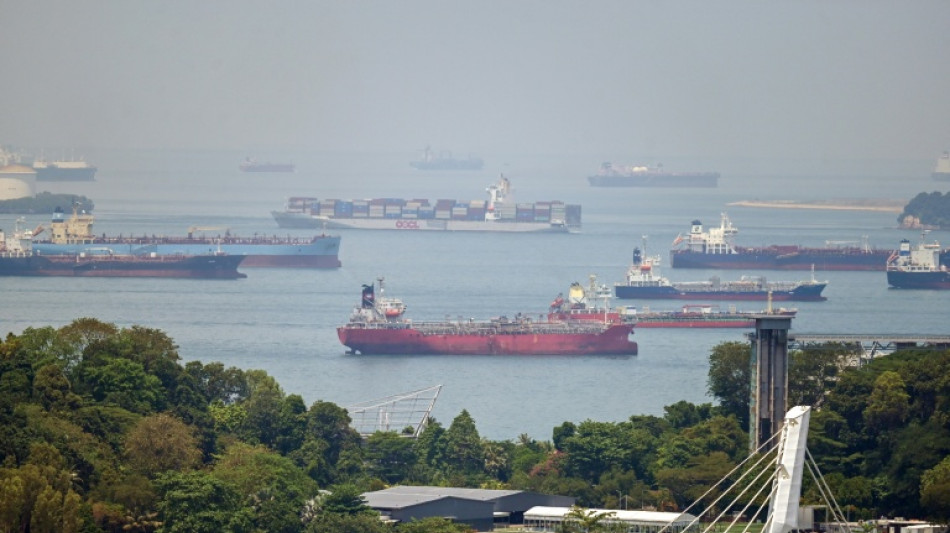
Iran's shadow oil trade endures near Singapore despite war / Photo: © AFP
Near Singapore, thousands of miles from the Strait of Hormuz, ship-to-ship transfers of Iranian oil have continued during the Middle East war, helping Tehran evade sanctions and maintain trade with China.
Nearly 400 tankers are sanctioned by the United States, the European Union or Britain for their activities related to Iran -- which is now facing off against the United States during a tense ceasefire.
The ageing vessels that make up Iran's "ghost fleet" operate clandestinely, exploiting opaque ownership structures, false flags, a lack of insurance and manipulation of GPS data to keep a low profile.
Ship-to-ship (STS) transfers on the high seas allow them to "launder" cargoes, disguising their origin.
An area off Malaysia and Singapore, about 100 kilometres (60 miles) southeast of the Malay Peninsula, has emerged as a strategic hub for moving Iranian crude.
Each week, dozens of transfers between tankers -- not only Iranian -- can be seen from the air, an AFP analysis of satellite imagery found.
"It's really the main hub," said Amir Handjani of the US-based Quincy Institute for Responsible Statecraft. He described the STS situation there as "total anarchy".
These transfers have continued during the war, despite a temporary easing of US sanctions.
On March 20, Washington authorised the sale of Iranian oil already stored on vessels before that date. The authorisation is due to expire on April 19.
But faced with "contradictory activities" by the United States -- easing sanctions then blockading Iranian ports -- "it's safer to keep exporting Iranian oil using shadow vessels and then STS transfers than it is to try to export that oil legitimately," said Elisabeth Braw, an expert at the Atlantic Council.
- Destination China -
Iranian tankers leave the Gulf via the Strait of Hormuz having loaded with crude, usually at Iran's strategic Kharg Island, according to analysis of several maritime tracking platforms.
They then skirt the Indian subcontinent and pass through the Strait of Malacca to Singapore on a two- to three-week journey, before anchoring and waiting for another tanker to take their cargo.
Since March 1, at least 37 Iran-linked tankers have transferred their cargo at sea in the area, amounting to at least 62.3 million barrels of crude, according to data from maritime tracking firm Kpler analysed by AFP.
When specified, the final destinations of these cargoes were ports in China's northern provinces of Shandong, Liaoning and Jiangsu.
Most of the vessels left the Gulf before war broke out on February 28, but at least six Iranian tankers -- among 26 that have crossed the Strait of Hormuz during the conflict -- have transferred their cargoes (totalling 10 million barrels) in recent weeks near Singapore.
The Silvia 1 loaded one million barrels at Kharg in February, passed through the Strait of Hormuz on March 3, arrived in the Singapore area on March 21, and transferred its cargo around March 25 to the Yug.
The Yug then took on the cargo of a second Iranian tanker, the Seastar III, on April 3.
The destination of the Yug is unknown, but the Comoros-flagged tanker is accustomed to STS transfers and generally delivers its cargoes to ports in Shandong, according to data compiled by Kpler and the NGO Global Fishing Watch.
- Iranian oil stored at sea -
Two other cargoes that left the Gulf on the Hilda I and the Amber were transferred to other tankers near Singapore at the end of March, and are expected to arrive at the ports of Yantai (Shandong) and Lianyungang (Jiangsu) on Thursday and Friday, according to Kpler.
Cargoes sometimes undergo several STS transfers.
The cargo of the Amber (two million barrels) transferred to the Medna on March 31, then to the Star Pine on April 4, before heading for China.
Kpler cannot rely on ships' automatic identification systems (AIS) transponder signals, which are switched off at key moments, to estimate cargoes and identify transfers within this shadow fleet.
Instead, the company uses algorithms comparing ships' AIS signals with past routes and analysing their draught, which can indicate when cargo has been offloaded.
STS transfers are likely to thrive due to the US blockade of Iranian ports that started on Monday, especially as "there's a lot of Iranian oil still on the water as floating storage," Naveen Das, an analyst at Kpler, told AFP.
F.Hughes--TNT