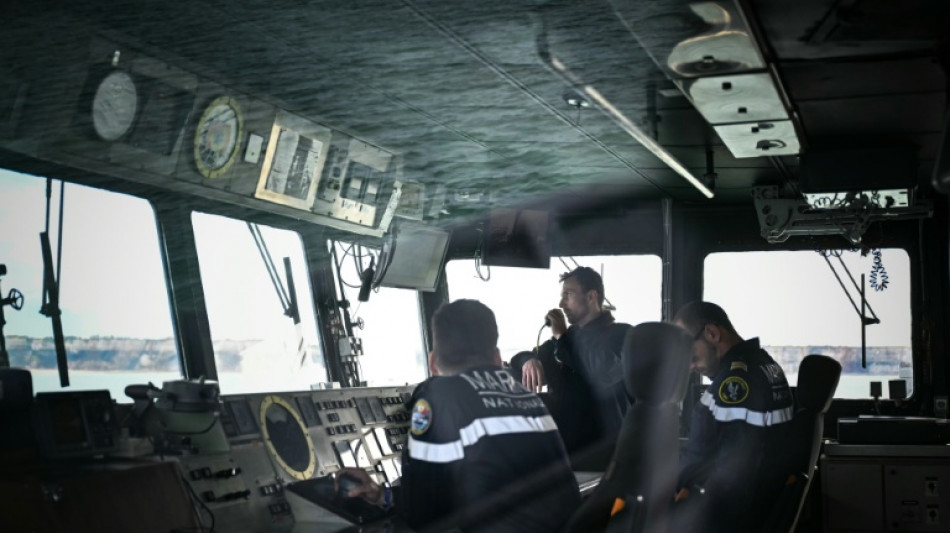
France's Gulf veteran minehunter patrols Channel
/ Photo: © AFP
Just a stone's throw from the chalk cliffs of Dieppe in northern France, French Navy minehunter L'Aigle -- a veteran of the Gulf war -- scans the seabed with ultrasound for unexploded devices.
The Eagle, as the ship would be called in English, has been in service since 1987.
It is one of eight such vessels operated by the French Navy, as debate swirls over whether and how to demine the Strait of Hormuz, where the Middle East war has since late February brought key oil and gas shipping to a near halt.
The French minehunter is no stranger to that crucial stretch of water, having helped demine it in the wake of the Gulf War.
In the gloom of the ship's operations centre, an analyst scours the sonar's screen, where white dots glow, representing objects detected on the seabed.
"Shrimp pots," he explained.
On another screen, the more accurate classification sonar displays an image, resembling a high-definition ultrasound scan, of a cylinder several metres in length -- could this be one of thousands of mines deployed some 80 years ago during World War II?
"We sent the mine clearance divers down this morning to check. It was a log," said L'Aigle's captain, Lieutenant Commander Jacquelin du Reau.
"There are lots of things underwater -– things that have fallen off boats or been carried in by rivers," he explained.
But there are mines, too.
Last year, underwater deminers defused 853 explosive devices off the French coast and on French beaches, including several dozen mines.
- 'Self-propelled fish' -
As currents and storms constantly churn the seabed up, some devices may rise to the surface, du Reau said. For example, moored mines –- spiked balls that were once attached to a cable and floated near the surface, but have since sunk over time.
It's painstaking work -- L'Aigle moves at five knots, or even slower, and can detect an object up to 500 metres away.
Its hull is made of resin and is "non-magnetic" to avoid triggering the explosion of mines, which detonate in the event of magnetic or acoustic disturbance.
Once it has spotted a suspicious object, L'Aigle can approach to within 150 metres to determine whether it is a rock or a far more lethal threat, by scanning it with sonar from different angles.
A new generation of drones equipped with sonar will allow operators to remain at a greater safe distance.
On the aft deck, two yellow underwater robots fitted with cameras are neatly stowed away: these are PAPs, short for "Self-Propelled Fish" in French, used to identify and then detonate mines, just like the six mine-clearing divers on board the vessel.
Ensuring an area is mine-free is a long-term task: "Clearing an area can take years," said du Reau.
But "opening a passage for ships is a matter of weeks," du Reau added.
"It isn't necessarily in our interest to clear" mines that do not directly hinder navigation and where swift progress is needed, he explained.
- Gulf experience -
In the Strait of Hormuz, Iran's Revolutionary Guards have warned of a "danger zone" covering 1,400 square kilometres -– 14 times the size of Paris –- where mines may be present.
It will be essential to ensure these underwater threats are eliminated if France and Britain do build a "purely defensive" coalition of countries to help restore "freedom of navigation in the Strait of Hormuz" after the Iran conflict.
For a mission of this kind, knowledge of the operational area is invaluable.
During each mine-clearing operation, a ship compiles a survey of the seabed. On any subsequent passages, the crew can then disregard objects that already appear in the database and focus on those that were not there before.
The British, the Americans and also the French have carried out numerous mine-hunting missions in the Gulf and the Strait of Hormuz over the years, compiling surveys of the seabed.
In 1991, following the Gulf War, L'Aigle neutralised some 15 mines that had been laid by the Iraqis.
I.Paterson--TNT