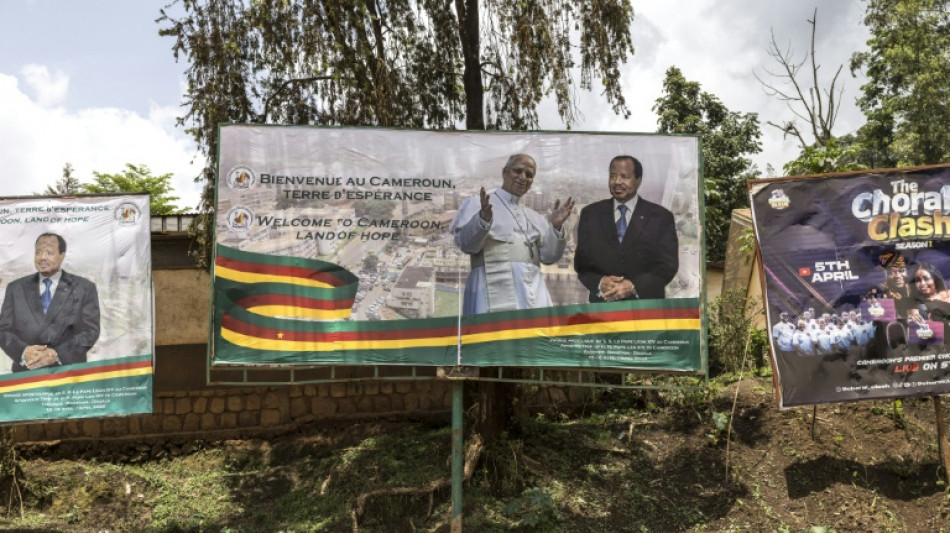
Cameroon's Catholics divided on papal visit / Photo: © AFP
As rumours emerged of a papal visit, some of Cameroon's Catholics voiced fears the trip would give longtime President Paul Biya a chance to polish his image six months on from deadly protests following his contested re-election.
Pope Leo XIV will meet Biya on Wednesday at the start of a four-day visit to the majority Christian country, where two English-speaking western regions have been torn apart by nearly a decade of conflict.
But unease that the face-to-face gives Biya the opportunity to bolster his international standing has been voiced by members of the Cameroonian clergy.
Posters of the president standing next to the pope have already been plastered around cities in the runup.
Biya, 93, the world's oldest head of state, has been in power since 1982 and was re-elected in October for an eighth term, leading to protests that were violently suppressed.
Several dozen people died, the government has said, without giving an exact figure.
"Leo XIV refuses invitations from (US President Donald) Tump because of his policies but accepts Biya's... who kills to stay in power," influential Cameroonian priest Ludovic Lado wrote on Facebook in November.
Among the most resistant, the Jesuit priest, known for his radical positions, sent a letter to the Vatican to express his reservations.
Contacted by AFP, he said that he had been ordered not to speak on the subject anymore, a sign that the Catholic clergy which supports the pope's decision to travel to Cameroon, wishes to avoid making waves.
- 'Validation of electoral theft' -
In a country where more than a third of the around 30 million residents are Catholic, bishops play a highly influential role in society.
It is not uncommon for them to comment on politics during their sermons and to take a public position on political issues.
Some clergy who are at times critical of the president have sought to reassure the Catholic community by dissociating the visit from any gesture of support for the country's leadership.
Opposition figure Jean-Baptiste Homsi, who is Catholic, admitted in an open letter to Pope Leo in November that his visit could be seen by some believers as support for those in power.
He said that many perceived the visit as an "endorsement" given by the Pope "to the dictatorial regime, which imposes on Cameroonians the heavy burden under which they bend" or as "a validation of the electoral theft" of the October presidential poll.
However, like many Cameroonian prelates, Homsi prefers to support the visit as an opportunity for the pontiff to talk "to those sinners who taint and destroy the lives of millions of Cameroonians, who steal and violate the future of millions of young people".
- 'Devil' over Biya -
Conflict erupted in Cameroon in late 2016 after Biya violently suppressed peaceful protests by minority English speakers, many of whom feel marginalised in the majority-francophone country.
"Our country has gone through many crises... some crises are still ongoing. The fruit we are to receive from this visit is to commit ourselves... as peacemakers," Samuel Kleda, the archbishop of the economic capital Douala, told reporters last week.
"This is our chance to show, by welcoming the pope, that we are capable of transforming our country," he said.
Kleda also made a point of speaking in front of the media about the fate of those imprisoned, including some "who have not been tried", after the post-electoral "crisis" that followed the announcement of Biya's victory. Douala was at the centre of the unrest.
Within the clergy, Kleda is one of the most critical voices of those in power.
In December 2024, nearly a year before the presidential election, he said on French broadcaster RFI that Biya's eighth run for the top job was "not realistic".
The bishops of Bafoussam, Ngaoundere and Yagoua have also been critical, the latter saying he'd rather see "the devil" leading Cameroon than Biya.
Previously, influential cardinal Christian Tumi, who died in 2021, had several times called on the head of state to "leave power" in particular pointing to his age.
One voice among the leading clergy however stands out: that of the archbishop of Yaounde Jean Mbarga, who is close to Cameroon's leadership.
"There are always major debates in a democracy, even within the Church," he told AFP, denying any "division" in the country's Catholic community.
Q.Marshall--TNT