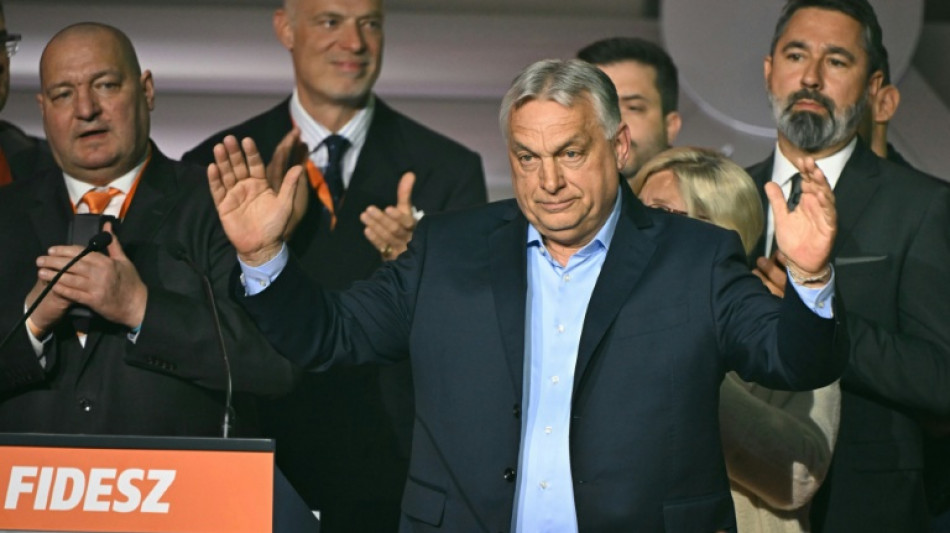
Exit stage right: Hungary's Orban 16-year rule draws to an end / Photo: © AFP
Hungary's Viktor Orban, who conceded defeat to his rival in parliamentary elections on Sunday, was for 16 years a dominant and divisive figure who constantly tweaked his country's political system during his time in power.
But the self-styled "illiberal" politician saw his tight grip on power gradually weaken from 2024 when Peter Magyar, 45, a former government insider burst on to the scene.
The 62-year-old nationalist was a close ally of US President Donald Trump, China and Russia, but a thorn in the side of the European Union establishment.
Leading a central European country of just 9.5 million people, Orban cultivated an international reputation as a staunch opponent of immigration, LGBTQ rights and the West's support for Ukraine against Russia's invasion.
He stood out among European political leaders "as someone different," Emilia Palonen, associate professor at the University of Helsinki told AFP.
"Illiberal political leaders look up to him as a role model, who has made it, managed to take power," she added.
- Learning from his mistakes -
Orban became a household name during the dying days of communism in 1989 with a fiery speech demanding democracy and the withdrawal of Soviet troops.
He was one of "new" Europe's brightest stars, becoming a lawmaker in freshly democratic and optimistic Hungary in 1990.
But he soon shed his image as a radical liberal and began moulding the Fidesz party he co-founded into a new conservative force preaching family and Christian values.
The move paid off, and with Orban developing a rare knack for connecting with ordinary voters, he became prime minister in 1998 at just 35.
His first period in office was rocky, resulting in a humiliating loss against the Socialists in 2002 and again in 2006.
He bounced back, older and savvier in 2010.
"The left was deeply unpopular back then, and, combined with the global economic downturn, this gave him a really fertile ground for a political shift," Palonen said.
Armed with a two-thirds majority in parliament, Orban implemented a root-and-branch reform of Hungarian state institutions and introduced a new constitution steeped in conservative values.
"He has learned from his first term mistakes. He was able to push through sweeping changes rapidly, cementing his power," Palonen added.
- Orban system -
Orban began remaking Hungary's institutions, building a system he dubbed the "illiberal state" in 2014.
"He managed to build up the political system around himself," political scientist Attila Gyulai from the ELTE University's Centre for Social Sciences told AFP.
"All policy issues, ideological preferences, socio-cultural perceptions culminate in one referendum-like question: do you want Viktor Orban? Yes or no?"
Orban's detractors repeatedly accused him of undercutting the independence of the judiciary and academic freedom, muzzling the press and curtailing civil rights, generating clashes with the European Union.
Orban turned this to his advantage, running multimedia campaigns around his tussles with "Brussels", portraying himself as the protector of national interests.
His governing Fidesz-KDNP coalition was re-elected with thumping majorities in the past three elections.
Long part of the EU's largest political family, the European People's Party (EPP) and Fidesz split in 2021.
The following year, the EU suspended billions of euros of funding earmarked for Hungary over corruption and rule of law concerns.
Although Orban's government undertook reforms that allowed some funds to be unblocked, billions of euros remain frozen.
- Wearing out -
After his 2022 electoral victory, Orban positioned himself as a geopolitical player, nurturing close ties with Trump, hard-right leaders and eastern autocracies.
Just last week, US Vice President JD Vance visited Hungary to rally together with Orban, who Trump described as a "truly strong and powerful leader".
Orban's government also spent taxpayers' money lavishly to promote his political model.
He used Hungary's six-month EU presidency in 2024 to undertake a self-styled peace mission to Moscow, infuriating fellow European leaders.
But even as similar leaders rose to power around the globe, Orban's domestic authority waned against a backdrop of economic stagnation, scandal and the emergence of the charismatic Peter Magyar.
His authority also took a hit as record numbers attended the Budapest Pride march he sought to ban.
"All of Orban's domestic and foreign policy since 2010 were about changing the prevailing liberal values and political logic in Hungary, and beyond," political scientist Gyulai said.
"He certainly succeeded on leaving his mark," he added, pointing to the EU's hardening line on migration.
"But he acted as a battering ram" so he could be the one who "wears out first," he said.
In the end, his focus on foreign policy and networks at the expense of domestic affairs cost him dearly.
"Orban's focus on external alliances, particularly his ostentatious closeness to Trump and Vance" was "less effective," according to Bulcsu Hunyadi, an anayst with Political Capital.
S.Mitchell--TNT