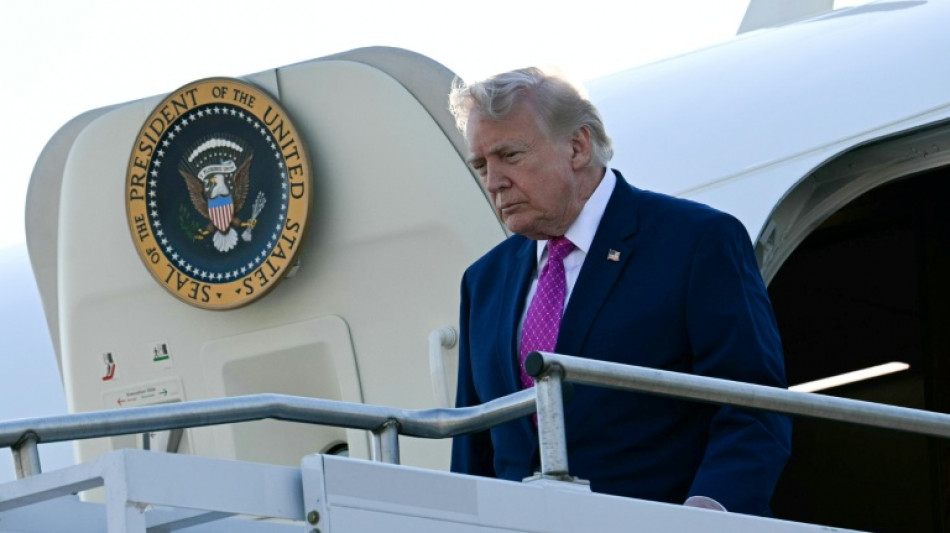
After unsuccessful US-Iran talks, what next for Trump? / Photo: © AFP
The failure of US-Iran peace talks has left President Donald Trump with several unpalatable options, as analysts say his order to blockade the strategic Strait of Hormuz could further complicate his next move.
Any hopes that US Vice President JD Vance would emerge from the marathon day of negotiations with top Iranian officials with a deal to end a war that has rippled across the Middle East were dashed when he left Pakistan emptyhanded.
Protracted talks would undermine Trump's insistence that Iran has "no cards" left to play, while ramping up military action would expose US forces to heightened risk and could alienate voters -- already angry with surging gas prices -- ahead of midterm elections.
And the blockade of the strait through which a fifth of the world's oil moves would do little to ease global economic jitters.
For Brian Katulis, a senior fellow at the Middle East Institute, Trump's propensity to talk off the cuff and make threats -- what he called the president's "carnival barker" style -- leaves his close aides scrambling to chart a path forward.
"He may be simply buying more time to move in more military assets or because he doesn't know what else to do. I wouldn't call it a strategy; it is a military-centric approach without strategy," Katulis told AFP.
Shibley Telhami, a professor of peace and development at the University of Maryland and a fellow at the Brookings Institution think tank, says the threat of a blockade was "bewildering and seems self-defeating."
"Iran already has no trust in Trump," Telhami told AFP. "Hard to understate what this makes of what's left of America's global credibility."
- 'Untrustworthy and duplicitous' -
Iran's powerful Revolutionary Guards on Sunday pledged that Tehran's enemies would be trapped in a "deadly vortex" if they were to make a wrong move in the strait.
Danny Citrinowicz, a fellow at Israel's Institute for National Security Studies, said a naval blockade would indeed expose US forces to increased risk.
"There is little reason to believe that a blockade would force Iranian capitulation. If anything, Iran's demonstrated resilience thus far suggests the opposite," Citrinowicz wrote on X.
"Iran's geographic scale and military capabilities mean that sustaining such an operation would demand substantial and prolonged allocation of American resources."
And such a prolonged military engagement may not sit well with Americans who say they are worried and stressed about the conflict, which began in late February.
A CBS News poll published Sunday revealed that worry, stress and anger far outweigh safety and confidence, when those polled were asked how they feel about the war.
More than 80 percent of respondents said the United States should seek to reopen the strait and improve global access to oil, which would bring gas prices down, and make sure that the Iranian people are "free."
But fewer than 10 percent said they believed those goals had been achieved.
"I don't see how, 40-plus days into this war, that we are safer, that our allies are safer. I'm not even sure Israel is safer," Democratic US Senator Mark Warner said Sunday on CNN's "State of the Union" talk show.
"I don't understand how blockading the strait is going to somehow push the Iranians into opening it. I don't get the connection there."
So if the blockade is not an answer, what about more negotiations?
Democratic Senator Tim Kaine suggested that would not be an easy path, given that Trump removed the US from a 2015 accord reached by Tehran and world powers on restricting its nuclear program in exchange for sanctions relief.
"This is not going to be an easy negotiation because the last negotiation that led to a control of Iran's nuclear program, the US made the decision to tear it up and walk away from the deal," Kaine told CNN.
Katulis echoed that idea.
"Iranian officials are also untrustworthy and duplicitous, but the Trump administration is providing the mirror image of that," he said.
"If I were an Iranian official leaving Islamabad, I would wonder if I am back on the Israeli kill list."
T.F.Russell--TNT