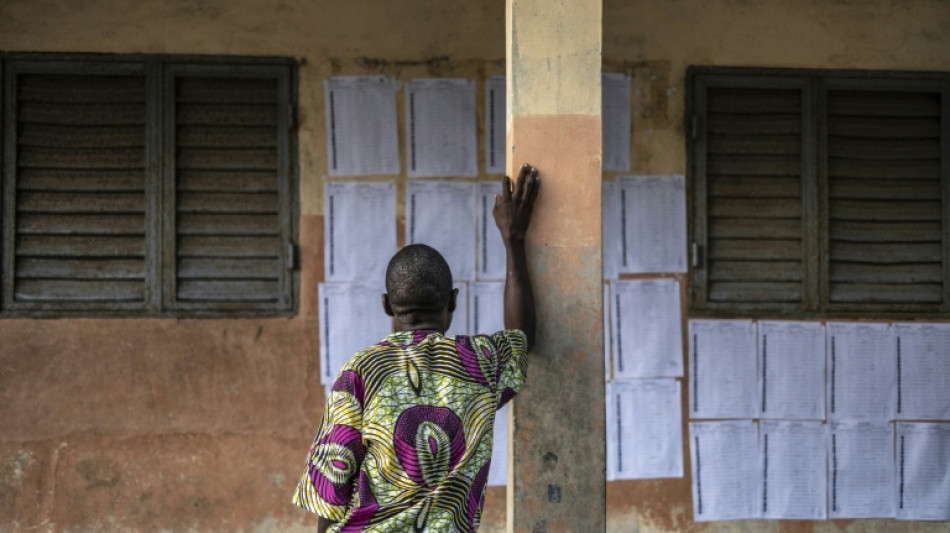
Finance minister favourite as Benin votes for president / Photo: © AFP
Benin was voting for a new president on Sunday, with Finance Minister Romuald Wadagni a shoo-in after overseeing a decade of economic growth in the west African country despite jihadist attacks in the north.
Nearly eight million voters are eligible to cast ballots to choose a successor to Patrice Talon, who is stepping down after two five-year terms and has endorsed Wadagni as his successor.
Turnout will be a crucial factor after a lacklustre campaign hit by voter apathy.
"We must vote to ensure a high turnout," said Yvan Glidja, a man in his 30s who turned up early at a school-turned-polling station in the commercial capital Cotonou to vote for Wadagni.
Backed by the two main ruling parties, Wadagni is being challenged by Paul Hounkpe, an opposition figure whose campaign has been very low-key and who needed help from majority lawmakers to secure the required parliamentary endorsements to get on the ballot.
"There can't be any real enthusiasm; for that, you would need debate and each side would have to believe in its chances," said Rufin Godjo, a political analyst.
The main opposition The Democrats party is not fielding a candidate as its leader, Renaud Agbodjo, failed to secure the required number of parliamentary endorsements needed to contest the vote.
"I won't go and vote, this election is not inclusive. You cannot talk about genuine democratic competition when some key political players are barred," said Arnold Dessouassi, a 39-year-old teacher.
The ruling majority blames The Democrats' exclusion on internal divisions. Several senior figures in the party joined Wadagni's campaign.
"The disgruntled haven't disappeared. Tensions and frustration remain high; their electoral hopes have been slaughtered," said Godjo, speaking of voters.
The European Union, the African Union and the Economic Community of West African States (ECOWAS) have all sent substantial delegations to monitor the vote.
"We hope a maximum of Beninese will come out to make their choice today", Nana Akufo-Addo, a former Ghanaian president heading the ECOWAS delegation, told AFP.
- Golden decade -
Benin's next elections will only take place in 2033, as a constitutional reform passed last year has extended the presidential term from five to seven years and synchronised all elections to take place then.
A key question for many is the next president's approach to civil liberties after the authoritarian turn taken by Talon, whose rule saw many opponents being handed heavy sentences for various crimes.
Hounkpe meanwhile has promised to release "political prisoners".
The country has seen burgeoning growth during the Talon decade: GDP has doubled, growth has surpassed six percent each year, tourism has expanded and numerous infrastructure projects have been completed.
As the architect of this development from his 10 years at the finance ministry, Wadagni embodies continuity.
- Major challenges -
But major challenges remain, including a huge gap between the haves and the have-nots.
"The next phase of the country's development will be the eradication of extreme poverty. That is one of his priorities," said one of Wadagni's close associates.
The poverty rate is estimated at more than 30 percent and many Beninese complain that the benefits of the economic growth over the past decade have not trickled down to them.
Benin's economic growth will also depend on ushering in security and stabilising the country.
Benin's north is plagued by increasingly deadly jihadist violence, carried out mainly by Al-Qaeda's Sahel branch, the Group for the Support of Islam and Muslims (JNIM).
Very active in neighbouring Burkina Faso and Niger, JNIM has recruited and conducted deadly raids against the army in this less-developed part of Benin.
If he is elected on Sunday, Wadagni is expected to be able to count on the loyalty of the army, which played a decisive role in repelling an attempted coup against Talon in December.
F.Harris--TNT