Buffets, baristas, but no briefings: journalists frozen out of Iran talks / Photo: © AFP
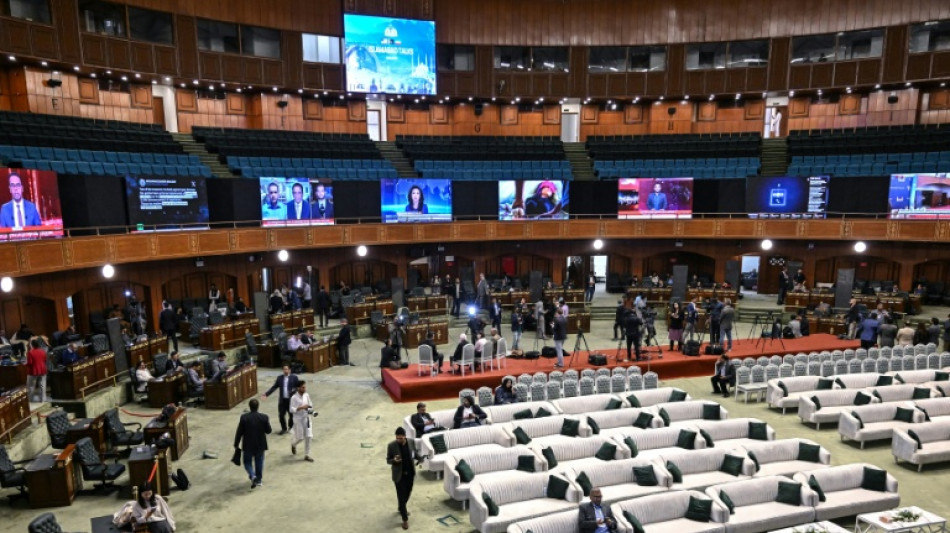
They came from around the world: hundreds of journalists rushed to Islamabad's flagship convention centre -- converted into a media hub by Pakistani authorities for landmark talks between the United States and Iran to end the war in the Middle East.
But as negotiations began behind closed doors half a kilometre away, all the world's media could do was wait -- and sip on an expertly brewed coffee while listening to live eastern folk music.
Even the lattes had a tagline: "Brewed for Peace."
Branding was a big part of the event, with Pakistan dubbing the process the "Islamabad Talks", and plastering a logo combining the Pakistani, US and Iranian flags all over the city.
Early Saturday, an overcast Islamabad felt like a ghost town, with almost no civilian traffic on its wide avenues.
The few vehicles that moved were driven by armed, uniformed personnel who patrolled the city.
Some journalists, accredited by the information ministry, were nonetheless held up for about an hour at a checkpoint outside the venue as a convoy of VIPs swept past.
Inside, they found lavish surroundings, wedding-banquet style spreads of biryani, kebabs and gulab jamun, along with gourmet coffee blended from Brazilian and Ethiopian beans.
"We did the branding ('Brewed for Peace') just for the day," one person manning the stall said.
Outside the hall, musicians played folk songs on a small stage.
"I'm a professional musician, and also teach music," Amir Hussain Khan, a sitar player, told AFP.
- 'Bored out of my mind' -
Staff had reserved seating with a clear view of the massive main stage for US media, directing correspondents from other outlets elsewhere.
Iranian media went to the opposite side of the hall.
"I'm bored out of my mind," one journalist told AFP, declining to be named.
Another offered a similar assessment: "There's not much to do here."
Updates did not begin to arrive until after about 2:00 pm (0900 GMT), hours after US Vice President JD Vance touched down in the capital.
On the large screen dominating the cavernous Jinnah Convention Centre, state television aired footage of his arrival and reception by Pakistani officials, prominently including army chief Field Marshal Asim Munir.
When updates did come, they arrived not from media briefings -- as would be the norm at an event of this scale -- but from press statements released via WhatsApp.
The foreign ministry said a "high-powered" US delegation, led by Vance and including Special Envoy Steve Witkoff and Jared Kushner, had been received by Foreign Minister Ishaq Dar, who commended Washington's "commitment to achieving lasting regional and global peace".
Hours later, Pakistan's government said Prime Minister Shehbaz Sharif had met Vance, expressing hope the talks would serve as "a stepping stone toward durable peace in the region".
Not exactly the kind of gripping, headline-grabbing quotes many of the journalists in the hall had flown thousands of miles for.
The convention centre offered high-speed wireless internet that AFP clocked at more than 150 megabits per second, far above Pakistan's national average of 25 Mbps, according to Speedtest.net figures from February 2026.
The gesture was not lost on reporters.
"They say they have facilitated the media. No doubt they have given 5G internet speeds," said journalist Nadir Guramani. "But media teams deputed inside Jinnah Convention Centre do not know what's happening outside."
Security measures added to the surreal atmosphere. An AFP journalist was told the coffee could not be taken into the main hall. "Foreign media is here, and they are watching," a guard said cryptically.
By sunset, the "Islamabad Talks" had produced press releases, a memorable food spread and impressively fast internet in a country riven with tech challenges.
Whether they produced anything more substantive remained, for those inside the hall, just beyond their reach.
T.Bailey--TNT