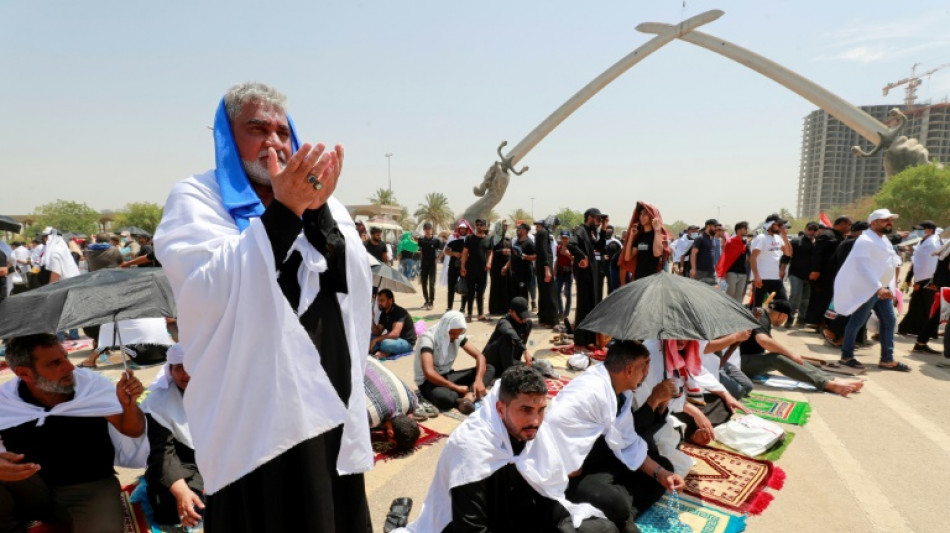
In new power play, Iraq's Sadr mobilises supporters for mass prayer / Photo: © AFP
Tens of thousands converged on Baghdad's Green Zone Friday for mass prayers in a new power play by Iraqi Shiite cleric Moqtada Sadr after his adversaries conditionally backed his call for early elections.
Sadr, a longtime political and religious force in the war-scarred country, has for months been in a political standoff with a rival alliance backed by Iran.
Worshippers converged on a vast square inside the normally secure Green Zone, home to government and diplomatic buildings, including the parliament which his followers have occupied since last Saturday.
Sadr's mass prayer appeal follows his demand for early elections -- a possibility that the rival bloc says it is conditionally open to, despite the last national polls only taking place about 10 months ago.
The country's political factions have not been able to form a government, even as the country grapples with rampant corruption, crumbling infrastructure and unemployment.
Sheikh Ali al-Atabi, 38, joined the throng to support Sadr. Calling people to Friday prayers is "part of his repertoire" when he "wants to use the people for something," Atabi explained.
A similar prayer call and pressure tactic from Sadr in mid-July drew hundreds of thousands of Muslim worshippers to Sadr City, a Baghdad district named after his assassinated father.
Also on his way to the midday prayers, Qassem Abu Mustafa, 40, described the gathering as "a thorn" jabbing "the enemy to demand legislative elections and reforms."
"The prayer will be the prayer of a million men," said the civil servant.
- Devoted following -
The faithful, mostly men but with some women, used umbrellas to protect themselves from Baghdad's 42 degrees Celsius (108 Fahrenheit) heat.
Some waved Iraqi flags and carried portraits of Sadr, calling out: "Yes, yes Sayyed," a reference to his formal title.
"Whatever Mr Sadr's opinion, we are with him," Abu Mustafa said.
Months of post-election negotiations between Sadr's bloc -- the largest in parliament -- and other factions failed to lead to agreement on a new government, prime minister and president.
Sadr's bloc emerged from the October polls as parliament's biggest, but still far short of a majority.
In June, his 73 lawmakers quit in a bid to break the logjam. That led to a rival Shiite bloc, the pro-Iran Coordination Framework, becoming the largest in the legislature.
The Coordination Framework's nomination of former cabinet minister Mohammed Shia al-Sudani as prime minister angered the Sadrists and triggered their occupation of parliament.
With armed groups linked to the various political factions in Iraq, the United Nations has warned about the risk of political tensions escalating.
On Wednesday Sadr called for the dissolution of parliament and new polls. His adversaries in the Coordination Framework on Thursday night said they were conditionally open to that idea, signalling a potential deescalation.
In a brief statement, the Coordination Framework said it "affirms its support to any constitutional way to resolve the political crises and realise the interests of the people, including early elections."
But "a national consensus on the question and providing a safe environment" were prerequisites for such polls, it said.
Above all, the Framework stressed the importance of "not disrupting the functioning" of constitutional institutions -- a clear reference to the occupation of parliament by Sadr's followers.
Parliament can only be dissolved by a majority vote, according to the constitution. Such a vote can take place at the request of a third of lawmakers, or by the prime minister with the president's agreement.
K.M.Thompson--TNT