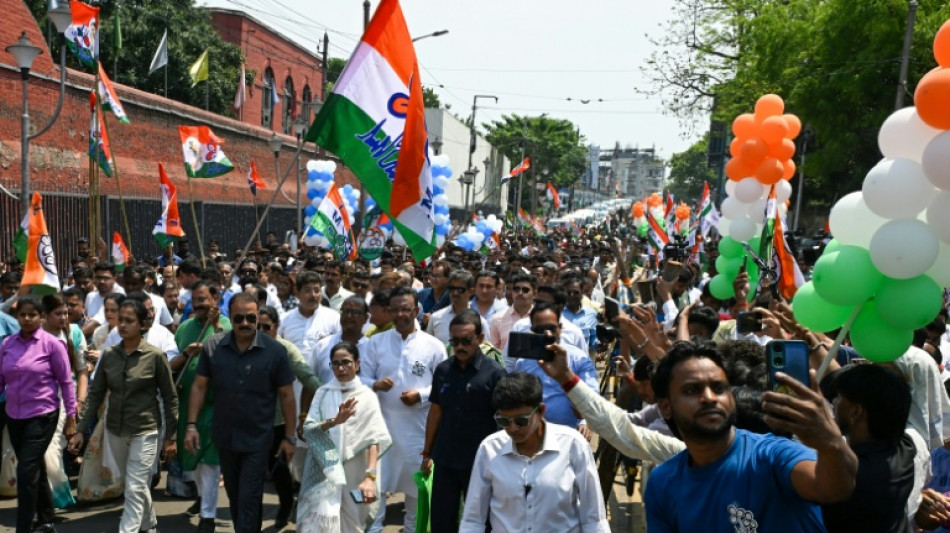
Fish furore fuels fierce election in India's West Bengal / Photo: © AFP/File
In India's West Bengal state, the beloved fish has leapt from the kitchen table to the campaign trail, becoming an unexpected flashpoint in a fiercely contested election.
For Bengalis, fish is not merely food. It is intrinsic to the Bengali identity and pride. Its aroma drifts from roadside fryers, and it is a must at wedding feasts and festival spreads.
Now, as the state of over 100 million people gears up for polls on April 23 and 29, the slippery staple has also become political ammunition.
In tea shops and markets, where mounds of fish glisten on beds of crushed ice, the chatter has centred around whether Prime Minister Narendra Modi's party will ban fish if it takes power.
Modi's Bharatiya Janata Party (BJP) has sometimes promoted vegetarianism as part of its Hindu nationalist agenda, and has imposed limited dietary restrictions in other states.
It is waging an aggressive bid to dislodge West Bengal's chief minister Mamata Banerjee, the firebrand leader of the opposition All India Trinamool Congress (TMC) which has been in power in the state since 2011.
But the fuss over fish has given the state premier an early opening.
At a recent rally, Banerjee warned that the BJP would "ban fish, meat and even eggs" if it came to power in West Bengal.
At another event, she portrayed the BJP as blind to the state's gastronomic soul, saying: "They are not aware of the traditions and culture of West Bengal... It's a party of outsiders."
The BJP has denied it intends to ban fish in the state.
But for many voters, Banerjee's claims have tapped into a deep local sentiment.
- 'Celebrated delicacy' -
"I cannot imagine Bengalis without a preparation of fish during lunch or dinner," said Sumita Dutta, 59, a teacher at a state-run school.
"If any restriction is imposed on the sale of fish, people in the state will revolt."
From the sacred "hilsa" offered during festivities to the carp served at wedding rituals to symbolise fertility and prosperity, fish is woven intricately in Bengali life.
"Fish is important to Bengali culture and cuisine, serving both as a daily staple and a celebrated delicacy," said Sabyasachi Basu Ray Chaudhury, former vice-chancellor of a state-run university.
"Fish and rice make a Bengali," he told AFP.
Hindus are a majority in India and widely eat meat and fish, though some communities follow vegetarian traditions.
Given the sensitivities in West Bengal, the BJP has been striving to show its appetite for the catch of the day.
One video of BJP candidate Sharadwat Mukhopadhyay canvassing with a fish dangling from his hand has gone viral, prompting both amusement and debate on social media.
The aim of the campaign was to "counter the TMC" and "address the debate on food habits", BJP state chief Samik Bhattacharya told AFP.
"Most people in (West) Bengal eat non-vegetarian food, and even BJP leadership consumes non-vegetarian food," he said.
He insisted the party had no intention of imposing dietary restrictions if elected.
- Angling for votes -
The fear of a fish ban has stemmed from some Indian states where BJP and its affiliates have pushed restrictions on meat, especially during Hindu festivals.
In 2024, the BJP government in the northeastern state of Assam announced a complete ban on serving or consuming beef in restaurants, hotels, public functions, and public spaces, expanding earlier local restrictions into a statewide policy.
And in Bihar state, where the BJP is part of a ruling coalition, the sale of fish and meat near schools and religious sites was banned in February, with the deputy chief minister saying it was meant to maintain "social harmony".
The news of the ban quickly travelled across state borders into neighbouring West Bengal's charged political atmosphere, tapping into anxieties around culture and autonomy.
"Emotions and identity are becoming a part of the political campaign," Ray Chaudhury said.
"Food choices are likely to influence voting in this election."
F.Harris--TNT