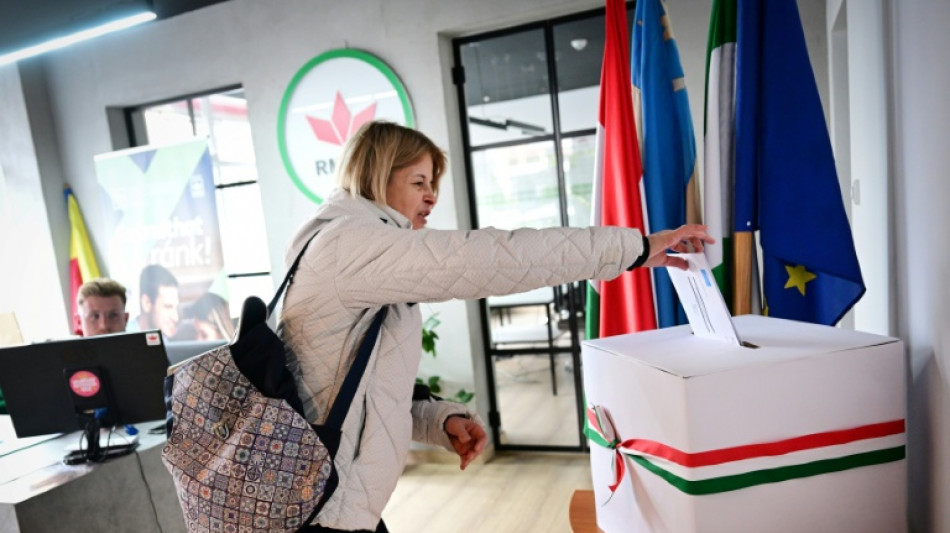
In Romania, many Hungarians root for Orban in vote / Photo: © AFP
In the Romanian town of Odorheiu Secuiesc, where most of the population are ethnic Hungarians, Teresia Hadhazi wants her vote to help nationalist Prime Minister Viktor Orban win again in Sunday's parliamentary election across the border.
"We want Viktor Orban to stay on, because he's exactly the kind of person we need. He has to lead Hungary and lead us as well," the 71-year-old told AFP.
"Our fate depends on this," she said after casting her ballot in the town in central Romania's Transylvanian region ahead of Sunday's main vote.
Orban -- in power since 2010 but facing an unprecedented challenge in this election -- has long courted the vote of ethnic Hungarians across the border.
Besides investing in schools, churches and football academies or stadiums in Transylvania, he has also simplified procedures to obtain Hungarian citizenship, so many local people have dual citizenship.
In February, in a letter sent by mail to potential voters which displayed his photo, Orban urged the diaspora to participate in the vote, mentioning "an alliance" with them which "has yielded renovated schools and churches".
"We receive help" from Hungary, so "it is important" to vote, Erzsebet Simo, 70, said, adding that she roots for Orban's Fidesz party.
Other Fidesz supporters in Romania praised the party for its "patriotism", income tax exemption for mothers or its hard stance on Ukraine. Orban's government opposes military aid for Ukraine and its bid to join the EU.
- Fraud concerns -
The estimated one million ethnic Hungarians in Romania mostly live in the Transylvania region, which became part of Romania after the dissolution of the Austro-Hungarian empire.
In Odorheiu Secuiesc, known as Szekelyudvarhely in Hungarian, 90 percent of the 30,000 inhabitants belong to the Hungarian minority.
Hungarian is the language most likely to be heard in streets and shops in the lively city, which sports well-preserved historical buildings.
Roughly 300,000 Hungarian citizens across Romania are registered to vote. Like in Serbia, Slovakia and Ukraine, they receive envelopes with the ballot to cast it remotely.
In Romania, they can take these to local offices of the Hungarian ethnic party UDMR or NGOs linked to it before April 12.
Romanian NGO Declic criticised the procedure as being "vulnerable to fraud and external interference".
Several UDMR leaders have supported Orban in recent weeks, including party leader Kelemen Hunor, who praised the Hungarian premier's "coherent and responsible national policy" regarding Hungarian minorities living abroad.
He said more than 90 percent of voters in Romania will pick Fidesz, according to surveys.
Though the choice influences only one or two seats in the 199-seat parliament, it is an "emotional" vote for those who do not feel fully respected in Romania, said Farcadi Botond, editor in chief at the local daily newspaper Haromszek, dedicated to the Hungarian community.
Through the simplified procedure to obtain Hungarian citizenship, Orban offered them "a sense of moral satisfaction" and "succeeded in reuniting them with the motherland", Botond added.
Last year, however, Orban angered many when he gave his tacit support to a far-right eurosceptic candidate in Romania's presidential election.
Religious and political leaders saw the candidate, who lost out to a centrist, as a threat to minority rights.
- Vote for 'change' -
Some people told AFP they would not vote for Orban's party, which is battling former-government-insider-turned-opposition-leader Peter Magyar.
"I voted with the intention of helping the opposition in Hungary take power and bring about change in the country," said Sandor Kolumban, 39, the owner of an IT company in Odorheiu Secuiesc.
A Fidesz voter in the past, he complained about the party's moves in recent years in education, forcing people to emigrate and political corruption.
He said many only watch official Hungarian TV channels and do not access independent media with "news that would be uncomfortable for Fidesz".
First time voter Hunor Toth, a 25-year-old journalist, also criticised the Orban government, saying it was "important for a real change to take place, a change in the stagnant leadership".
S.M.Riley--TNT