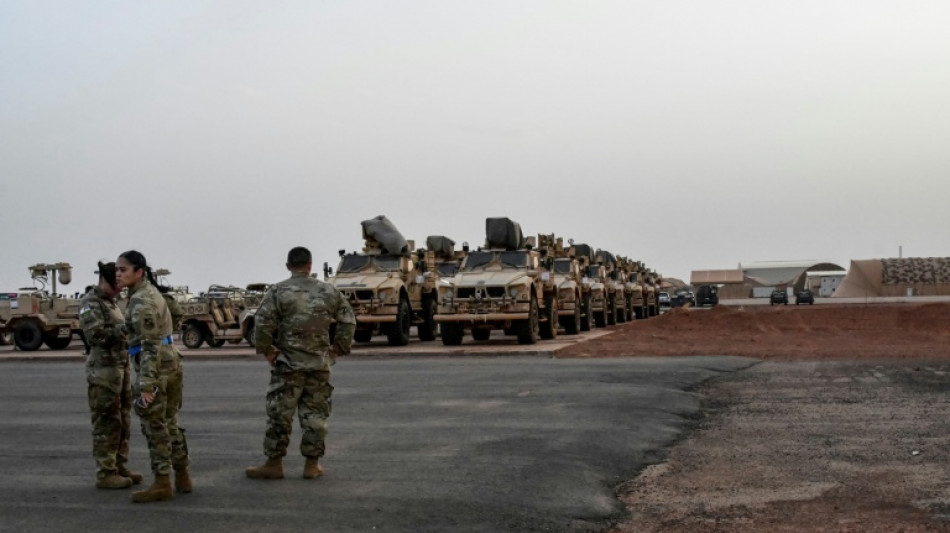
Trump makes up with Sahel juntas, with eye on US interests / Photo: © AFP/File
After years of sidelining the Sahel's military rulers, the United States under President Donald Trump is shifting to engagement and prioritizing the quest for security and minerals over promotion of democracy.
The Trump administration has made little secret that Africa is not its top priority but has watched warily as China and Russia make inroads in countries rich in uranium, gold, lithium and other resources vital in the modern economy.
The United States had suspended the bulk of its security and other assistance to Burkina Faso, Mali and Niger after military takeovers from 2020 to 2023.
Niger booted out some 1,000 US troops, along with forces of former colonial power France, with the United States under former president Joe Biden obliged to shut down a remote base built at a cost of $100 million from which US forces flew drones across the vast, unstable region.
For Nick Checker, the Trump administration's top official in the State Department's Africa bureau, the United States needs to be "dealing with the world as it is" and should have no illusions that it can "impose our will" and create democracies.
"Just by engaging, that itself is a tool; it's not an endorsement of how these governments came to power," Checker told AFP in an interview in his office, a red Trump "Make America Great Again" baseball cap on display behind his desk.
"The alternative is really not purity, but irrelevance," he said.
Checker recently visited Mali, Niger and Burkina Faso, which in recent years have all turned to varying extents to Russia.
"What I've tried to do in meeting with these governments is a sort of a radical correction on this moralizing, lecturing approach of the Biden administration that's created an enormous trust deficit," Checker said.
"It's destroyed our relationships, frankly."
The United States in February removed sanctions on Mali's defense minister, Sadio Camara, that had been in place over allegations of working with the Kremlin-linked paramilitary Wagner Group, which has been accused of abuses.
A UN report accused Mali's army and foreign fighters, suspected to be Wagner mercenaries, of killing at least 500 people during an anti-jihadist operation in 2022 in the town of Moura, a claim denied by the junta.
- 'Severe' trust gap -
Sahel states have been fighting Islamic State and Al-Qaeda extremists for more than a decade with limited success. France led a major offensive known as Operation Barkhane but withdrew its last troops in 2025 as both anti-French sentiment and Russian influence grew.
Checker said that the Sahel states have shown an "openness" to resuming security cooperation with the United States but that it would take time as there was a "severe, understandable trust deficit."
He said that the United States was interested in "burden-shifting" to African states to fight jihadist groups that primarily threaten their own countries, but with an eye on how the threat could evolve to hit the United States.
One key priority is rescuing an American missionary, Kevin Rideout, who was snatched in October in the Nigerien capital Niamey and is believed to be held in Mali by the Islamic State's Sahel branch.
A Malian security source voiced optimism for restoring cooperation but said the United States wanted exclusivity in operating in security areas where Russia and China may be involved.
"American cooperation on intelligence support is almost a done deal," the Malian said on condition of anonymity.
- Openness to US business -
The countries, among the world's poorest, have shown an openness to US investment despite their vows to protect sovereignty.
US company Flagship Gold Corp. signed an agreement with Mali in October to take over a gold mine in Morilla.
Trump has put a high emphasis on securing minerals, a key focus in his conflict diplomacy both in war-torn Ukraine and the Democratic Republic of Congo.
Under Biden, the United States emphasized moving away from a military-led approach seen in the French operation and strongly backed regional bloc ECOWAS in rejecting coups.
Ebenezer Obadare, a senior fellow at the Council on Foreign Relations, said that democracy, including responsiveness to citizens, was in the interest both of Africans and the United States.
"It is never paternalistic to insist that countries treat their citizens well," he said.
"I think there's a lot of short-termism that the United States might regret -- this new emphasis of, we just want to do business with you and we don't want to care about any other thing."
burs-sct/msp
M.Davis--TNT