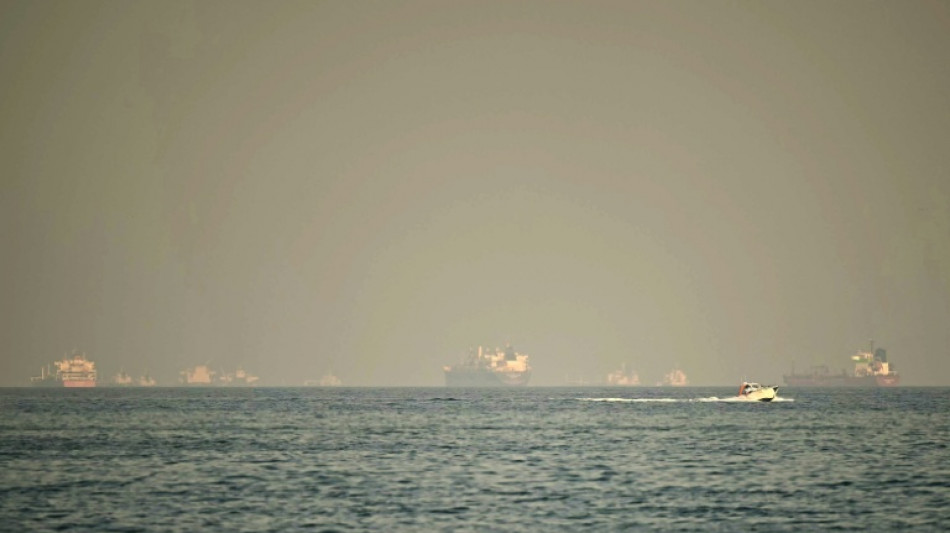
Dilemma over crossings as fate of Hormuz ships remains uncertain / Photo: © AFP/File
Only three ships risked crossing the Strait of Hormuz Wednesday, highlighting the extreme caution about using the key waterway even though both the US and Iran have said the strategic chokepoint would reopen.
- Who is taking the risk? -
Apart from the three ships which transited the strait after a two-week ceasefire in the Middle East war was announced overnight, only a handful of other vessels are on course to do the same, according to ship tracking website MarineTraffic.
That does not imply a major change, with an average of eight commodities carriers transiting the strait daily since March 1, according to maritime data provider Kpler.
More than 800 ships are stuck in the Gulf, according to maritime intelligence company Lloyd's List Intelligence, and traffic in the strait has fallen by around 95 percent.
"Everybody on the shipping side is obviously nervous," Lloyd's List editor-in-chief Richard Meade told AFP.
For crews who have been stuck for weeks aboard ships, the agreement between the US and Iran is the first sign of hope.
"The ceasefire definitely soothes our nerves, hoping it stays this way. The crew is finally taking a breather," an off-duty captain of a ship, whose crew is stranded off Qatar, told AFP.
- Is it safe? -
Leaving the Gulf now "would not be advisable" without coordination with the United States and Iran, Jakob Larsen, chief safety and security officer at shipping association Bimco, told AFP.
He was echoing the advice from other shipping industry voices who say the situation is still too uncertain for any major moves.
"We still don't know if the area has really become safe to pass through," the Japanese Shipowners' Association told AFP on Wednesday.
"There's been a lot of reference to Iran's 10-point plan, that needs to be clarified for shipping to be confident enough to go back through those waters", said John Stawpert, principal director marine at the International Chamber of Shipping (ICS).
He was referring to a proposal presented by Iran as a basis for talks with the US, but which a US official said is not the same set of conditions that were agreed to by the White House.
The UN's maritime body (IMO) said on Wednesday that it was working on a mechanism to guarantee "safe transit".
Aside from the risk of venturing into the strait at a time of high tension, a disorderly departure from the Gulf also risks causing collisions or grounding, Meade said.
- What about Tehran's 'toll booth'? -
It is still unclear whether Iran's recent system to allow some ships to cross the strait -- dubbed the "Tehran Toll Booth" by Lloyd's List because of reports that ships had to pay for permission to pass -- will remain in place.
The Iranian 10-point plan reportedly includes "maintaining Iranian control over the Strait of Hormuz."
US President Donald Trump said in a social media post that Iran has agreed to the "COMPLETE, IMMEDIATE, and SAFE OPENING of the Strait of Hormuz".
An Iranian diplomatic source told journalists a new mechanism had been organised with Oman "under which there has been and will be a right of passage".
On Wednesday, Oman welcomed the ceasefire without commenting on this issue.
Tehran is expected to ask for one dollar per barrel of oil passing through the strait, to be paid in cryptocurrencies, according to the Financial Times.
The idea of a partnership with Oman to operate the Strait of Hormuz is a "not a fantasy", Amir Handjari of the US-based Quincy Institute for Responsible Statecraft argued in an op-ed on Tuesday.
"Oman gets a revenue stream and more strategic relevance. Iran gets legitimacy, cash, and something to show its people it achieved during the war," the blog post said.
- What precedents are there? -
The effective closure of the Strait of Hormuz is unprecedented. It remained open even during the Iran-Iraq war from 1980 to 1988, though there were some tanker attacks that slowed traffic significantly.
More recently in 2024, attacks by pro-Iranian Houthi militias led to a halving of traffic passing through the Suez Canal and the Bab al-Mandeb Strait, the French economy ministry said.
alb-lmc-cl-Dt/ode/jkb/gv
S.Lee--TNT