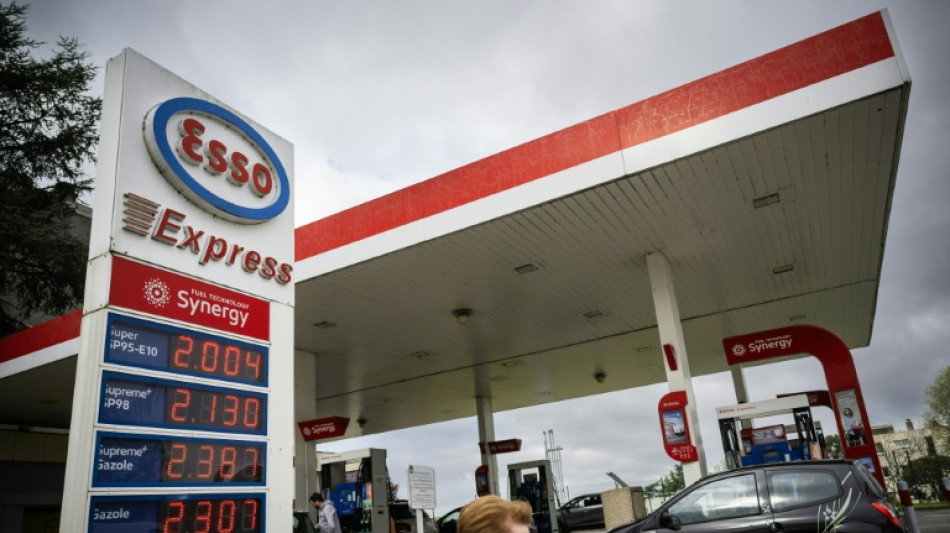
Iran truce spurs hopes for world economy, but recovery will be rocky / Photo: © AFP
The ceasefire agreed between Iran and the United States should bring some relief to a world economy that has been roiled since the start of hostilities on February 28, even if not all sectors will rebound at the same pace.
- Oil prices -
The ceasefire sent oil prices tumbling, with the main international contracts falling below $100 a barrel.
That should bring relief for retail customers at the pump, where surging petrol prices in recent weeks have forced many countries to take measures to reduce consumption and protect the most vulnerable.
In France, fuel prices could fall by "5 to 10 cents" per litre "very quickly," Olivier Gantois, president of the French Union of Petroleum Industries (Ufip), told AFP.
- Opening of Hormuz -
Two ships, one Greek-owned and the other flying the Liberian flag, have already transited the Strait of Hormuz since Iran agreed to reopen the strategic waterway, through which approximately 20 percent of the world's crude oil and liquefied natural gas normally passes.
But the Strait "remains subject to coordination with Iranian armed forces, suggesting continued Iranian control and influence," the risk management group Vanguard said. "As such, conditions are likely to remain controlled and potentially restrictive."
Niels Rasmussen, chief analyst for the shipping association Bimco, said "I doubt there will be a large influx of ships" into the Gulf.
"Many ships have already sailed to other regions and they do not want to risk being trapped after the two-week window closes," he said.
- Skies remain restricted -
For the moment, Iraq is the only country in the region to have announced a complete reopening of its airspace.
The United Arab Emirates and Qatar, whose Dubai, Abu Dhabi and Doha hubs handle large quantities of long-haul flights, have maintained many restrictions.
Furthermore, the return to normal jet fuel supplies for the aviation sector will take "several months given the disruptions to refining capacity", warned IATA, the world's leading airline association.
Therefore, "the most immediate lever" for airlines to preserve their operating margins is to "pass on the increased costs to ticket prices".
- Lasting fuel disruptions -
Even with falling oil prices, there will not soon be more physical supply passing through the Strait of Hormuz, given widespread damage to oil and gas infrastructure throughout the Gulf.
"Restarting oilfields and fixing damaged infrastructure is a gradual process, and producers will be cautious about ramping up output without reliable export routes," said Simone Tagliapietra, a fellow at Europe's Bruegel institute.
"Seventy-five energy plants have been attacked and damaged and more than a third of them are seriously or very seriously affected. Recovery will take a long time," Fatih Birol, executive director of the International Energy Agency (IEA), told French daily Le Figaro in an interview published Tuesday.
- Uncertain economic effects -
Stock markets soared and European government borrowing rates plummeted on news of the ceasefire.
"If we quickly return (to February levels), the macroeconomic impact and the impact on budgets won't be very significant, I'd say almost negligible," Claudia Panseri, chief investment officer at UBS Wealth Management France, told AFP.
"If, however, in two weeks, we find ourselves in a situation where there is no agreement, if the price of oil rises back to $100 a barrel, and if gas remains at high levels," the impact on inflation and growth will be more pronounced, Panseri said.
V.Allen--TNT