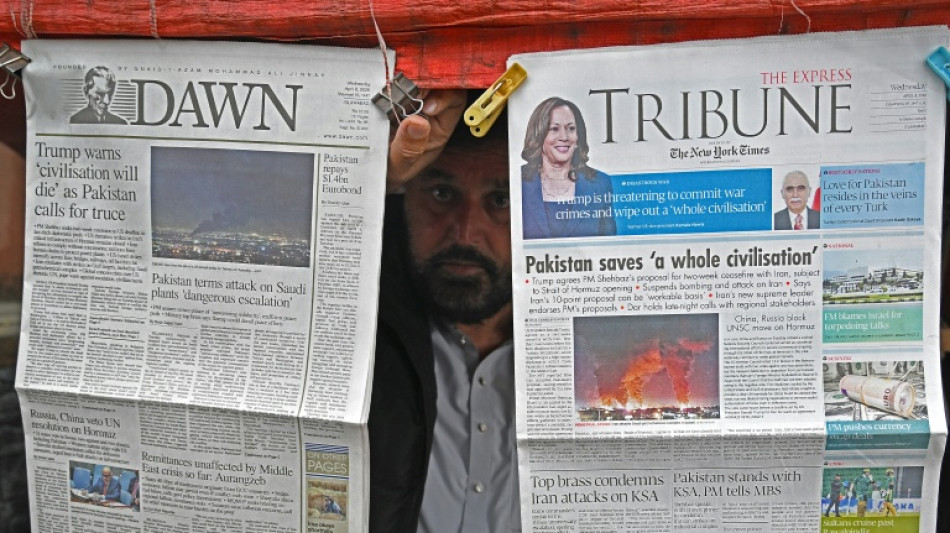
How did Pakistan broker a temporary truce between Iran and the US? / Photo: © AFP
Pakistan has emerged as a key intermediary between Iran and the United States to secure a temporary ceasefire and host negotiations to end the war in the Middle East.
On Wednesday, Prime Minister Shehbaz Sharif said the United States and Iran -- and their allies had -- agreed to a ceasefire "everywhere" following mediation by his government.
Sharif said the two-week truce - which Trump and Tehran had announced earlier - would next lead to talks in the Pakistan capital.
"Pakistan achieved one of its biggest diplomatic wins in years," said South Asia expert Michael Kugelman in an X post.
"It also defied many skeptics and naysayers that didn’t think it had the capacity to pull off such a complex, high stakes feat."
- What are Pakistan's ties to Iran? -
"Pakistan has strong credentials as the only country in the region enjoying good relations with the US and Iran," said the country's former ambassador to Tehran, Asif Durrani.
Pakistan shares a 900-kilometre (560-mile) border in its southwest with Iran, and also deep historical, cultural and religious links.
Pakistan is home to the world's second-biggest Shia Muslim population after Iran.
Iran was the first country to recognise Pakistan after independence in 1947. Pakistan returned the favour for the Islamic republic after the 1979 revolution.
Pakistan also represents some Iranian diplomatic interests in Washington, where Tehran has no embassy.
- How about the US? -
Pakistan's powerful army chief, Field Marshal Asim Munir, has built up a personal rapport with US President Donald Trump.
Munir -- in a Western business suit rather than army fatigues -- visited Washington with Sharif last year after a flare-up in hostilities between Pakistan and India in divided Kashmir.
Sharif praised Trump's "bold and visionary" intervention, while Munir said the US leader deserved the Nobel Peace Prize for stopping an escalation between the nuclear-armed neighbours.
On Iran, Trump said Pakistan knows the country "better than most".
Personal relations have long helped boost bilateral ties shaped by shifting strategic interests that have at times been strained.
Even as a non-NATO ally in the post-9/11 "war on terror", Pakistan faced US claims that it was harbouring militants who were responsible for attacking coalition troops across the border in Afghanistan.
Relations strained further when US troops killed al-Qaeda chief Osama bin Laden on Pakistani soil in 2011 without telling Islamabad, and Pakistan faced accusations of complicity in harbouring the fugitive.
- How about other regional players? -
Pakistan and Saudi Arabia signed a strategic mutual defence agreement in 2025, cementing longstanding ties but also restricting how far Islamabad could go in supporting Tehran.
Sharif and his government have been quick to keep Riyadh on side, and the prime minister recently visited for talks with Crown Prince Mohammed bin Salman.
Pakistan also shares close ties with Beijing, which, Trump told AFP, helped get Iran across the line to the negotiating table.
Pakistan's Foreign Minister Ishaq Dar hosted a meeting with counterparts from Saudi Arabia, Turkey and Egypt last month for discussions on de-escalating the conflict and then flew to Beijing for further talks.
China, which is Iran's largest trading partner, then joined its longstanding South Asian ally in calling for a plan to end the fighting engulfing the Middle East, saying it supported "Pakistan playing a unique and important role in easing the situation".
- What's in it for Pakistan? -
Neutrality makes economic sense for Pakistan, which relies on oil and gas imports through the Strait of Hormuz and wants to avoid getting dragged into further conflict on its doorstep.
Continued disruption would have worsened fuel supplies, driven up prices and forced further austerity measures for the cash-strapped government.
A permanent end to the war would not only boost regional stability but also Pakistan's international standing at a time when it is locked in armed conflict with neigbouring Afghanistan and less than a year after it traded strikes with arch-rival India.
- What role will Pakistan play next? -
The Pakistani premier said he would welcome US and Iranian delegations to the capital from April 10.
"Iran will feel more comfortable in Islamabad which is why it accepted Pakistan's mediation," said Durrani, the former ambassador, adding Pakistan could help the two sides resolve outstanding differences.
If talks were direct, "then Pakistan may help the parties to fine-tune the language if there is a stalemate", he said, adding that Pakistan officials could also act as the go-between if the two sides would not meet face-to-face.
Pakistan does not formally recognise Israel, which said on Wednesday it supported Trump's decision to suspend bombing, but that the two-week ceasefire did not include Lebanon where it has carried out ground and aerial operations against Iran-backed Hezbollah.
That contradicted Sharif's earlier statement that the ceasefire covered "everywhere including Lebanon".
K.M.Thompson--TNT