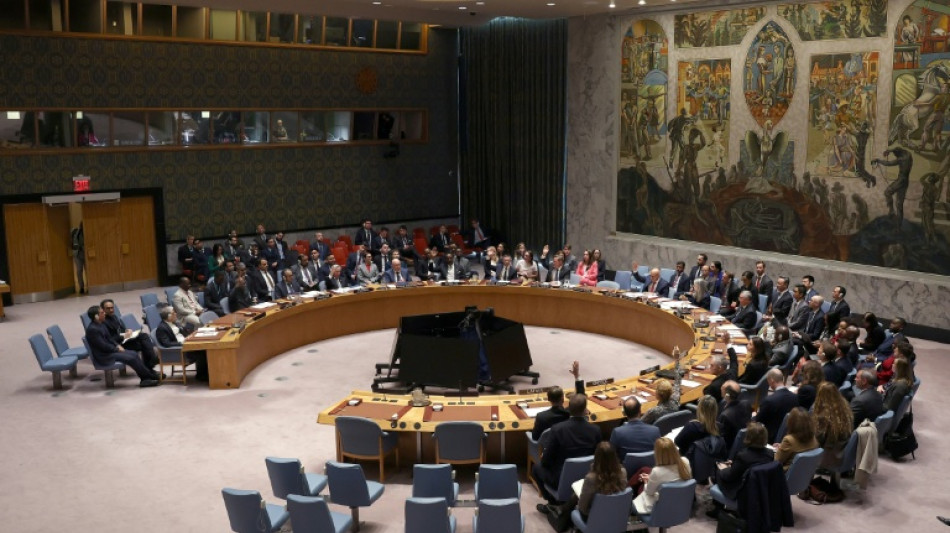
Russia, China veto UN resolution on reopening Strait of Hormuz / Photo: © AFP
Russia and China vetoed a UN Security Council resolution Tuesday on reopening the Strait of Hormuz, a text already diluted to remove Gulf states' desired green light to use force to protect the key shipping lane.
The draft resolution prepared by Bahrain and supported by the United States received 11 votes in favor, two against and two abstentions. Bahrain's Foreign Minister Abdullatif bin Rashid Al Zayani said Gulf states "regret" the outcome.
Iran has imposed an effective blockade on the critical waterway since the United States and Israel launched the war on February 28, sending ripple effects throughout the global economy.
The vote came hours before US President Donald Trump's dire ultimatum expires for Tehran to open the strait, which normally carries a fifth of the world's oil, or "a whole civilization will die" in Iran.
"Today's result does not restrict the United States to continue to act in its own self defense and in the collective defense of our allies and partners," US ambassador Mike Waltz said after the Security Council vote.
Al Zayani, speaking on behalf of the oil-exporting Gulf countries, said the failure to pass the resolution "sends the wrong signal to the world."
"This signal that the threat to international waterways can pass without any decisive action by the international organization responsible for the maintenance of international peace and security," he said.
Iran's UN ambassador said the text was designed "to punish the victim for defending its sovereignty and vital national interest in the Persian Gulf and the Strait of Hormuz."
"Had this draft been adopted, it could have opened the door to dangerously broad and abusive interpretation that could be used to justify further use of force and unlawful actions in clear violation of the UN Charter," said Amir Saeid Iravani.
- 'Cease all attacks' -
Bahrain launched negotiations two weeks ago on a draft that would have given a clear UN mandate to any state wishing to use force to unblock the strait.
But objections from several veto-holding permanent members -- including France, Russia and China -- forced the text to be watered down and the vote delayed multiple times.
French opposition appeared to be lifted by the addition of wording that meant any action would need to be "defensive."
After further amendments, the latest version of the text seen by AFP no longer mentioned authorization to use force, even defensively.
The latest draft "strongly encourages states...to coordinate efforts, defensive in nature, commensurate to the circumstances, to contribute to ensuring the safety and security of navigation, including through the escort of merchant and commercial vessels," rather than explicitly authorizing force.
It also "demands" Iran "immediately cease all attacks against merchant and commercial vessels and any attempt to impede transit passage or freedom of navigation in the Strait of Hormuz."
Additionally, it calls for the end to attacks on civilian water, oil, and gas infrastructure.
Justifying his veto, Russian ambassador Vassili Nebenzia said "nearly each paragraph of the draft that they proposed abounded with unbalanced, inaccurate and confrontational elements."
He said he understood concerns about transit in the Strait of Hormuz, and that Russia and China would propose an alternative draft resolution, without giving a date.
UN Security Council mandates authorizing member states to use force are rare.
During the 1990 Gulf War, a vote allowed a US-led coalition to intervene in Iraq after it invaded Kuwait.
In 2011, NATO obtained the green light to intervene in Libya when Russia abstained from a vote. Moscow later fumed that this had led to the fall of Libyan leader Colonel Muammar Gaddafi.
S.Clarke--TNT