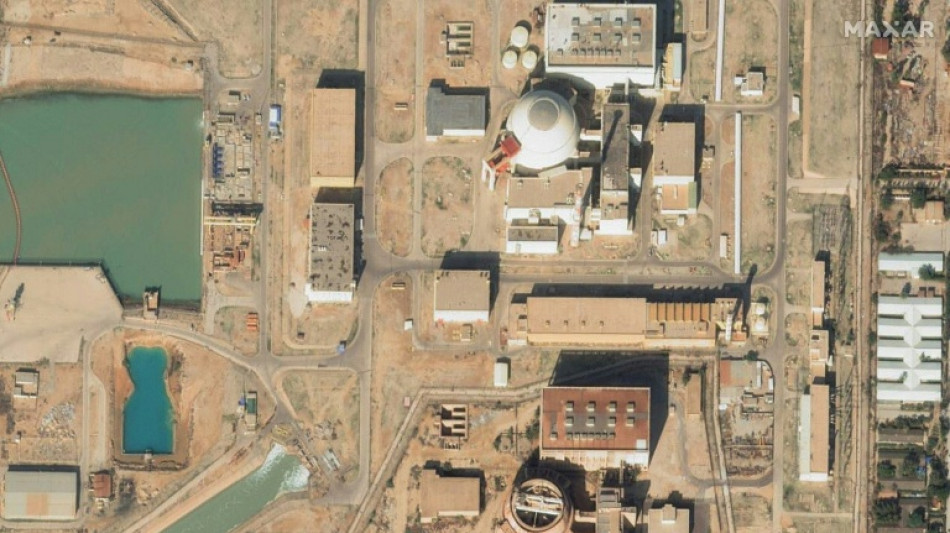
Bushehr: Iran's only nuclear power plant / Photo: © Satellite image ©2021 Maxar Technologies/AFP
Bushehr nuclear power plant, Iran's only operational civilian nuclear facility, was built by Russia and officially handed over in September 2013, after decades of twists, turns and delays linked to Iran's turbulent history.
The facility, located in the south of the country and equipped with a 1,000-megawatt reactor, was hit Saturday by a US-Israeli airstrike, killing a security guard, Iranian state media reported.
It had already been targeted four times since the start of the war on February 28. On Saturday Russia, which sends technicians to help operate it, began evacuating its 198 Rosatom employees.
Saturday's strike was just the latest episode in the plant's turbulent history.
- Begun under the Shah -
The project began in 1975 during the Shah's reign, and was initially awarded to Germany's Siemens.
But work on it was interrupted by the 1979 Islamic Revolution and the Iran-Iraq War (1980-1988).
Although a major oil and gas producer, Iran sought to revive the project in the late 1980s to diversify its energy resources and reduce its dependence on fossil fuels for domestic consumption.
But Germany's government persuaded Siemens to withdraw over concerns about nuclear proliferation.
Tehran then turned to Russia, which took over the contract in January 1995, aiming to commission the 1,000-megawatt pressurized water reactor in 1999. But a series of problems led to an 11-year delay.
Russians and Iranians also had several financial disputes over the cost, estimated at over one billion dollars.
- US pressure -
Washington exerted pressure on Moscow not to complete the plant, which the United States feared would facilitate Iran's potential acquisition of nuclear weapons.
Moscow obtained a waiver to complete Bushehr by concluding an agreement with Tehran that included supplying Iran with the fuel used by the plant -- then repatriating it back to Russia to reduce the risk of proliferation.
Many analysts and diplomats believe Russia delayed the plant's completion to maintain leverage over Iran, particularly to compel it to cooperate with the International Atomic Energy Agency (IAEA).
- Civilian use -
Unlike Iran's Natanz uranium enrichment facility or the future Arak heavy water nuclear power plant, the Bushehr facility is not considered a proliferation risk.
For years, Western nations have accused Iran of seeking to develop nuclear weapons, an accusation Tehran denies.
Iran has repeatedly accused or suspected Israel -- the country considered the only military nuclear power in the region -- of sabotaging some of its uranium enrichment facilities.
While the United States has insisted on a total ban on Iranian uranium enrichment, Iran defends its right to civilian nuclear programmes, even though it has reached a 60-percent enrichment level -- far beyond what is required for civilian use.
- Gulf neighbours -
Located on the Gulf coast, the Bushehr nuclear power plant is closer to Arab capitals such as Kuwait City and Doha than to Tehran, which lies more than 750 kilometres (470 miles) away.
Neighbouring Arab Gulf states have frequently expressed concerns about the plant's reliability and raised the risk of radioactive leaks in the event of a major earthquake.
In April 2021, the Bushehr region was shaken by a magnitude 5.8 earthquake, but Iran's authorities said there was no damage to the facility.
G.Morris--TNT