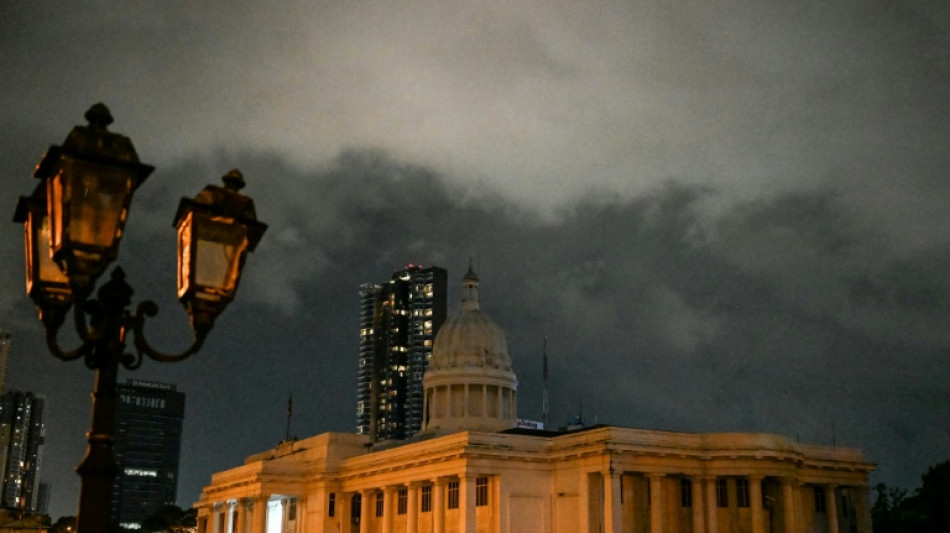
Sri Lanka struggles to avert economic collapse over Mideast war / Photo: © AFP
Sri Lanka is struggling to prevent a repeat of its spectacular economic collapse four years ago, as the prolonged Middle East war compounds the fallout from a deadly in November.
President Anura Kumara Dissanayake has rationed fuel, raised price by a third and increased electricity costs by up to 40 percent since the war began disrupting global energy supplies.
Panic buying fuel in Sri Lanka has brought back memories of 2022, when the economy tanked, with inflation hitting 70 percent after Colombo defaulted on its $46 billion external debt.
The accompanying protests toppled the once-powerful president, Gotabaya Rajapaksa, who was accused of mismanagement and corruption.
But the Frontline Socialist Party (FSP) that led the "Aragalaya", or struggle, that ousted Rajapaksa has warned that Dissanayake's administration may be facing an implosion.
"We believe that a response to this economic crisis will come politically," FSP politburo member Duminda Nagamuwa told AFP.
"Because of the strength of the (government's) mandate, this economic shock is still being absorbed by the people without exploding politically," he said.
Dissanayake's leftist JVP, or the People's Liberation Front, won a two-thirds majority at the November 2024 parliamentary elections after his own victory two months earlier in the presidential poll.
-- 'Into an abyss' --
A vendor at Colombo's Pettah night market, Wasantha Jayalath, 55, said he voted for Dissanayake in 2024 hoping for better times, but felt the situation was getting worse.
"We voted... thinking that a good, self-sufficient era would dawn for our country," Jayalath told AFP. "There is no such situation; instead, what we realise is that the country is going further into an abyss."
A trader at the capital's main wholesale market, Priyantha Sudharshana Silva, 53, is not blaming the administration for the crisis.
"Protesting won't help because the country is already in a difficult position," Silva told AFP. "We believe that moving forward, even with these difficulties, is a significant achievement."
-- State of emergency --
Human rights lawyer Bhavani Fonseka said protests have been subdued because people are preoccupied with the day-to-day challenge of securing supplies.
Fuel rationing has shortened queues, but on Thursday, the government began limiting water supply hours to conserve reserves and save pumping costs.
"Compared to what we had in 2022... you're not seeing that level of protest," Fonseka told AFP. "Sri Lanka was just coming out of another disaster -- Cyclone Ditwah -- and the government imposed a state of emergency to deal with that."
Fonseka said the wide powers that emergency laws give the authorities to arrest and detain suspects could be used to stifle any popular protests, serious concerns for rights activists.
"We are in a situation where... laws that are in place, and the way they are being used, raise the question of whether rights could be further eroded in the coming weeks and months," she said.
-- Deadly cyclone --
Cyclone Ditwah, the worst disaster since the 2004 Asian tsunami, killed 641 people and affected almost the entire country late last year.
The cyclone, which triggered floods and mudslides, caused an estimated $4.1 billion in damage, according to the World Bank.
Colombo also secured $206 million in emergency financing from the International Monetary Fund (IMF) in December to deal with the aftermath of the disaster.
An IMF delegation is currently in Sri Lanka to review its four-year $2.9 billion bailout loan before releasing a $700 million instalment.
Sri Lankan authorities have said they may ask the IMF to modify the austerity conditions, given the country's worsening economic circumstances due to external factors.
L.Graham--TNT