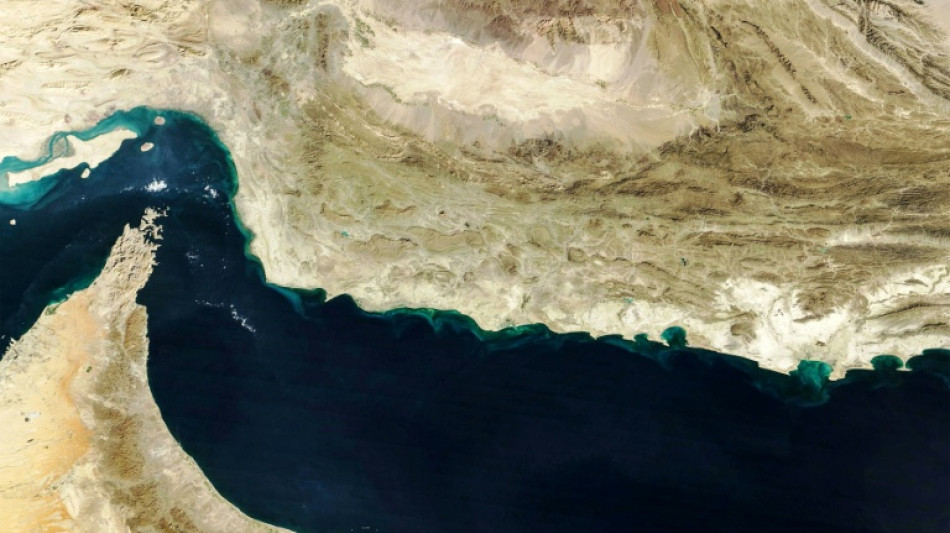
French, Japanese ships cross Strait of Hormuz in first since war / Photo: © NASA Earth Observatory/AFP/File
One French- and another Japanese-owned vessel are among a handful of vessels to have crossed the war-torn Strait of Hormuz, maritime tracking data showed Friday.
The passage, a vital maritime route for oil and liquified natural gas, has been virtually blocked by Iran since the start of the war.
But both ships made the crossing on Thursday, according to ship tracking company Marine Traffic's website.
The Maltese-flagged Kribi belonging to the French maritime transport group CMA CGM crossed the waterway to leave the Gulf on Thursday afternoon, Marine Traffic's data showed.
By early Friday, it was off Muscat, Oman, still broadcasting the message "owner France" on its transponder system in the field usually used to give the destination.
The vessel's navigation data showed it had crossed via an Iranian-approved route through its waters, dubbed the "Tehran Toll Booth" by leading shipping journal Lloyd's List.
- Southern route -
In addition, three tankers -- including one co-owned by a Japanese company -- crossed the Strait of Hormuz on Thursday by taking an alternative, southern route.
They hugged close to the shore of Oman's Musandam Peninsula -- a first in nearly three weeks according to Lloyd's List.
Before the war, which started more than a month ago, about a fifth of global oil and liquefied natural gas (LNG) passed through the Strait.
All three ships signalled they were an "OMANI SHIP" in the message broadcast by their transponder as they crossed the strait.
The Sohar LNG, which was empty when crossing, is co-owned by Japanese shipping company Mitsui O.S.K.
That makes it the first Japanese vessel to exit the Gulf since the start of the war, according to a company statement quoted by Japanese media.
The Hong-Kong flagged New Vision, which crossed the strait on March 1 right after the war started, is expected in the French port of Le Havre on Saturday evening.
Since the conflict started however, that has dwindled to a trickle as Iran selectively attacks ships and energy facilities throughout the Gulf in retaliation for US and Israeli attacks.
A few commercial ships crossing the Strait of Hormuz recently have passed through the Iranian-approved route in the north of the waterway.
- Down to a trickle -
Just 221 commodities vessels have crossed the Strait of Hormuz since March 1, some more than once, according to Kpler data up to Friday morning.
In peacetime, the same waterway handles around 120 daily transits, according to Lloyd's List.
Of the vessels that made the crossing, 60 percent either came from Iran or were heading there.
The other countries whose vessels -- of origin or destination -- made the crossing, were in decreasing order: the United Arab Emirates, China, India, Saudi Arabia, Oman, Brazil, and Iraq.
It was not clear from the data how many had been cleared to make the crossing by Tehran.
But it did show that, among the 118 crossings by ships carrying cargo, 37 had left the Gulf carrying crude oil.
Most of those oil tankers -- 30 of them -- came from Iran or sailed under the Iranian flag. And most ships carrying Iranian oil did not specify their destination on their transponder.
Of those who did, all but one reported they were heading to China.
In the early days of the war, transponder data showed dozens of ships broadcasting messages such as "Chinese crew" or "Chinese owner" in the field usually used for their destination.
This appeared to be an attempt by the ships to avoid being targeted by Iran.
dvz-jah-ys-lmc-lcr/jj
C.Blake--TNT