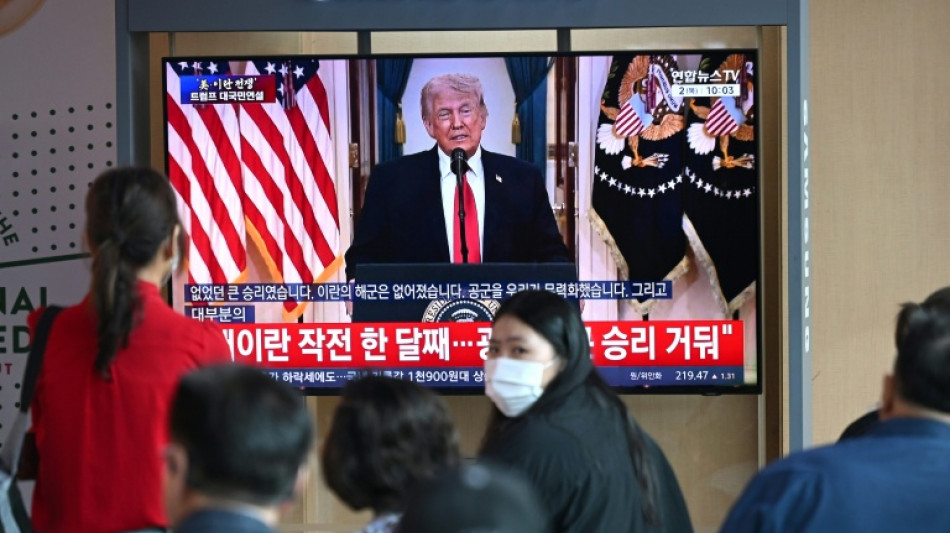
Trump gloats on possible war crimes in Iran, but punishment distant / Photo: © AFP
Threatening to destroy Iran's electricity grid and to reduce the country of 90 million to destitution, US President Donald Trump is shattering precedent by not just accepting but gloating about acts seen as potential war crimes.
The consequences for Trump, at least in the near term, are probably none, experts say, as his administration works hard to undermine international institutions tasked with keeping norms.
The Geneva Conventions governing the laws of war, agreed following World War II, prohibit destruction of "objects indispensable to the survival of the civilian population."
In 2024, the International Criminal Court indicted four Russian military officials over systematic strikes on Ukraine's power grid.
Nonetheless, Trump said in a Wednesday address that if Iran does not reach an unspecified deal with him, US forces will "hit each and every one of their electric-generating plants."
"Over the next two to three weeks, we are going to bring them back to the Stone Ages, where they belong," Trump said, a shift in tone after briefly suggesting, when joining Israel in launching the war on February 28, that a goal was to help Iranians overthrow their unpopular religious-led government.
On Thursday, Trump posted footage of the destruction of a major bridge, promising "Much more to follow!" And Iran reported major damage to a century-old medical research center, the Pasteur Institute.
Trump has also threatened to attack oil wells, despite international condemnation of Iraqi forces who set ablaze oil installations when withdrawing from Kuwait in 1991 in the first Gulf War.
Defense Secretary Pete Hegseth has boasted of "death and destruction from the sky all day long" on Iran and promised to reject "stupid rules of engagement."
- Impact on civilians -
The crippling of Iran's power plants would be "devastating to the Iranian people" by cutting off electricity to hospitals, water supply and other vital civilian needs, said Sarah Yager, the Washington director of Human Rights Watch.
"The US military has protocols designed to constrain that kind of harm to the civilian population, but when the president speaks this way, it risks signaling that those constraints are optional, and that is what makes this moment so dangerous," she said.
International law permits attacks on energy plants and other ostensibly civilian targets only if determined that they primarily support military activity.
Trump's own statements indicate otherwise, said Tom Dannenbaum, a professor at Stanford Law School.
"The reference to the Stone Age indicates that objects would be targeted seemingly because they contribute to the viability of a modern society in Iran, which is completely unrelated to the question of contribution to military action -- the necessary condition for targeting in war," he said.
Robert Goldman, a war crimes expert at the American University Washington College of Law, said that on energy sites, Trump "can't have it both ways."
"Trump repeated again that the United States has complete control of the skies and we can hit anything," regardless of power supply, he said.
"Now to attack a power plant would be, in my view, utterly disproportionate because it has very foreseeable consequences for the civilian population."
He said retaliation threatened by Iran could also constitute war crimes, such as targeting desalination plants in US-allied Arab countries with severe water limitations.
- Prosecution unlikely, but long-term risk -
Even if the United States commits war crimes, the immediate risks for Trump, Hegseth and other officials appear limited.
The Trump administration has aggressively sought to neuter the International Criminal Court out of opposition to its arrest warrant against Israeli Prime Minister Benjamin Netanyahu over Gaza.
Few expect the Hague-based court to target Americans and none of the countries involved -- the United States, Israel or Iran -- are parties to it.
But Dannenbaum said war crimes had universal jurisdiction with no statute of limitations, meaning any country eventually could prosecute.
"Even when the political conditions are such that it's unlikely that a war crimes case would be prosecuted successfully in the moment," he said, "that doesn't mean that accountability won't occur at a later date."
Goldman said the risk to the United States was primarily one of reputation -- and that undercutting the Geneva Conventions could have dangerous impacts for a country frequently at war.
"If we set aside the rules when we deem expedient, why can't our adversaries?" Goldman said.
"It could come back to bite us down the road."
M.A.Walters--TNT