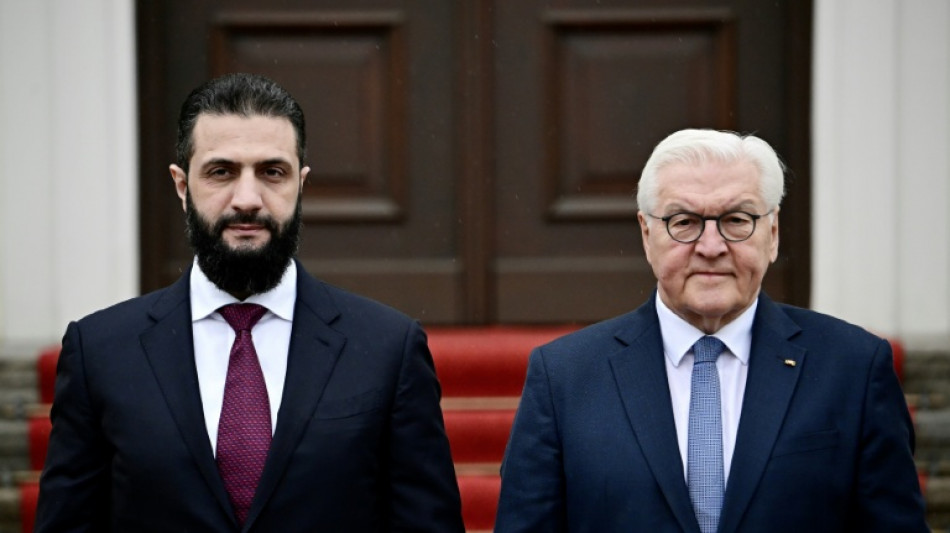
Syrian leader visits Germany to talk war, recovery, refugees / Photo: © AFP
Syrian leader Ahmed al-Sharaa started a visit to Berlin on Monday for talks on the Middle East war, rebuilding his country and the return of refugees, with critics saying his record on human rights is being ignored.
On his first trip to Germany since ousting his country's longtime strongman Bashar al-Assad in late 2024, Sharaa met his German counterpart Frank-Walter Steinmeier on Monday morning before talks with Chancellor Friedrich Merz and Interior Minister Alexander Dobrindt.
Europe's top economy is home to the largest Syrian diaspora in the European Union at more than a million, many of whom arrived during the peak of the migrant influx in 2015-2016.
Sharaa, 43, a former Islamist rebel leader, has managed to build relations with Western governments and made several overseas trips, including to the United States, France and Russia.
As a result, many international sanctions on Syria have been lifted to help the country rebuild after a bloody 14-year civil war.
Sharaa told a foreign ministry forum in Berlin that the country had experienced a "huge amount of destruction" during its long conflict, saying that Syrians "want to catch up with the rest of the world" as Germany did after World War II.
He pointed to investment opportunities in Syria's energy, transport and tourism sectors, describing his homeland as very diverse and with "a great wealth of human resources".
"We stand with Syria," German Foreign Minister Johann Wadephul said, pledging to support reconstruction efforts. "The Syrians deserve a chance, and we want to help ensure that this opportunity is well utilised."
Sharaa also suggested that he would like to see some of the Syrians who fled to Germany return to help with reconstruction.
"They have studied at German universities, acquired modern expertise that German companies have," he said.
- 'No grounds for asylum' -
Rights campaigners have criticised the visit, pointing to Sharaa's Islamist past and Syria's ongoing violence and instability.
Protesters gathered in front of the foreign ministry on Monday waving Kurdish flags and placards criticising the rapprochement between Merz and Sharaa, highlighting the latter's time as an Islamist militant.
Near the chancellery dozens of Syrians also turned out to welcome Sharaa, waving Syria's new revolutionary flag and a banner showing the president surrounded by hearts.
Merz, a conservative who took power last May, has stepped up a drive to limit irregular immigration as he seeks to counter the rise of the far-right Alternative for Germany (AfD) party.
Merz said last year that, with Syria's civil war over, people from the country now have "no grounds for asylum in Germany".
The government in December resumed deporting convicted criminals to Syria, though only a handful of cases have gone ahead so far.
Merz also said he assumed many Syrians would return home voluntarily, drawing criticism from campaign groups that cite continued instability and rights abuses in Syria.
The Green party's foreign affairs spokeswoman Luise Amtsberg told AFP that Germany should not engage in a "premature normalisation" with Sharaa's government.
Merz had reduced Syria policy "to the question of deportations and is ignoring the situation on the ground", she said.
- 'Authoritarian tendencies' -
Since Sharaa has been in power, sectarian tensions have continued to cause repeated bloodshed, while the Islamic State group remains at large.
After Assad's overthrow, Israel moved its forces into the UN-patrolled demilitarised zone on the Israeli-annexed Golan Heights, and has carried out hundreds of strikes in Syria as well as regular incursions.
Sharaa was initially planning to visit Germany in January, but the trip was postponed as he sought to end fighting between government troops and the Kurdish-led Syrian Democratic Forces in his country's north.
Sophie Bischoff, president of the German-Syrian NGO Adopt A Revolution, told reporters at an event on Monday that any support from the German government "must be linked to clear conditions" and warned that "authoritarian tendencies are on the rise again in Syria".
L.Graham--TNT