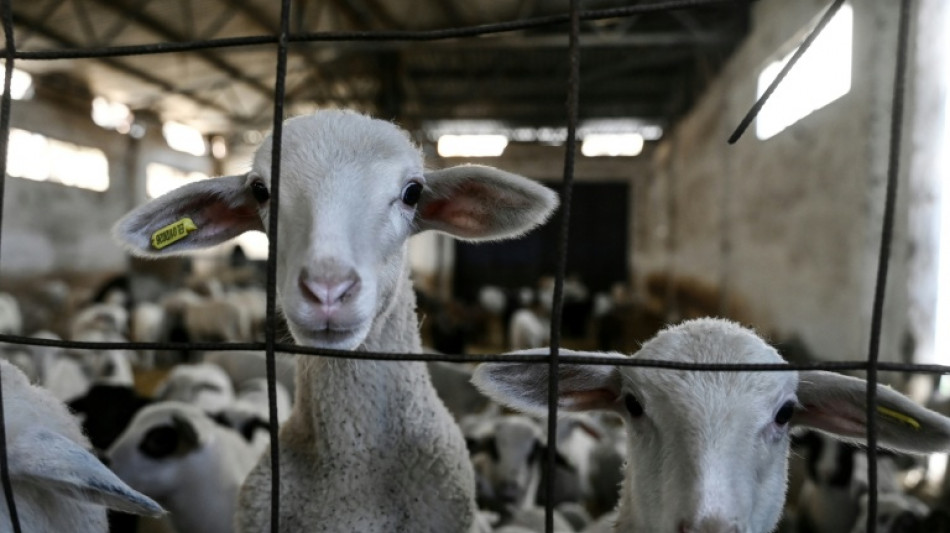
Sheep culls put pressure on Greek feta cheese production / Photo: © AFP
Three months after state vets seized and killed hundreds of his sheep to stamp out an ongoing pox pandemic, Kostas Theofilou fights back tears as he gazes at his empty stable.
"Three families lived off this place. Look what they’ve done to me. I'm 55 years old. What job can I do now?" the livestock farmer sobbed.
From August 2024 to early March, more than 480,000 sheep and goats have been slaughtered because of the pandemic, mainly in central and northern Greece.
Producers say the resulting fall in the livestock population and milk production is threatening feta, one of Greece's premier exports.
A heavy quiet hangs over Theofilou's farm in the absence of the bleats from the sheep and the tinkle of their bells.
The sheepdogs wander about.
"I only know how to be a shepherd. I have no other memory from my life. Only the sheep," he told AFP.
In Thessaly, where around 45 percent of the briny white cheese is made from sheep and goat's milk, the impact of the disease is already significant.
The central region, one of the country's key centres of agricultural production, has already sustained major livestock losses over the past three years owing to floods and sheep plague.
According to cheesemakers in the area, milk production this year is down by around 40 percent.
Thessaly is the leading region for feta exports, accounting for over 50 percent of Greece's total exports.
Christina Onasoglou is a food technologist specialising in dairy products who runs with her husband a medium-sized dairy that exports 98 percent of the feta it produces.
She told AFP that because of the animal culls, her milk deliveries have fallen by up to 50 percent, resulting in a corresponding reduction in feta production.
- Exports in jeopardy -
Sheep milk prices have also increased by up to 12 percent, she noted, further jeopardising exports.
According to estimates by the organisation representing feta producers, the National Interprofessional Organisation for Feta Cheese (EDOF), the drop in feta production due to the lack of milk is expected to reach 20,000 tonnes in 2026.
It is estimated that in 2025 feta production reached 140,000 tonnes.
To limit the spread of the disease, the authorities have banned livestock farmers from allowing their animals to graze freely.
With the exception of farmers who own fenced-off fields, the rest must keep their flocks in their pens.
"We’ve kept the animals inside since September 9," said Giorgos Xenitidis, a 59-year-old livestock farmer in the outskirts of Thessaloniki.
"We feed them, we water them and they don't go out to pasture. The costs are almost double because the animals are shut in. We live in constant fear that the disease might reach us too," he said.
Almost on a daily basis, police have arrested and put on trial farmers accused of trying to skirt the ban.
Cheesemakers say that by keeping animals confined in barns for a prolonged period that Greece is violating the core requirement of the Protected Designation of Origin (PDO) specification for feta.
"The main argument for obtaining PDO status for feta was that the milk comes from animals that graze freely in pastures full of native herbs, which gives the milk unique characteristics," said Onasoglou.
- Illegal vaccinations -
Running out of options, a large number of livestock farmers have proceeded to vaccinate their flocks -- even though Greek authorities have not approved the procedure.
According to Greek livestock farmers who spoke to AFP, the vaccines used in recent months come mainly from Bulgaria and Turkey.
"I was told it comes from Bulgaria and is approved there. I refused, but many others have gone ahead with such vaccinations," said a livestock farmer from the Thessaloniki area, who agreed to speak on condition of anonymity.
Greek authorities have seized pox vaccines originating from Turkey on at least two occasions.
The government has credited wintry weather with a recent lull in the disease.
But a northern Greece veterinarian argues that illegal vaccination has helped.
"One of the reasons there has been a relative lull in the past month is the fact that such vaccinations have been carried out on a large scale," the expert told AFP.
Greek authorities have strongly opposed vaccination, arguing that the antibodies they create can backfire by giving false signals of infection.
"The use of such vaccines does not allow us to distinguish vaccinated animals from infected ones," said Spyros Kritas, a member of the National Scientific Committee for the Management and Control of Smallpox (EEEDEE), a body specifically set up to combat the virus.
This makes it difficult for authorities to design effective control measures, said Kritas, a professor of Microbiology and Infectious Diseases at Thessaloniki's Aristotelio University.
D.Cook--TNT