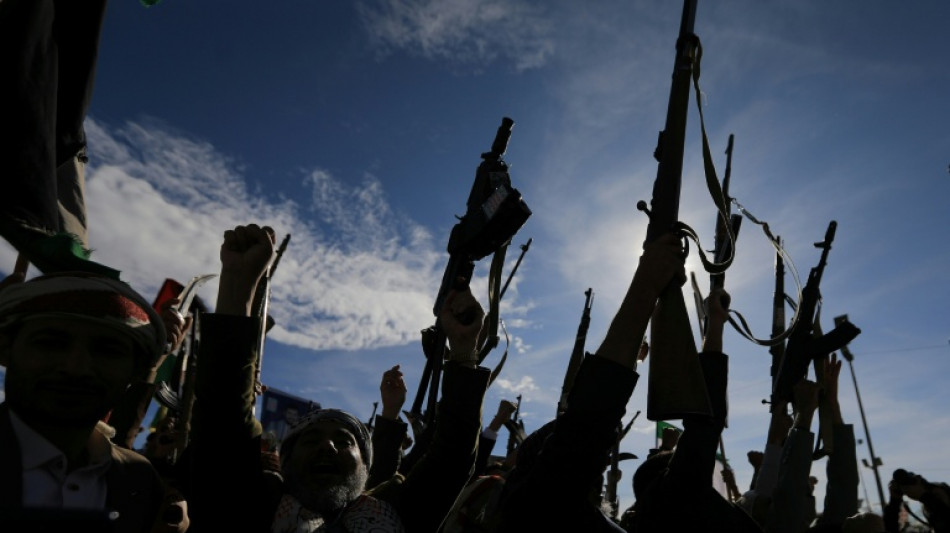
Houthis claim missile attacks on Israel, entering Middle East war / Photo: © AFP
Yemen's Iran-backed Houthi rebels joined the month-old Middle East war on Saturday, claiming two missile attacks on Israel as explosions shook the Iranian capital.
The intervention of Iran's Yemeni allies is raising concern about disruptions to Red Sea shipping lanes, already under pressure from the effective closure of the Strait of Hormuz.
During Israel's recent war in Gaza, the Houthis, claiming solidarity with Palestinians, attacked shipping in the Red Sea and Gulf of Aden, forcing companies to take costly detours.
Until Saturday, they had sat out the latest conflict, even as the Red Sea grew more vital.
Since the launch of hostilities, Saudi Arabia has rerouted much of its oil exports via the Red Sea port of Yanbu to avoid the Strait of Hormuz, which Iran says it has closed to shipping from hostile powers.
A Houthi spokesman said the group fired "a barrage of cruise missiles and drones targeting several vital and military sites" in Israel in a second strike.
Earlier, the group said it had launched ballistic missiles at Israeli military sites, its first attack on Israel since the war began a month ago.
- 'Complete attacks' -
Israel's military said Saturday it struck the headquarters of Iran's Marine Industries Organisation in Tehran, saying the facility developed "a wide range of naval weaponry."
An AFP journalist in Tehran reported intense explosions and a plume of black smoke overnight. On Saturday evening, another wave of blasts rang out in the capital for several minutes, with no immediate word on what was targeted.
An Israeli military spokesman said attacks on Iranian military industry had intensified and "within a few days, we will complete attacks on all critical components."
"I miss a peaceful night's sleep," an artist in Tehran told AFP, saying the previous night's strikes were "so intense it felt like all of Tehran was shaking."
"We are powerless to change a government that kills, and we don't want this war either. We just want a normal, simple life."
- Pakistan mediation -
The conflict began when the United States and Israel launched airstrikes across Iran that killed supreme leader Ayatollah Ali Khamenei, engulfing the region in conflict, sending energy prices soaring and prompting diplomatic efforts to halt the fighting.
Pakistan, acting as a go-between for Washington and Tehran, will host foreign ministers from Saudi Arabia, Turkey and Egypt in Islamabad on Monday for talks on the crisis.
Iran's President Masoud Pezeshkian thanked Islamabad "for its mediation efforts to stop the aggression," while Germany's Foreign Minister Johann Wadephul said Friday he expected a direct US-Iran meeting in Pakistan "very soon."
US President Donald Trump's special envoy Steve Witkoff said such a meeting could take place this week, and promoted a 15-point plan that Washington says "could solve it all."
- Red Sea shipping -
With Hormuz all but impassable, many Gulf shipments have been rerouted through Oman's Salalah port on the Arabian Sea, but Danish shipping giant Maersk said operations there were temporarily suspended after a drone attack.
Fire broke out after Iranian missiles and drones struck the Khalifa Economic Zone in Abu Dhabi, injuring six people. Emirates Global Aluminium reported significant damage.
Air travel has also been disrupted, with authorities in Kuwait and Erbil in Iraqi Kurdistan reporting airport facilities hit in strikes.
Elsewhere in Iraq, a former paramilitary coalition, integrated into the armed forces but containing pro-Iran factions, said three fighters were killed in a strike near Kirkuk, while the interior ministry said two police officers died in another in Mosul.
Both were blamed on the United States and Israel.
In Iran, the Khuzestan Steel Company said production was shut down at a major southwest steel plant following US-Israeli strikes, according to the Shargh newspaper.
Iran's Revolutionary Guards warned they would retaliate for economic damage by striking industrial sites across the region.
- Ukraine drone deal -
Ukraine's President Volodymyr Zelensky left his war-torn country for a Gulf visit to discuss leveraging his nation's anti-drone expertise to help the region defend against Iranian strikes.
"We are talking about a 10-year cooperation. We have already signed a relevant agreement with Saudi Arabia, we have just signed a similar agreement with Qatar, also for 10 years, we will sign one with the Emirates," he told reporters.
In Israel, hundreds gathered in Tel Aviv and other cities for protests against the war, which security forces sought to disperse.
"No one's thought how the hell we're going to get out of (the war), and there's no end in sight," said protester Joanne Levine, 76.
burs-arp/jgc
I.Paterson--TNT