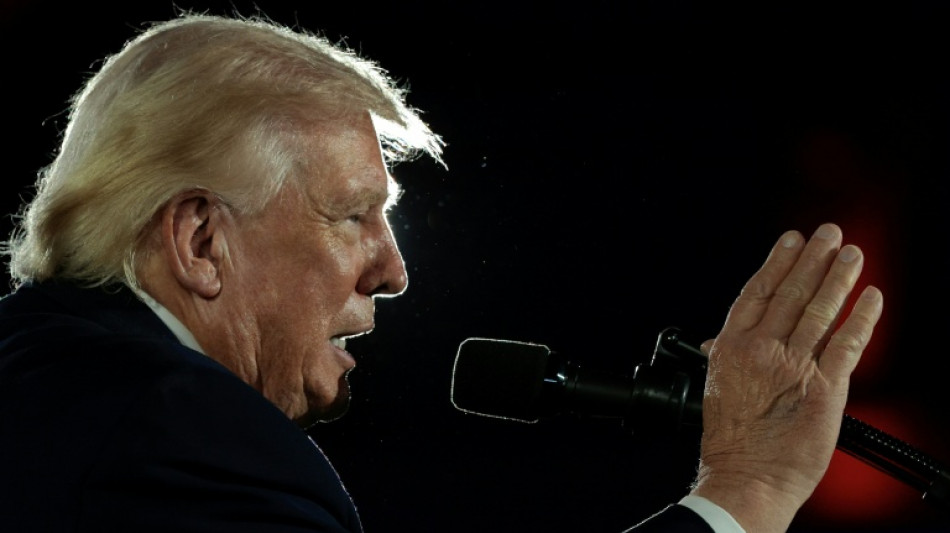
Trump pushes back Iran strikes deadline / Photo: © GETTY IMAGES NORTH AMERICA/AFP
US President Donald Trump on Thursday pushed back his deadline for strikes on Iran's energy assets to April 6, saying it was at Tehran's request and that talks were "going very well."
Trump had denied earlier that he was desperate for a deal to end the Middle East war, despite the Islamic republic's cool response to an American peace plan.
"Talks are ongoing and, despite erroneous statements to the contrary by the Fake News Media, and others, they are going very well," Trump posted on his Truth Social platform.
Last Saturday, Trump had initially given Iran 48 hours to open the crucial Strait of Hormuz to oil tankers, threatening to destroy its power plants, but he has now extended the deadline twice.
"As per Iranian Government request, please let this statement serve to represent that I am pausing the period of Energy Plant destruction by 10 Days to Monday, April 6, 2026, at 8 P.M., Eastern Time," he posted.
Trump's envoy Steve Witkoff told a cabinet meeting earlier of "strong signs" that Tehran was ready to negotiate, confirming publicly for the first time that Washington had passed a 15-point "action list" to Tehran through Pakistani officials.
"We will see where things lead, and if we can convince Iran that this is the inflection point with no good alternatives for them, other than more death and destruction," Witkoff said.
Meanwhile, the Iranian news agency Tasnim said: "Iran's response to the 15 points proposed by the US was officially sent last night through intermediaries, and Iran is awaiting the other side's response."
The Tasnim report, citing an unnamed official, said Iran's reply called for an end to US and Israeli attacks on Iran and also on Tehran-backed groups elsewhere in the region -- a reference to Lebanon's Hezbollah, among others.
War reparations should be paid and Iran's "sovereignty" over the Strait of Hormuz be respected, it said, citing conditions that put Tehran's demands far beyond anything in the US plan.
- 'Too few soldiers' -
In a televised meeting at the White House, Trump veered between repeated threats to "obliterate" Iran and claims it was already on the verge of capitulating.
"They want to make a deal. The reason they want to make a deal is they have been just beat to shit," he said.
Trump also said the United States might take control of Iran's oil, comparing it to the deal Washington made with Venezuela after toppling Nicolas Maduro.
Trump's tough talk came as Israeli opposition leader Yair Lapid warned his country's government for the first time that the war was taking too high a toll.
"The IDF is stretched to the limit and beyond. The government is leaving the army wounded out on the battlefield," Yair Lapid said, echoing a warning delivered a day earlier by military chief Lieutenant General Eyal Zamir.
"The government is sending the army into a multi-front war without a strategy, without the necessary means, and with far too few soldiers," Lapid said.
In a televised briefing, Israeli military spokesman Brigadier General Effie Defrin said: "On the Lebanese front, the forward defensive zone that we are creating requires additional IDF forces... For that, more combat soldiers are needed in the IDF."
- 'No turning back' -
At the cabinet meeting, Trump said Iran had allowed 10 oil tankers passage through the Strait of Hormuz to show it was serious about talks.
Under near-daily bombardment since February 28, Iran was hit by a new wave of Israeli strikes Thursday, one of which Israel said had "eliminated" the Guards' naval commander, Alireza Tangsiri, and several senior officers.
Later, an AFP reporter in Tehran heard warplanes overhead and three loud explosions.
Iranian media reported US-Israeli attacks in the central cities of Isfahan and Shiraz, in Bandar Abbas in the south and Tabriz in the northwest, but also Mashhad and Birjand, towards the Afghan border in an area largely spared until now.
Off the coast from Bandar Abbas on Qeshm, the largest Iranian island in the Gulf, one resident told AFP via Telegram he hoped the site would not be taken over by the military.
"The suffering of people, the poverty, and the political oppression have been getting worse every year," said Sadeq, 42.
"I don't think war is the solution to these conditions, but ending it won't change much for us either," he said.
Fresh violence flared in the Gulf, with two killed by debris from an Iranian ballistic missile intercepted near Abu Dhabi, and drones fired at both Saudi Arabia and Kuwait.
Iran has targeted Gulf nations it accuses of serving as launchpads for US strikes, including hits on oil and gas sites. Crude prices had fallen since last week, but the wavering messages on talks saw oil prices jump again Thursday.
L.Graham--TNT