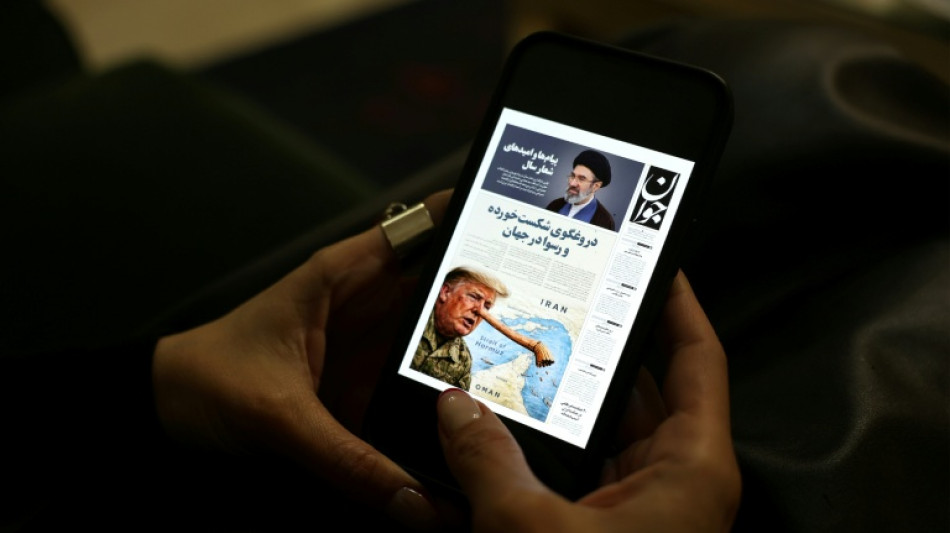
Israel strikes Iran as Tehran rejects US talks overture / Photo: © AFP
Israel struck new targets across Iran on Thursday, after Tehran rejected US overtures to wind down the nearly four-week Middle East war and vowed to keep up its "resistance".
Hopes for a negotiated end to the US-Israeli war with Iran -- which has mushroomed to engulf much of the Middle East -- rose after the United States was said to have put a 15-point peace plan to Tehran.
But the Islamic republic's top diplomat flatly denied any "negotiations" with President Donald Trump's administration late Wednesday -- conceding only that messages were being exchanged through "friendly countries".
"At present, our policy is the continuation of resistance", Foreign Minister Abbas Araghchi said on state TV, adding: "We do not intend to negotiate -- so far, no negotiations have taken place."
Under near-daily bombardment since the joint US-Israeli attack that started the war on February 28, Iran was hit early Thursday by what the Israeli army called "wide-scale" strikes targeting infrastructure.
Local media reported attacks in the central cities of Isfahan and Shiraz, as well as Bandar Abbas in the south, Tabriz in the northwest and Mashhad in the northeast -- an area largely spared until now.
Iran, in turn, kept up its retaliatory attacks on Israel, where medics said six people were lightly wounded by missile attacks in the country's centre.
Fresh violence also flared in the Gulf, with two people killed by debris from an Iranian ballistic missile intercepted near Abu Dhabi, while Saudi Arabia said it shot down at least 18 drones, and Kuwait reported a new missile and drone attack.
Iran has targeted Gulf nations it accuses of serving as launchpads for US strikes, notably with hits on energy sites that have sent markets into a tailspin, threatening lasting damage to the global economy.
- Rival conditions -
Crude prices have fallen since last week, as Trump appears to step back from the goal of regime change.
But the divergent messages on talks and de-escalation saw oil prices rise Thursday and equities mixed, as the closure of the Strait of Hormuz -- through which 20 percent of the world's oil and gas passes -- continued to cast a shadow.
Tehran has largely blocked the vital strait in retaliation for the US-Israeli attacks -- with "maritime routes" a key element of the US proposal to end the fighting, according to The New York Times, along with Iran's nuclear and missile programmes.
Details of the purported 15-point plan emerged via Pakistan, where two officials said Islamabad had passed it on to Tehran.
But Iran's state-controlled Press TV cited an unidentified official as saying Tehran had "responded negatively", and instead put forward its own five conditions for hostilities to end.
These include guarantees that the United States and Israel do not resume the war and compensation for damages.
Trump insisted at a dinner with lawmakers Wednesday night that Tehran wanted to "make a deal" -- but was covering up ongoing talks out of fear.
"They're afraid to say it, because they figure they'll be killed by their own people," he told a dinner with lawmakers. "They're also afraid they'll be killed by us."
The White House has declined to identify its interlocutor in Tehran following the assassination of supreme leader Ali Khamenei.
The late leader's son and successor Mojtaba Khamenei has not been seen since ascending to the role.
- No Lebanon 'surrender' -
Pro-Iran Hezbollah began firing rockets into Israel on March 2 to avenge Khamenei's killing, drawing Lebanon into the war.
The militant group said its fighters launched more than 80 attacks against Israel on Wednesday, the largest daily number in the current war, and attacked Israeli forces in nine border towns.
As the fighting showed little sign of stopping, Israeli Prime Minister Benjamin Netanyahu said the military had "created a genuine security zone" in southern Lebanon, where an Israeli soldier was killed in the fighting on Thursday.
Hezbollah meanwhile launched a new volley of missiles early Thursday at military sites in central Israel, after its chief Naim Qassem said negotiations with Israel would amount to "surrender".
burs-ec/smw
S.Mitchell--TNT