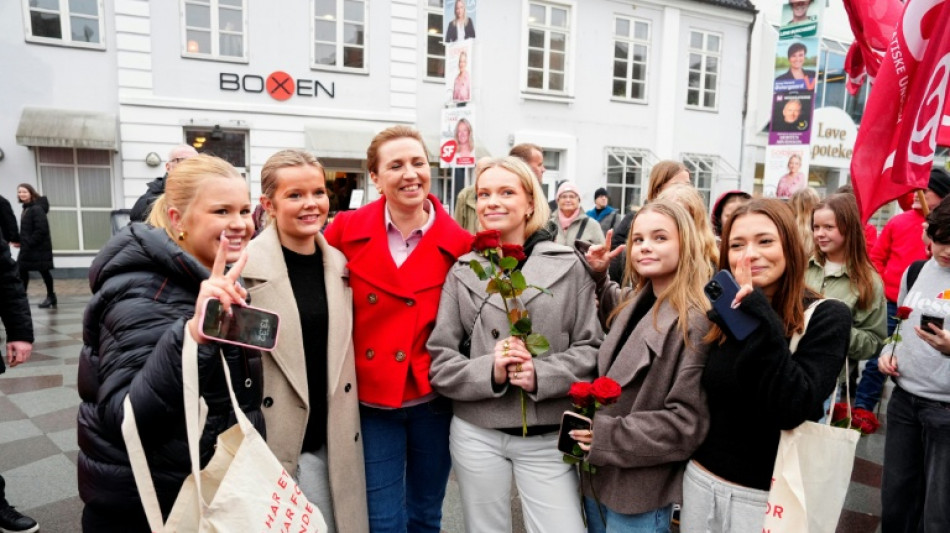
Danish PM's left bloc leads election, but no majority / Photo: © Ritzau Scanpix/AFP
Denmark's left bloc headed by Prime Minister Mette Frederiksen took an early lead in Tuesday's general election but failed to secure a majority, exit polls showed, with Frederiksen's Social Democrats posting their weakest showing in 125 years.
Two exit polls published by Danish public broadcaster DR and television channel TV2 after voting stations closed showed the left-wing bloc taking between 83 and 86 seats in the 179-seat parliament, while the right-wing bloc was credited with between 75 and 78 seats.
If the results were confirmed, the centrist Moderate party would become the kingmaker, with 14 seats.
The DR exit poll credited the Social Democrats, traditionally the country's biggest party, with just 19.2 percent of votes, its lowest score since 1901 and down from 27.5 percent in 2022, while the far-right Danish People's Party almost tripled its score to between 7.5 to 7.7 percent of votes.
As no party is expected to win a majority, thorny negotiations will be needed in the coming days and weeks to build a coalition government.
Frederiksen, a Social Democrat who has been in office since 2019, had been seen as the favourite in the run-up to the election.
At the head of an unprecendented left-right government since 2022, she has been praised for her leadership after fending off US President Donald Trump's repeated demands to annex Greenland, a Danish autonomous territory he claims the United States needs for national security reasons.
"People may not really like her, but they see her as the right leader," Elisabet Svane, political analyst at Danish newspaper Politiken, told AFP.
Frederiksen "is a unifying figure in a world full of insecurity," she said.
"We stand firm when the winds blow. And it has been blowing around our kingdom," she wrote on Instagram on Tuesday, as she spent part of election day in Aalborg, her electoral stronghold in the country's northwest, with Greenlanders living in Denmark.
- 'Serious situation' -
The four overseas seats held by Denmark's two autonomous territories -- two for Greenland and two for the Faroe Islands -- could tip the balance if the election result is very close.
The campaign has generated more interest than usual in Greenland, where 27 candidates vied for the two seats.
"I think it's the most important election for the Danish parliament in Greenland in history," Greenlandic Prime Minister Jens-Frederik Nielsen told AFP in Nuuk.
"We are in a time where we have a superpower trying to acquire us, take us, control us," he added, stressing that the territory still found itself in a "serious situation".
"I think the most important thing that all the parties in Greenland have agreed on is that we need to work together, whoever gets elected for the parliament," he said.
But Greenlandic voter Lars did not share the view that Greenland's parties stood more united, saying he kept seeing divisions play out on social media.
"Everybody is fighting. Greenlanders are fighting. It's terrible," the lawyer told AFP.
Greenland's main political parties all want independence from Denmark, but differ on the pace of the separation.
- 'New beginning' -
In Denmark, the row over the vast Arctic island has however not been central in the campaign.
In the wealthy nation of six million people, it instead focused on domestic issues, including inflation, the welfare state and high nitrate levels in water from agriculture.
"I think that the centre government has not ensured clean water in Denmark. They have not ensured that we have invested in welfare instead of taxation reliefs," Pia Olsen Dyhr, leader of the socialist Green Left, told AFP after casting her voting.
In a country where the far right has heavily influenced policy since the late 1990s, immigration has also been a hot topic.
During her second term, Frederiksen and the Social Democrats tightened migration policy in order to quell support for the far-right.
She has defended as "fair" a proposal to deny non-essential health care to people of foreign origin who threaten medical personnel.
The far-right Danish People's Party's leader Morten Messerschmidt told AFP after voting in Copenhagen: "I want a new beginning for Denmark, and that requires a strong Danish People's Party."
D.Cook--TNT