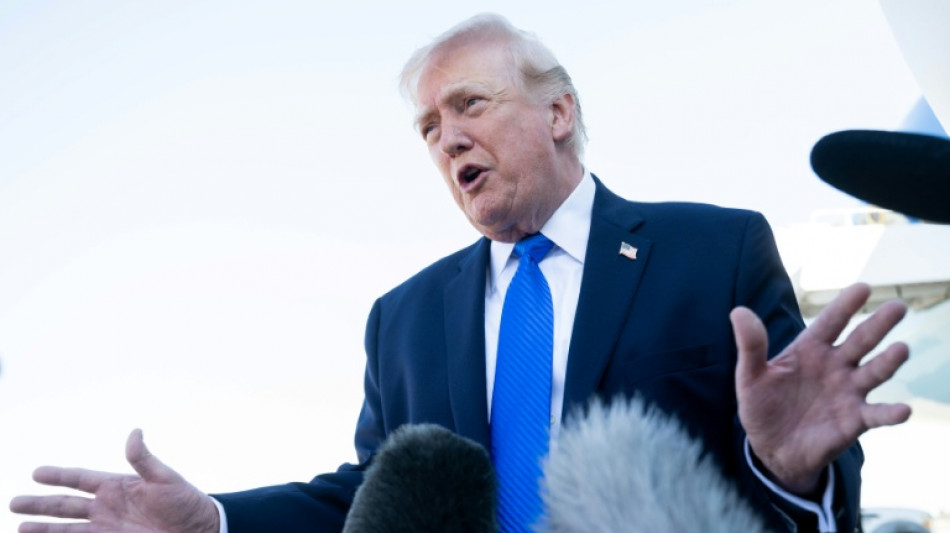
'A top person': Who is the US dealing with in Iran? / Photo: © AFP
He is, according to President Donald Trump, a "top person" in the Iranian system who is "most respected" and is in an unenviable position.
But who is the senior figure talking with the United States on the future of Iran after over three weeks of the Israeli-US war against the Islamic republic?
The individual, said Trump, is not supreme leader Mojtaba Khamenei who succeeded his father, Ali Khamenei, after the killing of the ex-number one at the start of the war on February 28.
After the killing of national security chief Ali Larijani in an Israeli strike last week, attention has focused on parliament speaker Mohammad Bagher Ghalibaf, who has survived the war so far.
But Trump gave no names, saying: "I don't want him to be killed."
Here are five possible figures.
- Parliament speaker Mohammad Bagher Ghalibaf
Ghalibaf has been pinpointed by several analysts as the de-facto wartime leader of Iran following the killings of Khamenei and Larijani and the failure of Mojtaba Khamenei to make any public appearance.
During three decades at the centre of the Iranian system he has held posts straddling civilian and military life, as commander of the aerospace forces of the Revolutionary Guards, Tehran police chief, Tehran mayor and now parliament speaker.
Regarded as deeply ambitious, he stood for president on three occasions but was never successful. After a report in Israeli media said he was the interlocutor of the US, he posted on X that "no negotiations have been held with the US" and denounced "fakenews".
- President Masoud Pezeshkian
President since 2024 after an election held following the death of former president Ebrahim Raisi in a helicopter crash, Pezeshkian is seen as belonging to the more moderate wing of politics in the Islamic republic.
However his position as president in no way makes him Iran's number one, with the supreme leader having the final say on all key matters, although how the power structures work in the post-Ali Khamenei era remains unclear.
Seeking to promote himself as an ordinary man of the people, Pezeshkian took to the streets earlier this month for a mass pro-government rally in favour of the Palestinian cause, taking selfies with well-wishers. Larijani also took part in the same event, only to be killed days later.
- Foreign Minister Abbas Araghchi
A veteran diplomat, Araghchi has held the post since 2024 following the death of former foreign minister Hossein Amir Abdollahian in the same helicopter crash that killed Raisi.
He acted as Iran's representative in talks last month with US envoys Steve Witkoff and Jared Kushner in Oman that were mediated by the Gulf sultanate and failed to stop the march to war.
The New York Times said Tuesday, citing US and Iranian officials, that Araghchi and Witkoff had "direct communication" in recent days which according to Iranian officials amounted to "essentially probes on how to de-escalate the conflict".
Araghchi, who holds a doctorate in political thought from the University of Kent in England, has vigorously defended Iran's position in TV interviews including with American media. But his position as foreign minister seems unlikely to equate to that of a "top person".
- Revolutionary Guards Commander-in-Chief Ahmad Vahidi
A former interior and defence minister, Vahidi is the third commander-in-chief of Iran's ideological army in less than a year after his predecessor Mohammad Pakpour was killed on the first day of the war and Hossein Salami was killed during Israel's 12-day war against Iran in June 2025.
Possibly for this reason, Vahidi has kept a very low profile in this war, making no public appearance.
Only one statement has been issued in his name as commander on March 19, expressing his condolences for the killing of the commander of the Guards' Basij militia, Gholamreza Soleimani, in an airstrike.
- Quds force commander Esmail Ghaani
An extremely shadowy figure, Ghaani became commander of the force responsible for the external operations of the Revolutionary Guards after the killing of Qassem Soleimani in a US strike in Iraq in 2020.
Ghaani was reportedly killed in the June 2025 war but then later re-emerged in public. Intense speculation has since surrounded his whereabouts and standing, amid reports he has come under pressure due to alleged intelligence lapses including the 2024 killing in Lebanon by Israel of Hezbollah chief Hassan Nasrallah.
On March 20, Iranian state media issued the first, and so far only, message in Ghaani's name of the war, predicting that Iran would "soon witness the shameful defeat" of its enemies in the war.
S.Mitchell--TNT