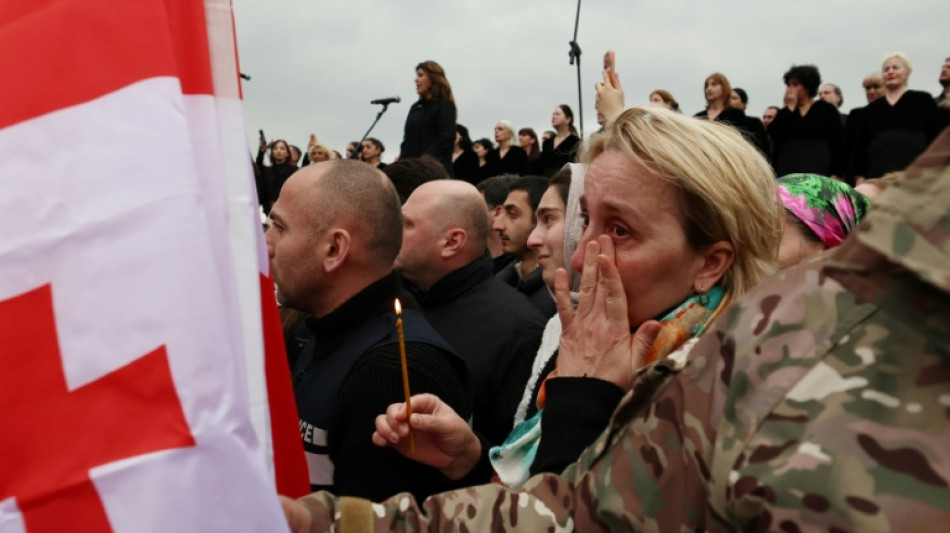
Georgia buries Patriarch Ilia II as succession stirs fears of Russian influence / Photo: © AFP
Thousands of Georgians attended the funeral of influential Orthodox Patriarch Ilia II on Sunday, as some expressed fears his successor could strengthen Russian influence over the Caucasus country.
Ilia II died on Tuesday aged 93 after nearly half a century at the helm of one of the country's most powerful institutions. He consistently topped opinion polls as the Black Sea nation's most trusted leader.
His death removes a towering figure in the Caucasus country, where the church remains highly influential, and has sparked speculation that a Russia-linked candidate could replace him.
Thousands gathered outside Tbilisi's Holy Trinity Cathedral, where Ecumenical Patriarch Bartholomew I of Constantinople led the funeral service, an AFP correspondent saw.
Mourners -- many holding gonfalons and Georgia's red-and-white flags -- then joined a kilometres-long procession to Sioni Cathedral, where the Patriarch was buried before the altar alongside several of his predecessors.
Bishops have up to two months to elect a new Patriarch. Until then, the church will be led by the incumbent of the patriarchal throne, Metropolitan Shio Mujiri.
- 'Unspoken struggle' -
Educated in Russia, Mujiri -- believed to have close ties to Georgia's ruling party and its oligarch leader Bidzina Ivanishvili -- is seen as a potential successor to Ilia II.
The party is widely accused of derailing Georgia's path to European Union membership and tilting towards Russia's orbit -- an allegation it rejects -- and many fear Mujiri's election could further strengthen Russian influence in Georgia.
"Metropolitan Mujiri has close ties to both the Russian Church and Georgia's ruling party," church expert Levan Sutidze told AFP.
"Some bishops have indicated that his instalment as 'locum tenens' of the patriarchal throne took place under suspicious circumstances," he added.
"It is natural to expect an increase in Russian influence if he is elected as the new patriarch."
Prominent writer Lasha Bugadze said: "This is not only the burial of Georgia's Patriarch -- before our eyes, an unspoken struggle is unfolding over whether Ivanishvili and (Russian President Vladimir) Putin's Russia will bring the entire Georgian Church under their control."
Despite the absence of diplomatic ties between Georgia and Russia, the Russian foreign ministry said that President Vladimir Putin's special representative, Mikhail Shvydkoy, attended the funeral and conveyed the Russian leader's "condolences to Georgian clergy and the people."
This marked the first visit by a Russian official to Tbilisi in nearly two decades.
- 'Builder of unity' -
"In sending my heartfelt condolences I assure Your Eminence, the Holy Synod, and the entire Orthodox Church of Georgia of my fraternal solidarity in your grief," Pope Leo XIV said in a letter to Mujiri, describing Ilia II as the "voice of reconciliation" and "tireless builder of unity."
In his letter of condolence, Britain's King Charles III expressed "deep sorrow" over Ilia II's passing.
"His work was characterized by wisdom and high moral authority, earning him great respect both in Georgia and abroad."
One of the world's longest-serving religious leaders, Ilia II was enthroned as the 141st primate of the Georgian Apostolic Autocephalous Orthodox Church in 1977.
Born Irakli Ghudushauri-Shiolashvili in 1933, he rose through the Soviet-era church hierarchy and became a central moral authority during Georgia's independence movement.
Ilia II played a stabilising role in times of political crisis, often mediating between rival factions.
Under his leadership, the church expanded its influence in Georgian politics and public life, while maintaining close ties with the state.
Critics, however, accuse the church of muted responses to government crackdowns on opponents and civil society, support for conservative legislation, and reluctance to challenge the ruling Georgian Dream government over what they call an erosion of democratic practices.
One of the world's 14 self-governed Orthodox churches, the Georgian church traces its origins to the early fourth century, when Christianity became the state religion of the ancient Georgian kingdom of Iberia.
P.Barry--TNT