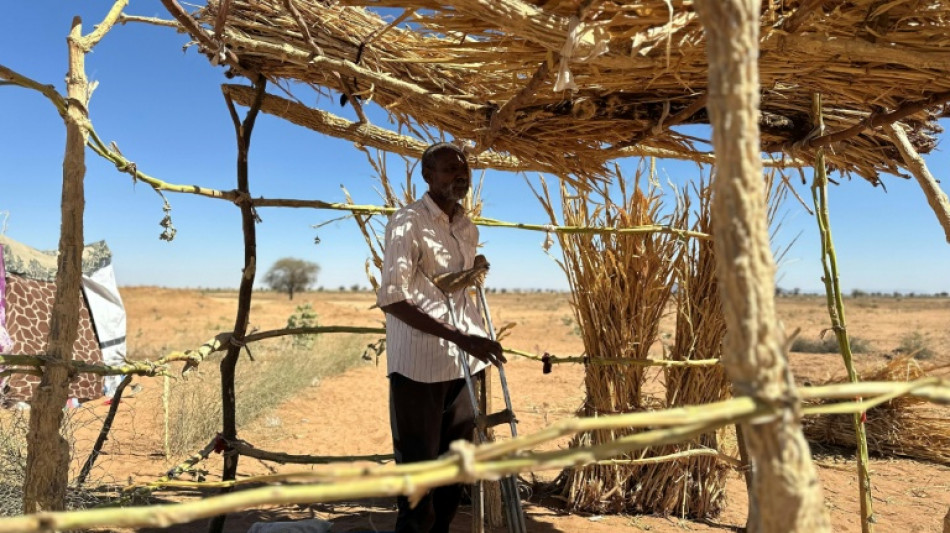
'They beat us with whips': Sudan RSF detainees tell of horrors in El-Fasher / Photo: © AFP
In the suffocating darkness of a sealed shipping container, every thud signalled to Ibrahim Noureldin that one more detainee had died in the crush as Sudanese paramilitary fighters kept forcing more men inside.
Thousands of people are estimated to have been detained in the Rapid Support Forces' (RSF) October takeover of North Darfur's El-Fasher, a battle that a UN investigation found bore the "hallmarks of genocide".
"When people died of thirst and hunger, we were beaten and forced to bury them outside," 42-year-old Noureldin said.
"We were put to work, lifting their luggage, materials, weapons. If we moved too slowly, they beat us with whips," he told AFP from Tawila -- an overwhelmed refugee town west of El-Fasher now sheltering hundreds of thousands of people.
In February, the United Nations' rights office and the London-based Centre for Information Resilience (CIR) said that the RSF had converted hospitals, schools, warehouses and shipping containers -- like the easy-to-lock, inescapable box that nearly killed Noureldin -- into a sprawling network of makeshift prisons.
The RSF, at war with Sudan's regular army for nearly three years, has an iron grip on El-Fasher, and has only allowed in a handful of humanitarians, who say the city is "a ghost town".
But in Tawila, an AFP journalist gathered rare testimonies from five former detainees, speaking to them inside fragile shelters of straw and tattered fabric.
- 'Sips of water' -
Under one straw awning, Noureldin leaned on a crutch, still weak from his injuries.
On October 26, he and six others were fleeing the RSF's final assault on the city when they were "shot at, beaten and accused of fighting for the army".
He was loaded into a Land Cruiser and taken to al-Borsa market in the city's east, then locked with about 120 men in the airless container.
For over a month, they survived on "tiny sips of water" and "a little lentils".
Months of testimony, satellite imagery and verified videos analysed by the UN and CIR show that the detainees included government workers, doctors, journalists, teachers and aid staff.
Many were held for ransom, accused of army affiliation or based on tribal identity.
The RSF denies the abuses. A spokesman told AFP the reports were "propaganda", accusing the army of "using civilians as human shields".
Both warring sides have been accused of atrocities against civilians, including deliberate targeting and detention.
- 'Nails ripped with pliers' -
One of the RSF's largest detention centres was El-Fasher Children's Hospital, where "more than 2,000 men" were held "without access to water and food", the UN said.
"They brought us to the children's hospital, said we were fighters and kept me there for a month," Abdullah Idris, 45, told AFP.
With nothing but saline solution to drink, he said he "could only watch" as dozens of people died every day.
The UN recorded up to 40 deaths a day during a cholera-like outbreak, killing 260 people in a single week.
Besides disease, "the torture was horrible, especially to the young men", he said.
"If you tried to speak, they'd kill you with a single shot."
Ahmed Aman, 45, another hospital detainee, said some detainees "had their fingernails ripped out with pliers".
After weeks at the hospital, he was moved to Garni, northwest of El-Fasher, where CIR-verified footage showed "at least 600 detainees" being forcibly marched, including women and children.
- 'Like animals' -
Nedal Yasser, 27, was abducted the day after the RSF assault on the city.
For six weeks, she was shuttled with other women between detention sites, including al-Mina al-Bary, a bus depot near the market where the UN said hundreds were held in about 70 shipping containers.
"I was beaten, tied up, interrogated. When they found out my husband was a soldier, the torture got even worse," she told AFP.
"We were exploited and sexually harassed, only sometimes allowed to go to the bathroom."
She and the other women were ordered to pay $2,000 ransoms, but everything she owned had "already been looted".
Finally, she was brought to a house, "assaulted", then dumped in a remote area.
She walked dozens of kilometres to Tawila, suffering a miscarriage on the way.
The UN has documented widespread torture and "cruel, inhuman and degrading treatment", including sexual violence, beatings with wooden rods, flogging and being suspended in painful positions from trees.
In the open fields of Tawila, survivors carry the scars.
Aman's back remains "torn apart" from beatings.
Yasser regularly faints when she tries to stand.
And mechanic Ahmed al-Sheikh, 43, walks with a limp and cannot see out of his right eye after being struck by an RSF fighter.
He reached safety only in February after four months in Shala prison, where the UN said the RSF held more than 2,000 detainees by January.
"They'd kill people right in front of us," he told AFP.
"They would select people randomly, killing us like animals."
According to the UN, at least 6,000 more detainees were transferred from El-Fasher to Tagris prison in the RSF's de facto capital, Nyala, where they maintain a complete communications blackout.
S.Cooper--TNT