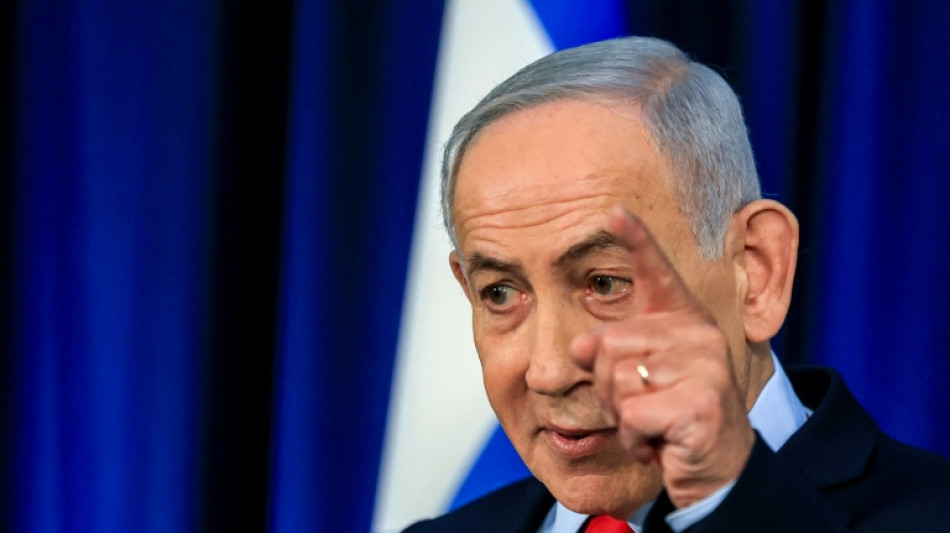
Netanyahu says Iran 'decimated,' Tehran targets Gulf petro-facilities / Photo: © POOL/AFP
Israeli Prime Minister Benjamin Netanyahu said Thursday that Iran is being "decimated" and it is unclear who is in charge, even as the Islamic Republic kept up attacks on Gulf oil and gas targets that have jolted global markets.
Nearly three weeks into the Middle East war launched by Israel and the United States, Netanyahu said Tehran no longer has the capacity to enrich uranium or manufacture ballistic missiles.
"We are winning and Iran is being decimated," he said at a press conference.
The European Union, following a meeting of the bloc's leaders in Brussels, called for a "moratorium" meanwhile on strikes against energy and water facilities.
"The European Council calls for de-escalation and maximum restraint, the protection of civilians and civilian infrastructure and full respect of international law by all parties," they said.
Netanyahu hailed his cooperation with US President Donald Trump and said, without providing a specific timeframe, that he sees "this war ending a lot faster than people think."
His comments came after the United States said there was no deadline to end the war that the two countries launched against Iran on February 28.
Netanyahu said he was "not sure who's running Iran right now."
"Mojtaba, the replacement ayatollah, has not shown his face," he said, in a reference to Iran's newly appointed supreme leader, the son of Ayatollah Ali Khamenei, who was killed in an Israeli airstrike on the first day of the war.
"We're seeing cracks, and we're trying to propagate them as fast as we can, not only in the top command, we're seeing cracks in the field," Netanyahu said.
While Israel and the United States expressed confidence in their war efforts, energy markets were left reeling by Iranian attacks on the world's largest liquefied natural gas plant in Qatar and refineries in Saudi Arabia and Kuwait.
Oil markets have already been shaken by Iran's chokehold on the strategic Strait of Hormuz.
- 'It's coordinated' -
Benchmark Brent surged six percent to $119 a barrel before falling back to $110, while European gas prices rose nearly a third, after Iranian missiles hit Qatar's huge Ras Laffan natural gas complex in retaliation for Israel's air raid on the South Pars gas field on Wednesday.
The latest attack on Ras Laffan caused "extensive damage" that QatarEngery said could cost $20 billion a year in lost revenue and take five years to repair.
Iran also struck elsewhere in the region, with a drone crashing into the Samref refinery in Saudi Arabia's Red Sea port of Yanbu, the Saudi defence ministry said.
The Saudi government said it reserved the "right to take military actions" in response.
In Kuwait, drone attacks sparked fires at the Mina Abdullah and Mina Al-Ahmadi refineries, which have a combined capacity of 800,000 barrels per day.
And in Israel an oil refinery in the port of Haifa was hit on Thursday. Media showed images of black smoke rising from the complex.
Trump indicated he did not know in advance about Israel's raid on South Pars, which supplies about 70 percent of Iran's domestic needs. But he said he had told Netanyahu not to hit Iranian gas fields again.
"We get along great. It's coordinated, but on occasion, he'll do something" that the United States opposes, Trump said.
Netanyahu insisted Israel "acted alone" with the strike.
The Israeli premier also rejected suggestions he had dragged Trump into the conflict, implying that he was the junior partner in the joint assault on Iran.
"Does anyone really think that someone can tell President Trump what to do?" Netanyahu said. "He didn't need any convincing," he added.
- 'ZERO restraint' -
Trump warned earlier that the United States would "blow up" South Pars if Tehran did not stop attacking Qatar. But he said Thursday there was no current plan to send ground troops into Iran.
Iran responded to the threats with defiance.
The military's Khatam Al-Anbiya operational command vowed the "complete destruction" of Gulf energy infrastructure if the Israeli attack was repeated.
Foreign Minister Abbas Araghchi said on social media there would be "ZERO restraint" if Iran's infrastructure was hit again.
Amid growing concern over the economic fallout from the conflict, Britain, France, Germany, Italy, Japan and the Netherlands said they would "contribute to appropriate efforts to ensure safe passage through the Strait of Hormuz."
But they gave few details.
Rome and Berlin later insisted any action would only happen if there was a ceasefire.
French President Emmanuel Macron condemned the "reckless escalation" in attacks and called for "direct talks between the Americans and Iranians."
UK Prime Minister Keir Starmer's office warned that "attacks on critical infrastructure risked pushing the region further into crisis."
India and China also expressed new concern about their oil supplies which flow through the Strait of Hormuz.
US Defense Secretary Pete Hegseth said there is no timeframe for ending the war, but that "we're very much on track" and Trump would choose when to end fighting.
"It will be at the president's choosing, ultimately, where we say, 'Hey, we've achieved what we need to,'" he said.
The Trump administration is reportedly seeking an additional $200 billion in war funding from Congress and Hegseth said "that number could move."
"Obviously it takes money to kill bad guys," he said.
burs-cl/des
S.Lee--TNT