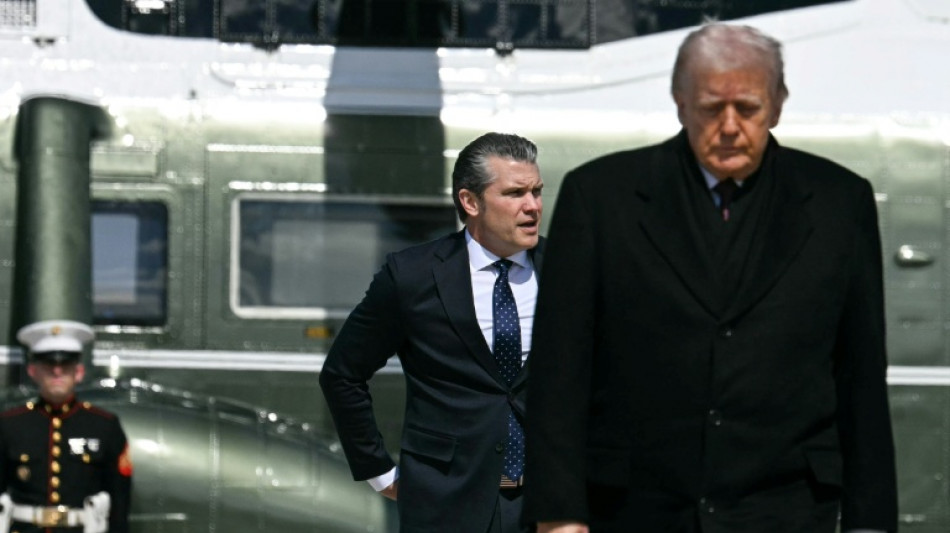
US, Israel tactics diverge on Iran as Trump's goals still 'fuzzy' / Photo: © AFP
US President Donald Trump and Israeli Prime Minister Benjamin Netanyahu both praise their relationship as excellent, but after three weeks of attacking Iran, their tactics are increasingly diverging -- the result, some experts say, of Trump's ill-defined goals.
Trump said Thursday that he told Netanyahu not to attack Iran's gas fields after an Israeli strike prompted Tehran to retaliate against a major energy hub in Qatar, sending global prices soaring further.
Earlier this month, the United States voiced unease after Israel bombed fuel depots around Tehran, smothering the city of 10 million people with toxic black smoke.
Trump, emboldened by his January operation in Venezuela, has held out hope for working with a figure within the Islamic republic -- while Israel has openly declared it will kill any high-ranking Iranian official it sees.
"The objectives that have been laid out by the president are different from the objectives that have been laid out by the Israelis," Tulsi Gabbard, Trump's director of national intelligence, acknowledged in a congressional hearing this week.
Netanyahu, after the public reproach on the gas fields attack, publicly hailed Trump at a news conference late Thursday, saying that no "two leaders have been as coordinated."
"He's the leader. I'm, you know, his ally," Netanyahu said.
- 'Fuzzy' Trump goal -
But Netanyahu has been far more clear than Trump on what he wants in Iran.
Netanyahu has long described Iran's cleric-run government as the top enemy and has vowed to topple or at least crush it.
"Israel wants some sort of regime change whereas the United States is fuzzy and unclear about what the end state is," said Brian Katulis, a senior fellow at the Middle East Institute in Washington.
Trump has spoken in glowing terms about tactical military successes but also faces mounting pressure at home unlike Netanyahu.
The war is unpopular with the US public, including parts of Trump's base, and has led to higher gas prices for consumers and turbulence on markets months ahead of congressional elections.
Trump also has a close relationship with Gulf Arab monarchies, longtime allies that serve as bases for US troops and are softer targets for Iran than Israel.
Netanyahu, Israel's longest-serving leader, also faces elections this year, in which he is expected to highlight his support from Trump.
Katulis noted that Trump has not hesitated to pressure Israel before -- forcing a ceasefire in Gaza last year after Israel attacked Hamas leaders in Qatar, and angrily demanding that Israel hold fire on Iran last year after he announced a truce.
"It's not unimaginable that Trump sees the cost of this war getting too high and hindering his domestic agenda," Katulis said.
"I don't think Israel under Netanyahu is going to ignore Trump but that would require Trump actually articulating some sort of soft landing."
- New dynamic for Israel -
The conflict marks a watershed for Israel in fighting a war as part of an alliance. In the two wars against Iraq, the United States tried hard to keep Israel out, fearing its presence would alienate Arab allies.
Yossi Mekelberg, a Middle East expert at London-based think tank Chatham House, said that Israel and the United States started with an aim of regime change before encountering the heavy counter-attack by Iran.
"When things go wonderfully well, everyone is happy, you know -- they all praise each other," he said.
"If it starts going really wrong, and we know that Trump is not the sentimental type, then the blame starts flying," he said.
Robert Malley, who negotiated with Iran under former president Joe Biden, said that both Israel and Iran had clear goals, with Israel wanting to sow the Iranian government's collapse and Tehran seeking to survive and to externalize the costs of the war.
The unpredictable actor is Trump, who has said both that the war will be short or will intensify and sees world affairs in deeply personal terms, particularly on whether he can claim victory.
"He's offered a series of shifting goals, not just day by day but often hour by hour," said Malley, now a senior fellow at the Yale Jackson School of Global Affairs.
"In some ways, you need to be more of a psychologist than a policy analyst to be able to understand where we're going," he said.
A.M.James--TNT