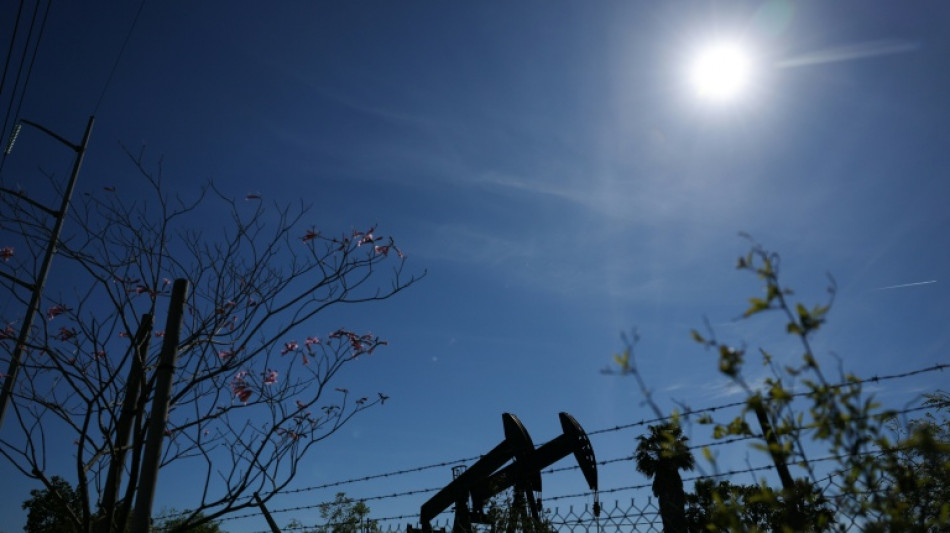
Crude prices surge, stocks sink as Iran warns of regional energy strikes / Photo: © AFP
Oil surged more than five percent Thursday and stocks sank as Iran carried out a series of attacks on Gulf energy facilities and warned of more following a strike on one of its key gas fields, while warnings of higher US inflation also soured the mood.
After spending much of Wednesday hovering around $100, crude soared as Tehran threatened to target regional installations in reply to what it said was an Israeli hit on a site serving its massive South Pars field, which it shares with Qatar.
Abu Dhabi later shut down operations at a gas facility due to falling debris from missile interceptions, while Qatar's Ras Laffan site was hit, with QatarEnergy saying emergency teams had been "deployed immediately to contain the resulting fires".
Iranian state television later said Thursday that a missile struck the site again, which QatarEnergy said caused extensive damage.
Qatar has ordered several Iranian diplomats to leave the country.
Meanwhile, the UN nuclear watchdog said Iranian authorities had reported a projectile impact at the country's only operational nuclear power plant but that it caused no damage.
"We warn you once again that you made a big mistake in attacking the energy infrastructure of the Islamic republic," the Revolutionary Guards said in a statement carried by Iranian media.
"If it is repeated again, further attacks on your energy infrastructure and that of your allies will not stop until it is completely destroyed."
And President Masoud Pezeshkian wrote on X that the attacks on South Pars "will complicate the situation and could have uncontrollable consequences, the scope of which could engulf the entire world".
Brent spiked more than five percent to hit a peak of $112.86, while West Texas Intermediate was sitting around $99.
The increased tension hit equities, which had enjoyed a broadly positive start to the week thanks to a fresh rally in tech firms.
Tokyo and Seoul, which had been the best performers between the start of the year and the start of the war, both sank more than two percent.
Hong Kong, Shanghai, Sydney, Singapore, Taipei, Wellington and Jakarta were also well down.
After talks with US President Donald Trump and Qatar's emir, French President Emmanuel Macron said on X: "It is in the common interest to implement without delay a moratorium on strikes targeting civilian infrastructure, particularly energy and water infrastructure."
Markets have been hammered since the US-Israel attacks on Iran on February 28 that sparked a wave of retaliatory strikes across the Gulf by Tehran. The Islamic republic also effectively closed the Strait of Hormuz, through which a fifth of global oil and gas flows.
That has sent crude soaring, stoking fears of another surge in inflation.
And while the White House unveiled new steps Wednesday to try to counter the spike in energy costs prices, waiving a century-old shipping law and easing Venezuela sanctions, observers said the measures were nowhere near enough.
The attacks shook up energy markets, which had seen a period of stability this week helped by Iraq saying it had resumed limited oil exports through Turkey to avoid the Strait of Hormuz.
The strategic waterway usually sees a fifth of global oil pass through it but Iran has effectively shut it since the outbreak of the war, with attacks on ships.
Expectations that the spike in energy costs would send inflation soaring again has seen traders pare their expectations for central bank interest rate cuts this year.
Those concerns were compounded Wednesday with data showing US wholesale inflation rose more than expected in February.
Later, Federal Reserve Chair Jerome Powell said he expected higher energy prices to boost inflation in the near term but added that little was clear at this point.
"We're right at the beginning of this, and we don't know how big -- you just don't know how big this will be and how long it lasts," he said after the bank held interest rates. Officials would have to "wait and see", he said.
Eyes are also on decisions Thursday by the European Central Bank, the Bank of England and the Bank of Japan.
Australia's central bank hiked its key rate Tuesday, pointing to "sharply higher fuel prices".
- Key figures at around 0220 GMT -
West Texas Intermediate: UP 2.2 percent at $98.42 per barrel
Brent North Sea Crude: UP 3.7 percent at $111.33 per barrel
Tokyo - Nikkei 225: DOWN 2.8 percent at 53,670.83
Hong Kong - Hang Seng Index: DOWN 1.5 percent at 25,633.40
Shanghai - Composite: DOWN 0.8 percent at 4,031.72
Euro/dollar: UP at $1.1485 from $1.1451 on Wednesday
Pound/dollar: UP at $1.3293 from $1.3256
Dollar/yen: DOWN at 159.58 yen from 159.87 yen
Euro/pound: UP at 86.40 pence from 86.38 pence
New York - Dow: DOWN 1.6 percent at 46,225.15 (close)
London - FTSE 100: DOWN 0.9 percent at 10,305.29 (close)
S.Mitchell--TNT