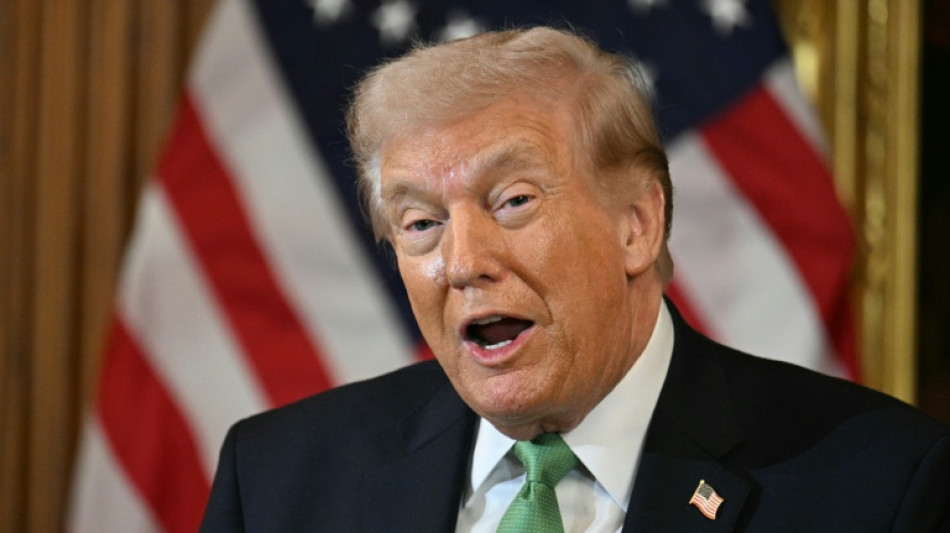
Trump faces impasse over Iran war / Photo: © AFP
Having failed to clearly define an objective or exit strategy -- and sell the American public on a new war in Iran -- President Donald Trump finds himself at an impasse, mere weeks into the conflict.
Add to that the high-profile protest resignation of a senior US counterterrorism official on Tuesday, who said publicly that the Islamic republic posed "no imminent threat to our nation" and he couldn't "in good conscience support the ongoing war in Iran."
Trump has repeatedly said Iran has been "decimated" by American and Israeli strikes, indicating he is in the position to declare victory.
But the Republican leader has not gone that far -- and for good reason.
It takes both sides to end a war, unless an opponent capitulates.
Iran, though severely weakened militarily and politically by an onslaught of airstrikes that began February 28, has voiced no intention to surrender.
While Trump has said the US has destroyed the Iranian navy, its ballistic missiles and legions of its leadership, US media has reported that he failed to fully anticipate Iran's remaining capacity for broad-ranging retaliation.
That may be where the real problem lies for Trump.
As the war entered its third week, oil prices soared as violence spread throughout the Middle East, from Lebanon to the Gulf -- including attacks on the hard-won US embassy in Iraq.
As such, the US president is paying the price for having joined Israel's side without a mandate, or consulting either Congress or his other global allies.
Europeans and other allies politely refused Trump's requests for aid in the Strait of Hormuz, the narrow Gulf waterway that has been effectively blocked by Iran.
On Tuesday, Trump reversed course, saying he no longer needed their help.
In a rare admission, Trump said Monday that he was surprised by the Iranian reprisals targeting Gulf countries -- from Saudi Arabia to Qatar -- despite Tehran's repeated warnings.
"They weren't supposed to go after all these other countries in the Middle East," Trump said of Iran. "Nobody expected that. We were shocked."
- Dipolomatic stalemate -
Richard Haass, president emeritus of the Council on Foreign Relations, said in a recent newsletter that "while the United States initiated this conflict on its own, it will require both Israel and Iran to sign on to stopping it."
"The longer this war goes on, the more the balance between its costs and benefits shifts toward the former," Haass, a former US diplomat in George W. Bush's administration, added.
For the United States, beyond weakening Iran over the long-term, victory means resuming maritime traffic in the Strait of Hormuz to restore global oil supplies, and an end to Tehran's attacks on its neighbors.
Many observers say this will not be possible through military force alone.
The diplomatic path has narrowed significantly, but it remains an option, and will depend in part on the Islamic republic's goodwill.
The question remains, who will come to the table?
"There are no clean options at this point, only less bad ones," Sina Toossi, a senior fellow at the Center for International Policy, told AFP via email.
"The most realistic path is a negotiated de-escalation that allows all sides to save face. The US can claim it degraded Iran's capabilities, while Iran claims it absorbed the pressure and demonstrated it can retaliate," Toossi said.
More broadly, he added, "Persian Gulf stability ultimately requires some degree of accommodation with Iran."
Mona Yacoubian, the Middle East program director at the Center for Strategic and International Studies, said the region is "currently living their 'nightmare scenario.'"
"Gulf governments will need to find a way forward that acknowledges Iran's enduring regional presence," she said.
Until then, America's allies are not hiding their frustration.
German Chancellor Friedrich Merz said Monday the US war against Iran is not a NATO matter, nor will Berlin join the war or help clear transit in the Strait of Hormuz.
Merz stressed talks to find a diplomatic solution can't begin until Israel and the United States say they have achieved their military objectives.
A.Wood--TNT