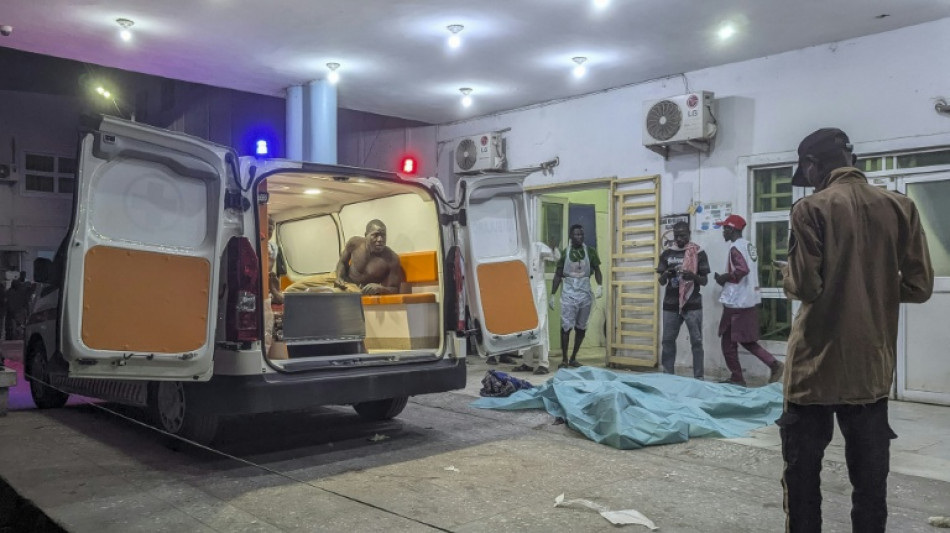
Nigeria suicide bombings kill 23, wound more than 100 / Photo: © AFP
Coordinated blasts by suspected suicide bombers tore through a busy market and other areas in the Nigerian city of Maiduguri, killing at least 23 people and wounding more than 100 others, in one of the worst recent attacks on the capital of Borno state.
Three blasts detonated Monday evening just after people in the Muslim-majority city broke their Ramadan fasts, striking a main market, the entrance of Maiduguri's largest teaching hospital and a post office axis.
The military blamed the blasts in the city of around 1.2 million people on suspected Boko Haram militants and warned of "an increased threat" of suicide attacks in the final days of the holy month of Ramadan.
It came after an attack on a military post overnight Sunday to Monday, which authorities blamed on suspected jihadists, and as President Bola Tinubu was preparing for a state visit to the United Kingdom, where security is expected to be on the agenda.
Tinubu ordered the country's security chiefs "to move to Maiduguri to take charge of the situation".
Witnesses described panic as people fled an initial explosion at the market towards an exit that passes through the post office area, where minutes later another blast hit.
Survivor Mala Mohammed, 31, told AFP that many people "ran toward the post office area because the market entrance and the post office are not far apart. Unfortunately, as they were running towards post office, the person who had the explosive device ran into the crowd while people were still trying to escape."
Combined with the attack on the military position and a mosque bombing in December, the assaults have wrecked a peaceful stretch in the city, which had become a relative oasis of calm as Nigeria's long-running insurgency was pushed to the rural hinterlands.
Maiduguri is the town where Boko Haram originated, home to its initial uprising in 2009 which became a bloody campaign to establish a caliphate in the country.
Violence has slowed from its peak around 2015 but fighters from Boko Haram and rival jihadist group Islamic State West Africa Province (ISWAP) have recently stepped up attacks in northeastern Nigeria.
Their campaign has killed more than 40,000 people and displaced around two million.
Despite improved security within Maiduguri, "the city has always been vulnerable," Confidence McHarry, a conflict analyst with Lagos-based SBM Intelligence, told AFP, noting that countryside attacks have continued, often just a few kilometres from town.
The military's attention has recently been focused on ISWAP, said McHarry, yet Boko Haram "still has cells" around Maiduguri and the attacks show "they're still a force to be reckoned with".
Police put the toll at 23 dead and 108 wounded. An anti-jihadist militia member told AFP the death toll from the explosions could be as high as 31.
An AFP reporter at a city hospital on Monday evening saw dozens of wounded people seeking treatment, as well as bodies covered by sheets on the pavement outside.
- 'Barbaric' attacks -
Police said that "normalcy has been fully restored in the affected areas" and that security forces have increased their "presence and surveillance across Maiduguri and its environs to prevent any further occurrences".
Borno state Governor Babagana Zulum called the apparent bombings "barbaric" and said "the recent surge in attacks is not unconnected with intense military operations in the Sambisa forest", a known jihadist stronghold.
An attack the previous evening was launched around midnight Sunday into Monday on a Nigerian military post in Ajilari Cross district, a southwestern suburb of Maiduguri and just a few kilometres from the airport.
That same evening also saw an attack in Damboa area, south of Maiduguri.
Maiduguri, once the scene of daily shootings and bombings, had been relatively calm in recent years, with attacks peaking in the mid-2010s.
The last major attack was in 2021, when Boko Haram jihadists fired mortars at the city, killing 10 people.
But in December, an unclaimed bombing -- again a suspected suicide attacker -- killed at least seven people in a city mosque.
And in the countryside surrounding Maiduguri, violence has continued.
Last month, the United States began deploying 200 troops to Nigeria to provide technical and training support to the country's soldiers in fighting jihadist groups.
R.Evans--TNT