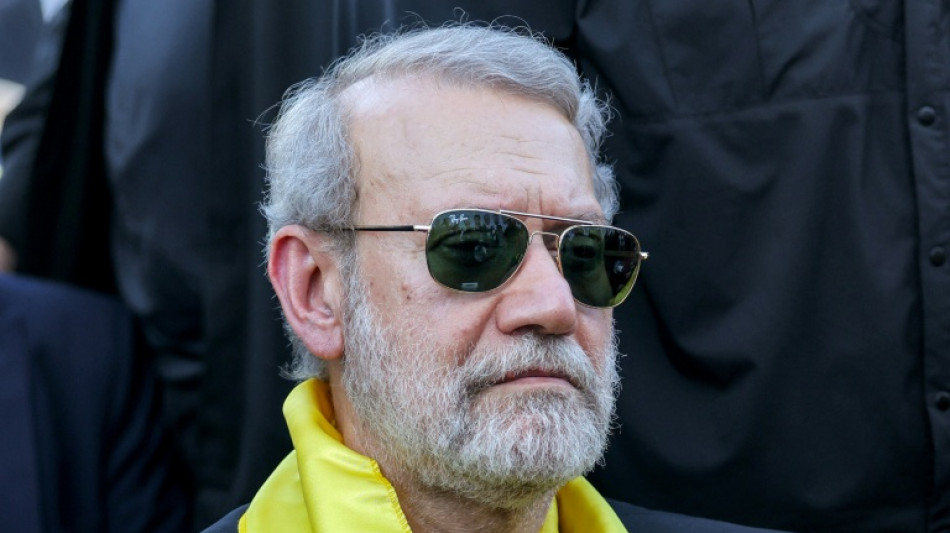
Iran's Larijani, the man whose power grew during Mideast war / Photo: © AFP
When Israeli and US strikes killed Ayatollah Ali Khamenei at the start of the Middle East war, Iran's security chief Ali Larijani became even more powerful than he had been for decades.
Israel's Defence Minister Israel Katz said on Tuesday that Larijani had been killed, though Iran's authorities have not confirmed his death.
Larijani had since the start of the war played a far more visible role than the new supreme leader, Mojtaba Khamenei, who has not been seen in public since he was appointed to replace his slain father.
The security chief, on the other hand, was seen walking with crowds at a pro-government rally last week in Tehran, in a sign of defiance against Israel and the US.
His killing, if confirmed, would be a major blow against the Islamic republic, undermining a key figure seen as capable of navigating both ideology and diplomacy.
- Pragmatist -
Adept at balancing ideological loyalty with pragmatic statecraft, Larijani was central prior to the war to Iran's nuclear policy and strategic diplomacy.
Bespectacled and known for his measured tone, the 68-year-old was believed to enjoy the confidence of the late Khamenei, after a long career in the military, media and legislature.
In 2025, after Iran's last war with Israel and the US, he was appointed head of Iran's top security body, the Supreme National Security Council -- a position he had held nearly two decades earlier -- coordinating defence strategies and overseeing nuclear policy.
He later became increasingly visible in the diplomatic arena, travelling to Gulf states such as Oman and Qatar as Tehran cautiously engaged in nuclear negotiations that were ultimately scuppered by the war.
- 'Canny operator' -
"Larijani is a true insider, a canny operator, familiar with how the system operates," Ali Vaez, the International Crisis Group's project director for Iran, said before the Middle East war began.
Born in Najaf, Iraq in 1957 to a prominent Shia cleric who was close to the Islamic Republic's founder Ayatollah Ruhollah Khomeini, Larijani's family has been influential within Iran's political system for decades.
Some of his relatives have been the targets of corruption allegations over the years, which they denied.
He earned a PhD in Western Philosophy from the University of Tehran.
A veteran of the Islamic Revolutionary Guard Corps during the Iran-Iraq war, Larijani later headed state broadcasting IRIB for a decade from 1994 before serving as parliamentary speaker from 2008 to 2020.
In 1996, he was appointed as Khamenei's representative to the Supreme National Security Council (SNSC). He later became secretary of the SNSC and chief nuclear negotiator, leading talks with Britain, France, Germany and Russia between 2005 and 2007.
He ran in the 2005 presidential elections, losing to populist candidate Mahmoud Ahmadinejad, with whom he later had disagreements over nuclear diplomacy.
Larijani was then disqualified from running for president in both 2021 and 2024.
Observers viewed his return as the head of the SNSC as signalling a turn reflecting his reputation as a conservative capable of combining ideological commitment with pragmatism.
Larijani supported the landmark 2015 nuclear deal with world powers which unravelled three years later after US President Donald Trump withdrew from the agreement.
In March 2025, Larijani warned that sustained external pressure could alter Iran's nuclear posture.
"We are not moving towards (nuclear) weapons, but if you do something wrong in the Iranian nuclear issue, you will force Iran to move towards that because it has to defend itself," he told state television.
Larijani repeatedly insisted negotiations with Washington should remain confined to the nuclear file and defended uranium enrichment as Iran's sovereign right.
- Violent repression -
Larijani was among officials sanctioned by the US in January over what Washington described as "violently repressing the Iranian people", following nationwide protests which erupted weeks earlier due to the rising cost of living.
According to rights groups, thousands of people were killed in the government's brutal crackdown of the protests.
Larijani acknowledged that economic pressures had "led to the protests", but blamed the violence which ensued on foreign involvement by the United States and Israel.
K.M.Thompson--TNT