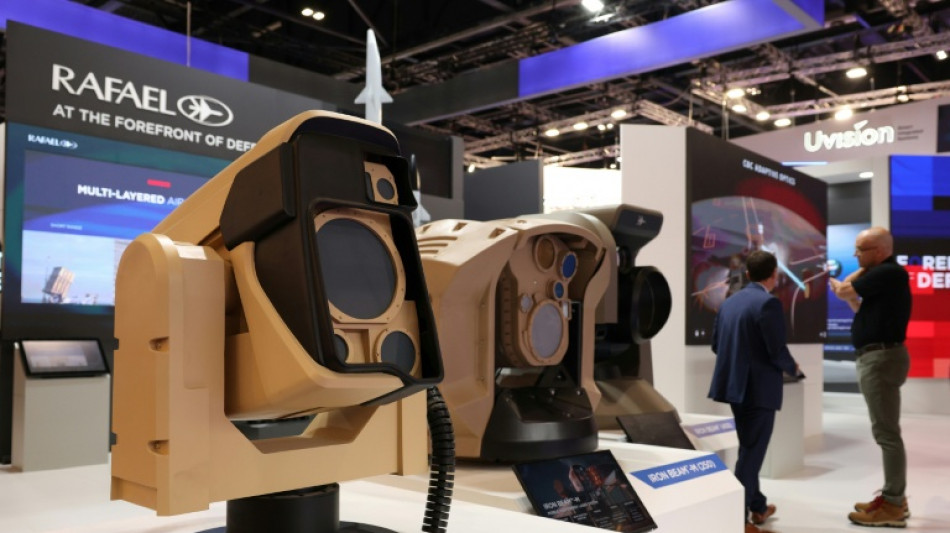
Rise of drone warfare sharpens focus on laser defense / Photo: © AFP
The surge of drone use in conflicts worldwide, seen most vividly in the Ukraine and Middle East wars, will accelerate the race to develop high-power laser systems that could down the devices far more cheaply than traditional defensive weapons.
It is a critical issue for governments threatened by low-cost, easily obtainable drones that can wreak outsize destruction, and are usually shot down only by the most advanced -- and expensive -- missile technologies.
Currently, so-called directed energy weapons (DEWs) mounted to ships or armored vehicles can fire a concentrated electromagnetic beam at targets up to 20 kilometers (12 miles) away.
"Those systems have made a lot of progress in the last 10 to 15 years," said Iain Boyd, director of the Center for National Security Initiatives at the University of Colorado.
Russia is using several versions against drones from Ukraine, which is testing its own system, while Israel has deployed the Iron Beam technology from Rafael against drones fired by Lebanon's Iran-backed militant group Hezbollah.
However, the Israeli Army confirmed to The Jerusalem Post last week that Iron Beam was not being deployed in its current war with Iran, saying it was not ready for regular use.
China presented its LY-1 system last September, Britain and France are developing their own versions, and the United States has started equipping warships in particular, with Helios from Lockheed-Martin or the LWSD from Northrop Grumman.
"We have shown this technology has broad applicability including military operations and for homeland defense," Northrop told AFP in a statement.
- Pennies per shot? -
US President Donald Trump said recently that "the laser technology that we have now is incredible," and would soon replace the Patriot interceptor missile for taking out drones.
That would be music to the ears of military planners who are using the pricey Patriot and similar systems, where a single missile can cost millions of dollars, to down drones worth just several thousand dollars.
A top official in Britain's DragonFire program has estimated its per-fire cost at around 10 pounds ($13).
"The cost of firing one laser or microwave is really the cost of electricity," an expert in DEW systems design told AFP on condition of anonymity.
After the initial investment is made, "it's going to be pennies per shot," the designer said.
At that price, not even Iran's notorious Shahed drones, estimated to cost as low as $20,000 each, or drone interceptors developed by Ukraine, whose costs start at around $700, can compete.
Other advantages include no launching device, the ability to modulate the beam's intensity, and unlimited "ammunition."
Billions of dollars have been invested in the technology, and in 2018 the US Navy ordered two DEW prototypes for around $75 million each.
- Limitations -
But the challenges for making lasers more widespread in the fight against drones are daunting.
"One is just the pointing, the ability to point -- you really need to maintain the laser spot on the same area to create an effect," said Boyd of the University of Colorado.
"If it's sort of moving all over a drone or something, it's not going to do anything."
Laser systems are also less effective in cloudy weather, and can also be a risk for other aircraft in the area.
In February, the FAA aviation authority shut down airspace near El Paso, Texas after the US military mistakenly shot down a government drone with a laser near the Mexican border.
According to The New York Times, the FAA had not approved the use of the laser.
B.Cooper--TNT