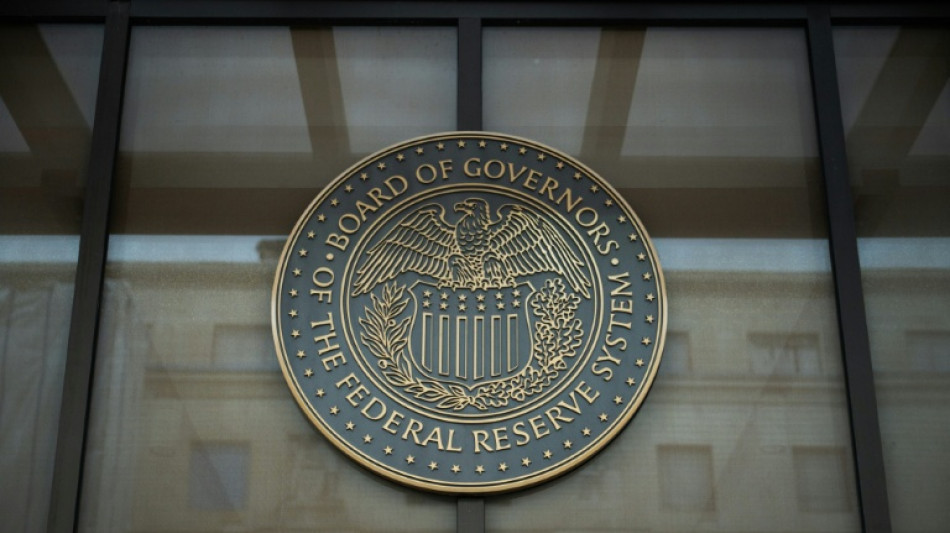
Central banks meet as Mideast war fuels inflation fears / Photo: © AFP
Some of the world's biggest central banks meet this week as fears grow the energy shock unleashed by the Middle East war could fuel inflation and weigh on growth.
The US Federal Reserve, European Central Bank, Bank of England and Bank of Japan hold previously scheduled meetings on Wednesday and Thursday, with their comments on the conflict's potential fallout set to be closely scrutinised.
The war, which began with US-Israeli strikes on Iran, has led to the closure of the Strait of Hormuz, a key energy transit route, as well as Iranian attacks on energy infrastructure around the Gulf.
Oil and gas prices have surged, which typically feed into higher household energy and food costs, raising fears of a repeat of the 2022 Ukraine war inflation shock.
But, rather than rush to hike rates to cool a potential price spike, policymakers are expected to keep borrowing costs on hold for now while offering assurances they stand ready to act.
"We think most central banks will remain on hold this time and wait to assess the impact of the spike in energy prices on inflation," UniCredit analysts said in a note.
- 'Tough spot' -
The Fed will announce its rate decision on Wednesday, and is widely expected to keep borrowing costs on hold for its second straight meeting.
But the US central bank is "in a really tough spot right now", Wells Fargo economist Nicole Cervi told AFP, as concerns about rising inflation due to the Iran war come into conflict with worries about the job market.
The Fed has a dual mandate of holding inflation near a long-term target of two percent while ensuring full employment. But inflation is already well above target, while signs are growing of labour market weakness.
The European Central Bank is expected to keep rates steady, with inflation having settled around its target in recent months, and ECB President Christine Lagarde will likely reiterate her belief that rates remain in a "good place" for now.
She will likely be keen to emphasise the bank is ready to act, however, particularly since the ECB was criticised for moving too slowly to combat the surge in costs following Russia's invasion of Ukraine.
Jack Allen-Reynolds, deputy chief eurozone economist at Capital Economics, told AFP that the ECB would want to stress that they were "not panicking".
"They're not going to rush to react to energy price movements which have been very extreme but very volatile," he said.
"It's not clear how long this is going to last and what the long-term or medium-term inflationary impact is going to be," he added.
- Moves on hold? -
Also announcing its decision on Thursday is the Bank of England, which is expected to keep rates steady.
Before the conflict, investors had been betting on more cuts this year as Britain's sticky inflation eased further -- but these bets have now been scaled back.
Unlike many of its Western peers, the Bank of Japan had already been hiking rates in recent times to combat rising inflation, following a decade of ultra-loose monetary policy.
While the central bank is not expected to tighten borrowing costs again when it meets Thursday, some analysts believe higher energy costs could encourage policymakers to bring forward its next hike to April.
Despite the worries about a surge in global costs similar to that seen in 2022, when inflation topped 10 percent in the eurozone and nine percent in the US, some analysts played down the dangers.
Allen-Reynolds of Capital Economics said that the economic backdrop in 2022 -- with loose monetary and fiscal policy combined with an energy shock and supply constraints -- was different to that today.
"It was a kind of perfect storm for inflation," he told AFP. "We're not in that world now."
G.Waters--TNT