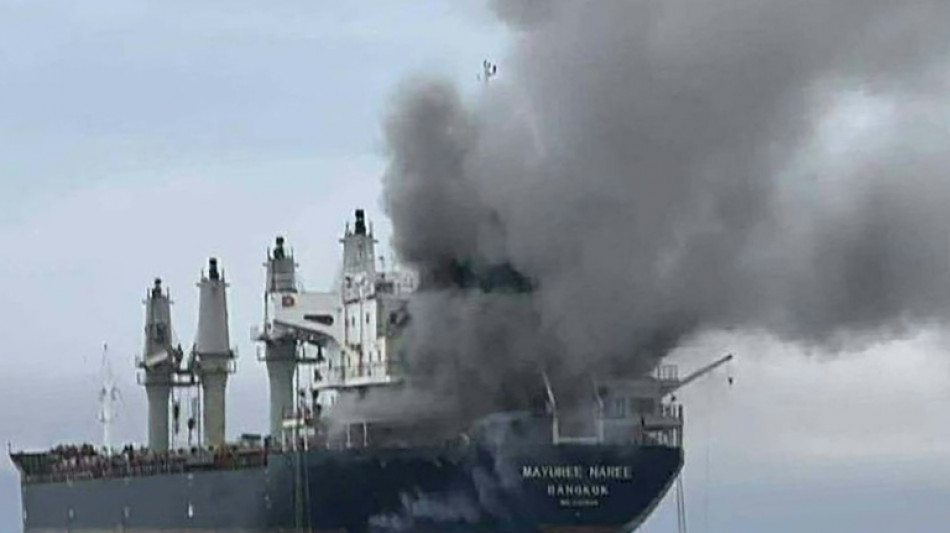
Strait of Hormuz forms part of front line in Mideast war / Photo: © ROYAL THAI NAVY/AFP/File
Attacks targeting commercial vessels in or near the Strait of Hormuz have put the blockaded waterway on the front line of the Middle East war, with spreading economic repercussions.
Iran's quest to inflict maximum pain on the global economy in retaliation for US-Israeli strikes has all but shut the narrow strait through which 20 percent of global crude and LNG normally passes.
US President Donald Trump on Saturday urged countries that rely on oil carried through the Hormuz strait to step up and help take responsibility for keeping the passage open -- with American support.
Currently, only a tiny fraction of the vessels that used to navigate the strategic waterway have made it through, while some have ended up in flames.
- Vessels hit -
At least 10 oil tankers have been hit, targeted or reported attacks since the start of the conflict, according to data from the UK Maritime Trade Operations (UKMTO), the International Maritime Organization (IMO), Iraqi authorities, and Iranian authorities.
Seven were reported to the UKMTO: the Skylight, MKD Vyom, Hercules Star, Ocean Electra, Stena Imperative, Libra Trader and Sonangol Namibe.
Iraq's State Organisation for Marketing of Oil said two other oil tankers, Safesea Vishnu and Zefyros, were hit on Thursday.
The Revolutionary Guards, the ideological arm of the Iranian military, claimed drone strikes on two other oil tankers: the Prima and the Louis P. It also said it hit the Athe Nova, an asphalt/bitumen tanker.
AFP was not in a position to independently verify these claims.
Four bulk carriers, three container ships, a tugboat, an oil drilling vessel and a cargo ship also reported explosions, strikes or suspicious activity in the area to UKMTO.
Thailand's navy said its bulk carrier, the Mayuree Naree, was attacked while transiting the strait. Oman's navy rescued 20 crew members, but efforts were underway to find three more.
The Revolutionary Guards claimed the attack on Wednesday, and also said they had struck a Liberia-flagged vessel.
Provisional figures from the IMO show that at least six sailors and a port worker were killed, and one sailor was still reported missing as of Wednesday.
- 'Maritime disruption' -
The UKMTO said in its latest advisory, issued on Saturday, that, since the war started, "at least twenty maritime incidents involving commercial vessels and offshore infrastructure have been reported" across the Gulf, the Strait of Hormuz and the Gulf of Oman.
It said that there was "no consistent pattern of Western ownership linkage, suggesting that the current strike pattern reflects a campaign aimed at broad maritime disruption rather than selective vessel targeting".
The Western-led Joint Maritime Information Center (JMIC) concurred, saying that while some vessels "have potential Western commercial associations... multiple attacks have involved vessels with no confirmed affiliation to US or Israeli ownership".
- 'Burn any ship' -
Iranian officials have issued contradictory statements regarding the Strait of Hormuz since the war's outbreak.
On March 3, a Revolutionary Guards general threatened to "burn any ship" attempting to cross the strait and to block all oil exports from the Gulf.
But three days later, Foreign Minister Abbas Araghchi said Iran had "no intention" of closing the passage.
And on Wednesday, IRGC naval commander Alireza Tangsiri said in a social media post that "any vessel intending to pass must get permission from Iran".
Separately, the Iranian military's operational command declared on state television that any vessel belonging to the United States, Israel or their allies would be considered a legitimate target and repeated a warning that it would "not allow a single litre of oil to transit" the strait.
- Mine-layers destroyed -
The Pentagon said Tuesday that US forces had destroyed 16 Iranian mine-laying vessels that could have been used to block the strait, but attacks with drones or missiles continued on Wednesday with at least three ships hit.
After US attacks on military infrastructure on Iran's crude oil export hub of Kharg Island Saturday, Trump warned that for "reasons of decency, I have chosen NOT to wipe out the Oil Infrastructure on the Island".
"However, should Iran, or anyone else, do anything to interfere with the Free and Safe Passage of Ships through the Strait of Hormuz, I will immediately reconsider this decision."
France's President Emmanuel Macron, whose country is current president of the Group of Seven advanced economies, on Wednesday urged other G7 leaders to act to restore navigation in the Strait of Hormuz "as soon as possible".
bur-lam-vr-sjw/rmb
A.Little--TNT