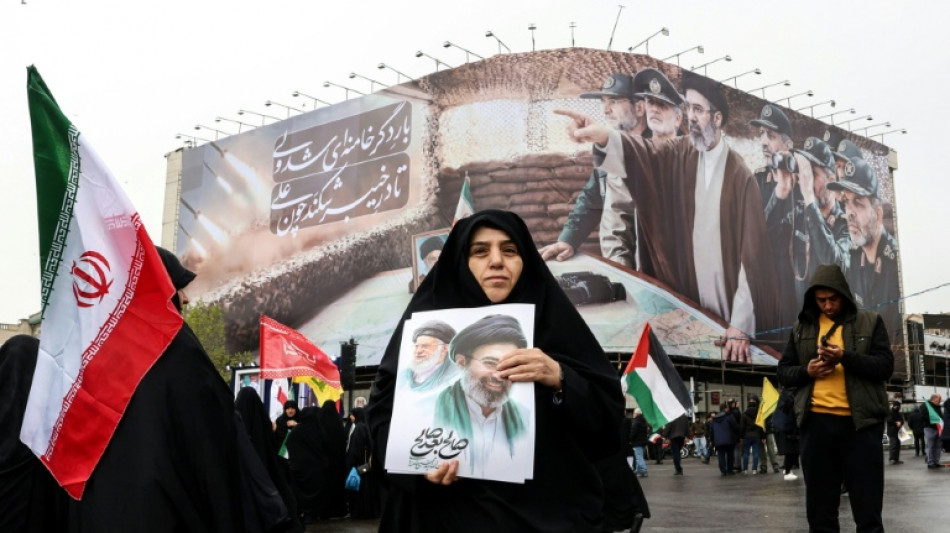
Trump seeks global backing to secure vital Gulf oil route / Photo: © AFP
US President Donald Trump urged other nations to help secure a vital shipping lane choked off by the war with Iran that showed no signs of slowing on Saturday, as strikes hit the US embassy in Baghdad and a major Emirati energy facility.
Two weeks after the United States and Israel attacked Iran, the entire Gulf region remained in the grip of a conflict that has sent shockwaves through the global economy.
The war has also spilled into Lebanon, where the health ministry says Israeli strikes have killed hundreds as Israel battles the Tehran-backed militant group Hezbollah.
Oil prices have surged 40 percent as Iran has choked off the vital Strait of Hormuz and attacked Gulf energy facilities.
Clouds of black smoke rose over Fujairah, home to a major Emirati oil storage and export terminal, AFP journalists saw, shortly after Iran's military warned UAE civilians to avoid port areas.
Washington's embassy in Iraq was hit by a drone, security sources told AFP -- the second such strike during the war -- while the Emirati consulate in Iraqi Kurdistan was targeted for the second time in a week.
US officials in Baghdad urged citizens to "leave now," but warned them not to approach the embassy or the consulate in Erbil "in light of the ongoing risk of missiles, drones, and rockets in Iraqi airspace."
In Kuwait, a drone strike damaged the international airport's radar system but caused no injuries, the civil aviation authority said.
After earlier vowing that the US Navy would "very soon" begin escorting tankers through the Strait of Hormuz, Trump called for reinforcements on Saturday.
"Many countries... will be sending War Ships, in conjunction with the United States of America, to keep the Strait open and safe," he posted on social media, saying China, France, Japan, South Korea and Britain would "hopefully" be among them.
He later said that although the United States had "beaten" Iran, countries dependent on the strait for oil "must take care of that passage, and we will help."
- 'Decisive phase' -
US forces struck Kharg Island on Friday -- from which nearly all of Iran's oil exports flow -- with Trump saying they had "obliterated every MILITARY target" while sparing energy facilities.
Iran had warned that US-linked oil and energy firms would be "turned into a pile of ashes" if struck, with Foreign Minister Abbas Araghchi repeating the threat and accusing Washington of firing rockets at Kharg from bases in the UAE.
Israel's Defence Minister Israel Katz said the war was entering a "decisive phase," though he cautioned it would "continue as long as necessary."
Despite facing superior US and Israeli firepower, Iran appeared determined to fight on.
AFP journalists heard blasts over Jerusalem after the military detected missiles launched from Iran on Saturday. Tehran later confirmed firing another salvo.
Qatar evacuated parts of downtown Doha and intercepted two missiles, with blasts heard by AFP journalists.
Iran's Revolutionary Guards (IGRC) said late Saturday they had launched missiles at US forces stationed at the Al-Kharj base in Saudi Arabia.
The kingdom has not confirmed the attack but said earlier it intercepted six ballistic missiles headed toward Al-Kharj.
Riyadh, a close US ally that hosts large numbers of American troops, has repeatedly been targeted by Iran -- including strikes on its oil industry -- but has not deployed its military against the Islamic republic.
The war has also begun disrupting global sport, with motorsport's governing body cancelling April's Bahrain and Saudi Arabia Formula One races.
Iran continued to face heavy bombardment, with local media reporting strikes in several provinces including one on an industrial site in Isfahan that killed 15 people, according to the Fars news agency. AFP could not verify the toll.
Iran's health ministry says more than 1,200 people have been killed by US and Israeli strikes -- figures AFP could not independently verify -- while the UN refugee agency says up to 3.2 million have been displaced.
The Pentagon says more than 15,000 targets in Iran have been hit by US and Israeli forces. A report this week said the first six days alone cost Washington $11.3 billion, while 13 US military personnel have died.
- Transition -
US media reported that the Pentagon has dispatched the amphibious assault ship USS Tripoli and around 2,500 Marines to the region.
In Iran, leaders appeared intent on projecting stability despite the killing of supreme leader Ali Khamenei on the war's opening day.
His son Mojtaba Khamenei was named the new supreme leader but has not appeared in public and is reportedly wounded.
Iran said Saturday that "there is no problem with the new supreme leader."
The war has also sparked another devastating round of fighting between Israel and Hezbollah in Lebanon.
The Tehran-backed militant group attacked Israel after Khamenei's death and its leader, Naim Qassem, has called the current conflict an "existential battle."
Israel has responded with air and ground assaults, killing at least 826 people, according to the Lebanese authorities.
It has also issued evacuation orders covering hundreds of square kilometres of Lebanon, displacing hundreds of thousands of people and prompting warnings of a humanitarian disaster.
Hezbollah said it was engaged in "direct clashes" with Israeli forces in the southern Lebanese town of Khiam late on Saturday.
Clashes began at 9:20 pm (1920 GMT), involving "light and medium weapons as well as rocket-propelled projectiles," it said.
A Lebanese official told AFP the country was forming a delegation to negotiate with Israel but no agenda, timing or location had yet been decided.
O.Nicholson--TNT