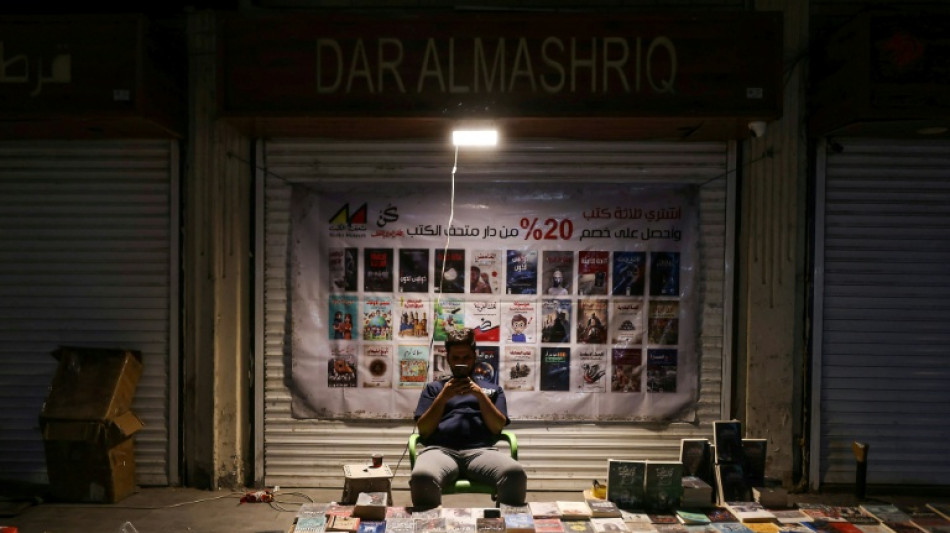
'Normal, but not really': Iraqis try to carry on as missiles fly / Photo: © AFP
Hours before strikes hit Iraq's capital, crowds milled in central Baghdad to the sound not of missiles but clinking coffee cups, children laughing and women filming TikToks.
While Iraqis have grown accustomed to conflict over the decades, this has not diminished their anxiety about a wider war.
"Life seems normal here, but it isn't really," said Karim Al-Aqabi, 65, as he strolled with two friends down Al-Mutanabi Street, famous for its booksellers and performers.
"Instead of listening to music, we listen to the news constantly," the father of three, gesticulating to emphasise his point, told AFP.
Shortly after the US-Israeli attack on Tehran on February 28, Iraq closed its airspace.
Within hours, warplanes and missiles arriving from every direction filled its skies, and the country became a chaotic danger zone with air strikes on Iranian-backed militias, attacks targeting US interests and Iranian strikes against exiled Kurdish opposition groups.
In Iraq, successive governments have long struggled to maintain a delicate balance between Tehran and Washington. Now, once again, Iraqis are watching their nation become a proxy battleground between the two rivals.
The oil-rich country has spent much of the past four decades devastated by conflict and international sanctions, including a bloody sectarian struggle that followed the US-led 2003 invasion which toppled ruler Saddam Hussein and the emergence of jihadists.
Aqabi lived through the eight-year Iran-Iraq war in the Eighties. "Even then, we didn't abandon our country," he said.
He said Iraqis would weather this latest conflict, too. "I will not leave my city even if we are ordered to evacuate. I will not leave even if my home remains buried under the rubble."
But his sentiment isn't shared by all: Mariam Ahmed, 22, hasn't left her home without her brother since the war began.
She spoke to AFP inside a smart new shopping centre off Al-Mutanabi street, a shiny complex which has become emblematic of Baghdad's partial recovery.
"I feel extremely worried and sad about what's happening," she said, describing how she had repeatedly heard warplanes.
"We don't deserve this," she said.
- 'Nothing to do with us' -
The strikes early on Saturday, which killed three members of an Iranian-backed militia, were the first in the heart of Baghdad since the start of the war. Shortly after, a drone hit the US embassy.
Since the start of the war, Tehran-backed Iraqi factions have faced strikes -- unconfirmed by either the United States or Israel -- while Baghdad's airport, US bases and oil fields have been targeted and claimed by those groups.
Sitting with friends, Muhammad Ali, 22, said that, despite the warplanes roaring over Baghdad day and night, the war hadn't affected him.
Behind him sat scores of men, chatting and laughing as a large screen played jazz while an elderly woman wound through the crowd selling white roses.
Ali said he was "confronting the enemy (the US) through social media," while the "resistance attacks US bases," referring to Iran-backed groups.
As Ali and his friends chatted, puffing on a hookah pipe, across from them street photographer Walid Khaled was less nonchalant.
The 26-year-old has lost work already, as people cut back and make essential purchases only.
He lives near Baghdad International Airport, which has been targeted by drones and missiles and hosts a US diplomatic facility.
"We hear explosions all day long," he said, describing how his family had stocked up on rice and gas, in case the situation worsened.
"We had begun to experience a period of relative calm in Iraq, but now some have dragged us into matters that have nothing to do with us."
B.Cooper--TNT