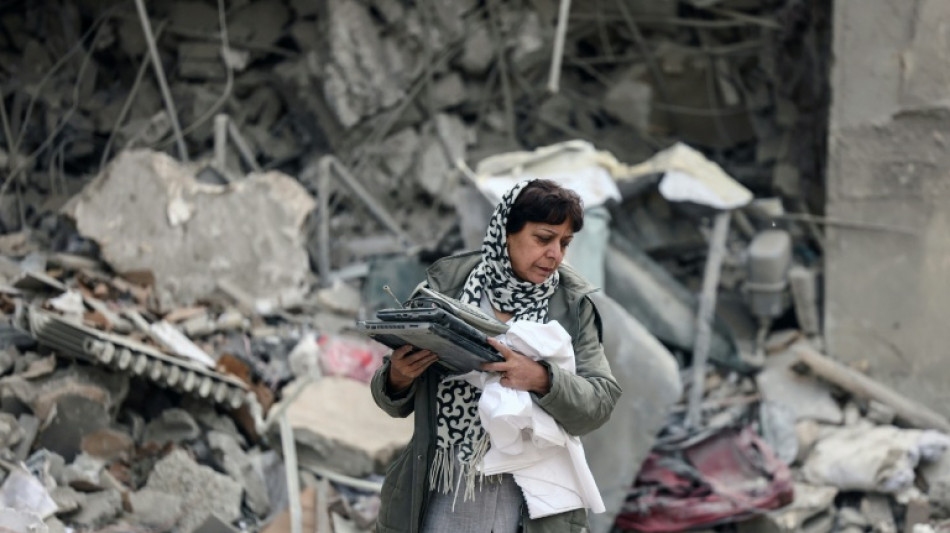
Trump urges world powers to secure Iran shipping lane / Photo: © AFP
US President Donald Trump urged other nations to help secure a vital shipping lane choked off by the war with Iran that showed no signs of slowing on Saturday as strikes hit the US embassy in Baghdad and a major Emirati energy facility.
Two weeks after the United States and Israel attacked Iran, the entire Gulf region remained in the grip of a conflict that has sent shockwaves through the global economy.
The war has also spilled into Lebanon, where the health ministry says Israeli strikes have killed hundreds, as Israel fought the Tehran-backed Hezbollah once again.
Oil prices have surged by 40 percent as Iran has choked off the vital Strait of Hormuz and attacked Gulf energy facilities.
Clouds of black smoke rose on Saturday over Fujairah, home to a major Emirati oil storage and export terminal, AFP journalists saw, shortly after Iran's military warned UAE civilians to avoid port areas.
Washington's embassy in Iraq was hit by a drone, security sources told AFP, the second time it has been targeted in the war, and the Emirati consulate in Iraqi Kurdistan was also struck for the second time in a week.
Having earlier vowed that the US Navy would "very soon" start escorting tankers through the Strait of Hormuz, Trump appeared to call for reinforcements on Saturday.
"Many countries... will be sending War Ships, in conjunction with the United States of America, to keep the Strait open and safe," he wrote on Truth Social, saying China, France, Japan, South Korea, the UK would "hopefully" be among them.
US forces struck Kharg Island on Friday, from which nearly all of Iran's oil is exported, with Trump saying they had "obliterated every MILITARY target", though sparing its energy facilities.
Iran had threatened that US-linked oil and energy firms would be "turned into a pile of ashes" if they were hit.
The strike on Kharg could be a turning point, with both sides escalating the conflict in a bid to force a surrender, analyst Vali Nasr of Johns Hopkins University said on social media.
"The end will likely not be Iranian backing off but inflaming the Gulf."
- 'Long as necessary' -
Israel's Defence Minister Israel Katz said the strikes showed the war was entering a "decisive phase", though he cautioned it would "continue as long as necessary".
Yet, despite facing superior US and Israeli firepower, Iran appeared determined to fight on.
Blasts were heard by AFP journalists over Jerusalem after the military detected missiles launched from Iran on Saturday.
Qatar evacuated downtown areas and intercepted two missiles, with blasts heard by AFP journalists.
The Palestinian Islamist movement Hamas urged Iran to refrain from targeting Gulf neighbours, many of which have supported its cause. It was a rare breach between the allies, though Hamas affirmed Tehran's right to defend itself.
Iran continued to face heavy bombardment with local media reporting strikes in several provinces through Saturday.
Israel's military, meanwhile, warned people in an industrial zone of Tabriz in northern Iran to evacuate, signalling an imminent attack.
Iran's health ministry says more than 1,200 people have been killed by US and Israeli attacks, numbers that could not be independently verified, while up to 3.2 million people have been displaced, according to the UN refugee agency.
Trump described Iran as "totally defeated" and in search of a deal he was unwilling to consider.
More than 15,000 targets in Iran have been hit by the US and Israel, the Pentagon said. A report this week said the first six days alone cost the US $11.3 billion, while 13 military personnel have died in the war.
- Transition -
US media raised the possibility of American troops on the ground in Iran, with the New York Times and Wall Street Journal reporting the Pentagon had dispatched the Japan-based amphibious assault ship USS Tripoli to the region along with around 2,500 Marines.
In Iran, the country's rulers appeared intent on showing they would survive the war and maintain control, despite their supreme leader Ali Khamenei being killed on the opening day.
Khamenei's son Mojtaba Khamenei was named the new supreme leader, but has been absent from public view and is reportedly wounded.
Reza Pahlavi, the US-based son of Iran's last shah, said on social media on Saturday that he was ready to lead a transition "as soon as the Islamic Republic falls".
But Iran's Revolutionary Guards have threatened a heavy crackdown on any anti-government protests. Thousands were killed during mass demonstrations in January, and a near-total internet blackout has been imposed since the war began.
- 'Existential battle' -
The war has also sparked another devastating round of fighting between Israel and Hezbollah in Lebanon.
The Tehran-backed militant group attacked Israel after Khamenei's death and its leader, Naim Qassem, has called the current conflict an "existential battle".
Israel has responded with air and ground assaults, killing at least 826 people according to the Lebanese authorities.
It has also issued evacuation orders covering hundreds of square kilometres of Lebanon, displacing hundreds of thousands and prompting warnings of a humanitarian disaster.
An overnight strike in southern Lebanon killed more than a dozen health workers at a clinic, health authorities said and put the total number of paramedics killed this month by Israel at 31.
On a visit to Beirut, UN chief Antonio Guterres said "diplomatic avenues are available" to end hostilities.
V.Allen--TNT