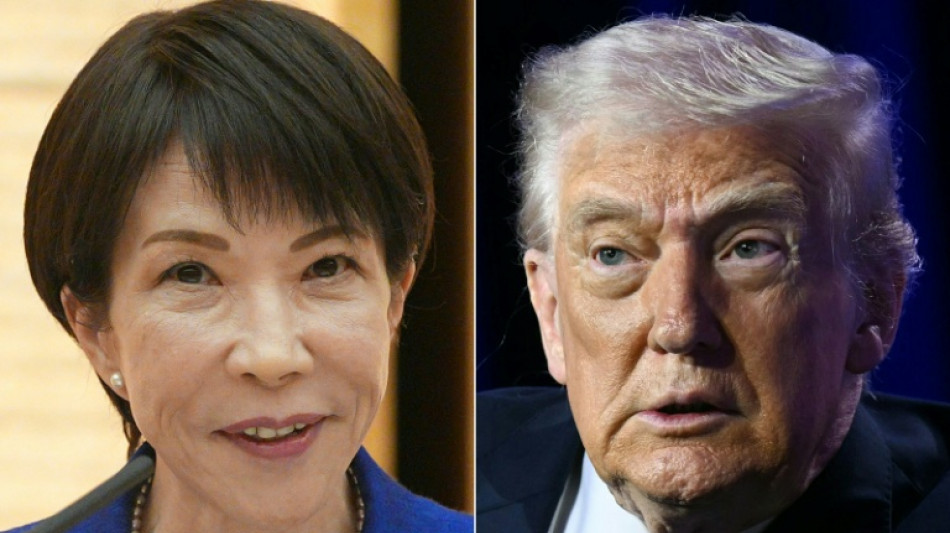
Takaichi to be 'candid' with Trump as war hurts Japan / Photo: © POOL/AFP/File
Japan is hurting from the Iran war ahead of Prime Minister Sanae Takaichi's visit to Washington next week. She has promised to be "candid" with the US president.
How forthright Japan's first woman premier can afford to be in their March 19 meeting, and how receptive the 79-year-old Trump will be, remain to be seen however.
The world's number-four economy is the fifth-biggest importer of oil, 95 percent of it from the Middle East and 70 percent passing through the Strait of Hormuz, now effectively closed.
On top of oil rising above $100 per barrel, Japan's hefty import bill has also risen because its currency has fallen against the dollar, as every barrel of crude -- traded in the US currency -- costs more yen to buy.
On Wednesday, Japan was the first to announce a release from its strategic oil reserves, with Takaichi, 65, saying Japan was being "severely impacted".
Trump has said that defeating Iran's "evil empire" was more important than crude prices.
Pricier oil -- and also gas -- risks making life more expensive for firms and families alike, which could hurt Takaichi's popularity.
Just over four weeks ago, she was basking in a landslide election victory, but polls published this week suggest that the honeymoon is souring.
After rice prices doubled last year, Stefan Angrick, senior economist at Moody's Analytics, said that in particular, food could jump again.
"(You) need energy to produce food. And natural gas, for example, is often used to produce fertiliser," Angrick told AFP.
Growth is already feeble -- 0.3 percent in the last quarter -- and Takaichi last year pushed through a 21.3-trillion-yen ($134-billion)stimulus package.
Any extra efforts could worry investors who are already fretting -- bond yields hit records in January -- about Japan's colossal debts.
- Rules -
Japan is a strong backer of the rules-based international order but Takaichi has been careful not to criticise the war and anger Trump after charming him on his visit to Japan in October.
"We do not possess detailed information, including whether this was a measure for self-defence. Our country will refrain from making a legal assessment," she said on March 2.
Tokyo can ill afford to annoy Trump since the United States has for decades -- with 60,000 troops on Japanese soil -- been the guarantor of Japan's security.
Trump is due to visit China from March 31 to April 2.
Japan-China ties have worsened after Takaichi suggested in November that Japan might intervene militarily in any Chinese attempt to take Taiwan.
Already there are concerns Washington has taken its eye off the Asia-Pacific, analysts said.
Two US destroyers normally based in Japan were in the Arabian Sea as of last week, according to a report issued Monday by the US Naval Institute.
Japan remembers that Afghanistan and Iraq "bogged down US resources and attention for decades," said Yee Kuang Heng, a professor in international security at the University of Tokyo.
"On the other hand, some hope that the display of US military might (in Iran and also Venezuela) will enhance deterrence of China," Heng told AFP.
- Investments -
Probably more on Trump's mind will be Japan's pledge to invest $550 billion in the United States in return for lowering threatened tariffs of 25 percent to 15 percent last year.
The promises remain valid even after the US Supreme Court struck down Trump's global tariffs in February and he imposed a new blanket 10 percent duty on imports.
Tokyo and Washington announced before that ruling a first tranche of $36 billion for three infrastructure projects and more may be announced next week.
"Takaichi will need to use the personal rapport she has built with Trump since last fall to try to convince him to look past the current conflict in the Middle East, and make him see the repercussions that it is having beyond the region," said Sayuri Romei at the Indo-Pacific Program of the German Marshall Fund of the United States (GMF).
"Notably, she will need to underscore Japan's perspective on China's multi-faceted threat: not only Beijing poses a threat from an economic coercion point of view, it is also a direct security threat," Romei told AFP.
T.Bennett--TNT