The Chinese cable that could trip up Chile's new leader / Photo: © AFP
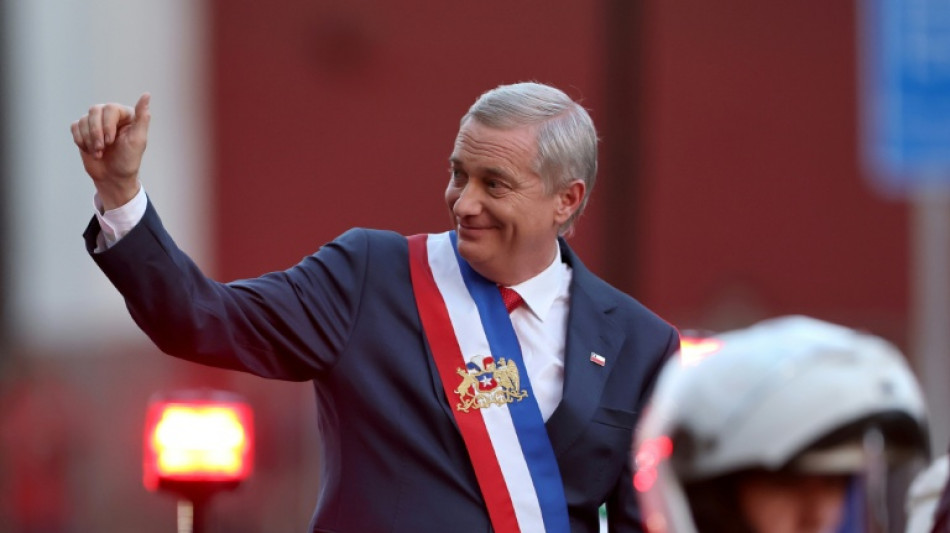
Chile's new president Jose Antonio Kast faces a tough choice in his first weeks in office.
Will he bow to US pressure to nix a project to link China and Chile across the Pacific via an undersea fiber optic cable?
Or will Kast, who took office Wednesday, revive an initiative cherished by Chile's biggest trading partner, at the risk of incurring Washington's wrath?
The Chile-China Express would carry data nearly 20,000 kilometers (over 12,000 miles) under the sea from Hong Kong to the port of Valparaiso, allowing Beijing to reduce its dependence on internet routes that pass through North America.
But it has become entangled in the intense rivalry between Washington and Beijing for influence in Latin America.
The US State Department has called it a threat to regional security in what it calls "our hemisphere."
Chile's then-transport minister in January approved the project, which was proposed by state-owned China Mobile.
But two days later the government abruptly rescinded its approval, amid pressure from Washington.
The United States sanctioned three Chilean officials, including the transport minister, over the project -- a rare rebuke of one of the United States' closest Latin American allies.
A Chinese cable "basically leaves the United States unable to see what is happening" in regional data traffic, telecommunications expert Jonathan Frez, a professor at Diego Portales University in Santiago, told AFP.
It would allow China to connect directly with Latin America, including fellow BRICS member Brazil, Frez added, referring to a grouping of major emerging economies.
Kast faces a delicate balancing act in trying to reconcile Chile's trade ties with China with his desire to deepen links with Trump, who hosted the Chilean at his "Shield of the Americas" summit in Florida last week.
The cable project created friction between Kast and his left-wing predecessor Gabriel Boric in the final days of Boric's presidency.
Kast accused his predecessor of withholding information about the cable and suspended cooperation with Boric on the handover of power for several days.
- 'A warning' -
Kast is Chile's most right-wing president since the 1973-1990 dictatorship of General Augusto Pinochet, elected on a promise to crack down on organized crime and irregular migration.
Washington is interested in supporting Kast on those issues, which are central to the Trump presidency, but also in "denying China access to resources and markets," Gilberto Aranda, an international relations expert at the University of Chile, told AFP.
He saw the sanctioning of Chilean officials as "a warning" to the incoming Kast administration.
To avoid confrontation with either superpower, Chile should develop new markets, Aranda advised.
China is the main destination for Chilean exports.
In 2025, Chile sold more than $38 billion worth of products to China, primarily copper, cherries, and lithium.
- Tech hub -
Chile is hooked up to at least three international undersea cables, all connected to North America.
Successive governments of the right and left have positioned the country, which has the world's sixth-fastest internet speeds, according to Speedtest Global Index, as a tech hub.
The 14,800-kilometer Humboldt cable, currently being built between Valparaiso and Sydney, will be the first between South America and the Asia-Pacific.
It is being developed in partnership with Google.
Experts cited by Chile's Diario Financiero financial daily predicted that if the Chile-China Express cable was jettisoned by Santiago, Beijing would likely take it to Peru, the second-largest recipient of Chinese investment in Latin America.
L.Graham--TNT