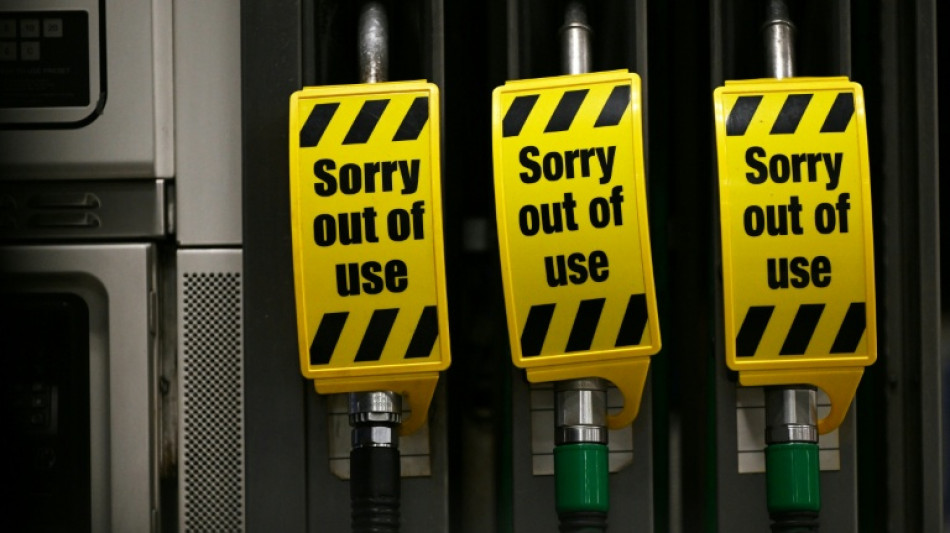
Germany, Japan to unblock oil reserves as G7 stands 'ready' to act / Photo: © AFP
Japan and Germany said Wednesday they would tap into their oil reserves to tackle the rise in crude prices due to the Middle East war, with Berlin saying the IEA global energy body had asked member states to release 400 million barrels.
France, the current chair of the Group of Seven countries, said nations were coordinating their steps as G7 energy ministers said they stood ready to take "all necessary measures".
The latest announcement came as leaders of the Group of Seven advanced economies were set to discuss the widespread economic fallout from the US-Israeli war with Iran, now into its second week, at a video conference meeting chaired by French President Emmanuel Macron.
Prime Minister Sanae Takaichi said Japan would release oil reserves as early as Monday, while Germany's Economy and Energy Minister Katherina Reiche said her country planned to do the same, without specifying a date.
"Without waiting for a formal decision on coordinated international stock releases with the IEA, Japan has decided to take the lead in easing supply and demand in the international energy market by releasing strategic reserves as early as the 16th of this month," Takaichi told reporters.
"Given Japan's exceptionally high dependence on the Middle East (for oil) and as we will be severely impacted, we plan to utilise Japan's strategic petroleum reserves," she said.
- Oil market volatility -
Germany's Reiche said the Paris-based International Energy Agency (IEA) had asked its member states to release oil reserves "amounting to 400 million barrels".
"We will comply with this request and make our contribution," Reiche said.
The crude market has been hit by wild volatility since the United States and Israel began striking Iran at the end of last month, with Tehran retaliating by attacking targets across the oil-rich Gulf and effectively shutting down the Strait of Hormuz.
French Finance Minister Roland Lescure said countries' announcements that they would release part of their strategic oil reserves were "undoubtedly part of a highly coordinated strategy".
On Tuesday, member states of the IEA held crisis talks to assess the security of supply and the potential release of emergency stocks.
"In principle, we support the implementation of proactive measures to address the situation, including the use of strategic reserves," the energy ministers of the G7, of which France currently holds the rotating presidency, said in a statement.
They said they were coordinating within the group, with IEA member countries and beyond.
"We agreed to stand ready to take all necessary measures in coordination with IEA Members," they said.
Lescure said the meeting of the G7 leaders would "no doubt discuss this issue of strategic reserves".
"We need to send a very clear message, which is that if we cannot reopen the Strait of Hormuz, we will replace it with other oil that will come from elsewhere and circulate around the world," he told broadcaster BFMTV/RMC.
- 'Pumping less oil' -
Citing officials familiar with the matter, the Wall Street Journal reported Tuesday that the IEA had proposed its largest-ever release of oil reserves to counter soaring crude prices driven by the war.
The release would exceed the 182 million barrels of oil that IEA member countries released in 2022 when Russian leader Vladimir Putin invaded Ukraine, the newspaper said.
The IEA did not immediately respond to a request for comment from AFP.
Ipek Ozkardeskaya, a senior analyst at trading platform Swissquote, said 400 million barrels would still be a "meagre" amount compared with the roughly 45 million barrels that IEA countries consume every day.
"It would therefore be a temporary fix," she said, adding the announcement helped keep oil prices in check on Wednesday.
"The Middle East is now pumping less oil -- around 6 percent less -- in reaction to the Iran war."
Asian equities extended gains Wednesday while oil stabilised after the WSJ report.
Countries around the world have been left scrambling in response to the oil price spikes. Bangladesh has deployed the army to guard oil depots, India has imposed tighter controls over natural and cooking gas and French officials conducted inspections at petrol stations and fined those found to be inflating prices.
The 32 members of the IEA hold over 1.2 billion barrels of public emergency oil stocks, with a further 600 million barrels of industry stocks held under government mandates.
S.Arnold--TNT