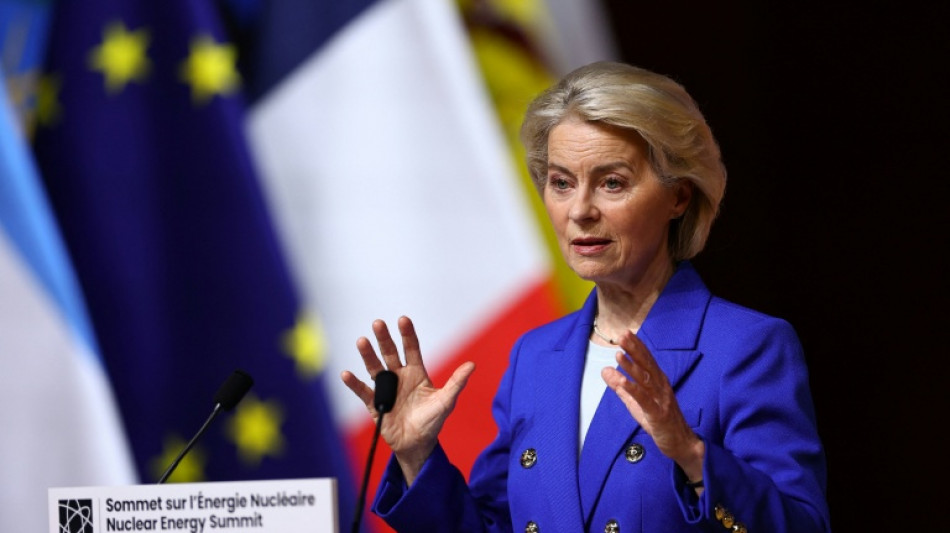
Citing 'strategic mistake' EU pivots back to nuclear energy / Photo: © POOL/AFP
EU chief Ursula von der Leyen on Tuesday said Europe's turn away from nuclear power had been a "strategic mistake", as soaring oil prices rekindled concerns about the bloc's energy vulnerability.
Speaking at a nuclear summit in Paris, the European Commission president endorsed a return to atomic energy, saying the European Union would back investments in "innovative nuclear technologies".
"It was a strategic mistake for Europe to turn its back on a reliable, affordable source of low-emission power," she said.
The US-Israeli strikes on Iran and Tehran's retaliatory attacks across the Gulf region have upended the world's energy and transport sectors, virtually halting activity in the strategically vital Strait of Hormuz.
EU officials have said the situation is yet to reach the crisis levels hit after Russia invaded Ukraine in 2022.
But the conflict has rekindled a debate on the bloc's external dependencies and high energy costs, which European industry has long said hamper competitiveness vis-a-vis Asia and North America.
"For fossil fuels, we are completely dependent on expensive and volatile imports. They are putting us at a structural disadvantage to other regions," von der Leyen said at the Paris summit, which aims to boost the use of civilian nuclear energy.
"The current Middle East crisis gives a stark reminder of the vulnerability it creates," she added.
Her comments came as the EU is set to unveil new energy plans that von der Leyen said will include "a 200-million-euro ($230-million) guarantee to support investment in innovative nuclear technologies".
Brussels is focusing in particular on small modular reactors (SMRs), which the commission would like to see in operation by the early 2030s.
SMRs have about a third of the generating capacity of a traditional nuclear power reactor -- but are relatively simple to build and thus more affordable.
Their designs promise enhanced safety features and more efficient operations than traditional plants, but have yet to be deployed at scale.
- Breaking 'taboos' -
The EU money, while modest, is supposed to help Europe play catch up with the United States and China in the sector.
It will come from the bloc's Emissions Trading System (ETS) -- which obliges heavy polluters to pay for permits, said von der Leyen.
Brussels will also work with member states to align regulatory frameworks and speed up permitting, she added.
Nuclear energy on the continent fell into crisis after the 2011 Fukushima disaster in Japan, which reinforced fears highlighted by the 1986 Chernobyl catastrophe.
Putting EU money behind nuclear projects was long a no-no, with the 27-nation bloc focusing on renewables in the race to cut planet warming emissions.
Russia's war on Ukraine sparked a re-think -- but atomic power remains divisive.
Germany's chancellor Friedrich Merz has also labelled the shuttering of nuclear plants a "serious strategic mistake".
On the other hand Austria has historically opposed atomic power and Spain remains a strong advocate of renewables as the first port of call for greener power supplies.
EU industry chief Stephane Sejourne celebrated the EU nuclear pivot Tuesday saying Brussels dared "to break certain taboos".
"The commission is now fully integrating nuclear power into its industrial strategy and financing instruments. This is a first!", he said.
Yet wind and solar are set to dominate the European energy mix for years to come, as building new nuclear capacity will inevitably take time, experts caution.
In 2024, renewable energy sources accounted for 47 percent of electricity production in the EU, compared to 23 percent for nuclear power, according to Eurostat, the union's data agency.
E.Cox--TNT