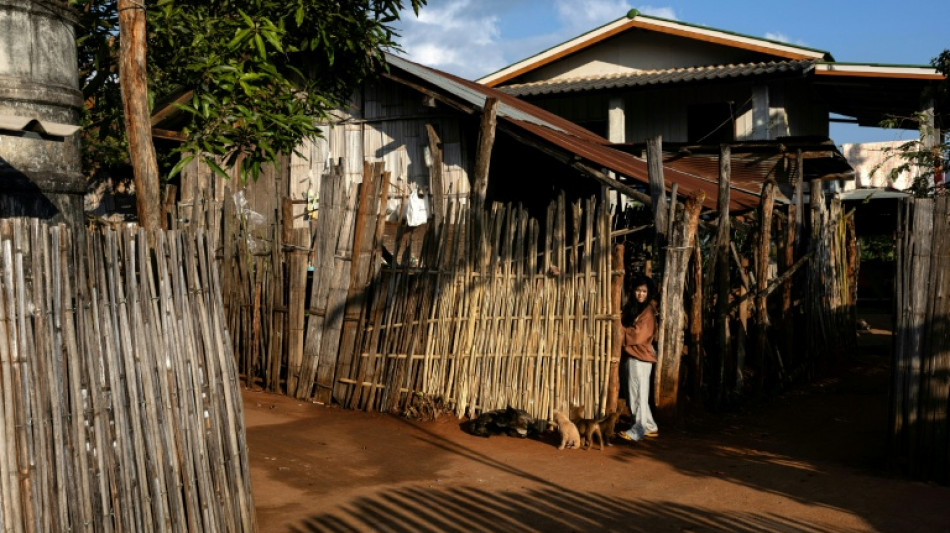
Myanmar civil war drives drugs epidemic in Thai hills / Photo: © Courtesy of Luke Duggleby/AFP
Hundreds of thousands of people in northern Thailand have become collateral damage from the civil war in neighbouring Myanmar, turning to drugs as supply through the area rockets on the back of the conflict.
The area is part of the Golden Triangle -- where the two countries' borders meet Laos -- once the world's biggest opium hub when wars raged across Indochina in the 1960s and 70s.
When peace came to much of Southeast Asia the title moved to Afghanistan, but it was taken by Myanmar after the 2021 military coup and subsequent civil war, with a thriving methamphetamine industry alongside.
Drugs are smuggled into Thailand on their way to market, and research shows usage rates in its northern regions have tripled in five years.
The poorest and most vulnerable are hardest hit, among them the area's hill tribes such as the Lahu, around 300,000 of whom live along the frontier, mostly in Myanmar's Shan state but around one-third in Thailand.
Researchers say that with few opportunities available to them, individual Lahu also often become involved with drugs as opium field labourers or as low-level smugglers.
Jawa Jabo, 70, relapsed into opium in the face of gruelling work on his coffee farm and marital tensions, before turning to religion to try to tackle his addiction.
At a cleansing ceremony in Mae Ai, just 10 kilometres (six miles) from the border, a spiritual leader cupped his hand over a candle before gripping Jawa's legs and body to drive out the toxins.
"May all that is bad dissolve into the river and never return," the shaman chanted.
At the culmination of the ritual Jawa burned through a sacred white cord to tie around his wrist for protection, and as a reminder of his promises.
"After the ritual, the pain eased -- and from today, I must quit opium," said Jawa.
- Supply spike -
On a foggy winter morning captain Khetsopon Nopsiri led a six-strong Thai army patrol along dirt tracks through the forest, assault rifles at the ready.
His unit monitors cross-border drug smuggling routes from Myanmar and regularly clashes with suspected traffickers, four times in November alone.
One group of 10 to 12 suspects fled after a firefight, he said, leaving behind 2.2 million methamphetamine pills.
"Drug trafficking into Thailand is increasing as production becomes more efficient," he said.
For centuries opium was an economic mainstay for many Golden Triangle hill tribes, where soils are too poor for most crops and government authority was weak.
Organised crime groups also operate methamphetamine labs that are easy to hide among the trees and offer reliable harvests in pill or crystal form.
Some of the myriad armed organisations in Myanmar, including its own military, have long been accused of profiting from the drugs trade, while others are said to have turned to it more recently to fund their fighting.
The conflict disrupts efforts to combat the industry, with the central government weakened and its attention elsewhere.
At the same time, some drug-producing areas have more stability, the United Nations Office of Drugs and Crime (UNODC) said in a report, "allowing major drug producing groups to ramp up production without law enforcement intervention".
Conflict-related incidents rose more than 17-fold in southern Shan state between the three years before the coup and the same period afterwards, the report found.
In the same timescale, the amount of crystal methamphetamine seized in Myanmar rose by more than 150 percent, even as the number of seizures fell.
Opium production has more than doubled since the coup, UNODC said, and poppy was farmed on more than 53,000 hectares last year, the largest area since 2015.
"The first victims are the communities living along the border," Delphine Schantz, UNODC regional representative for Southeast Asia and the Pacific, told AFP.
"The closer they are to production areas, the cheaper the drugs become, and we are seeing rising drug use, particularly among young people in border communities."
- Usage triples -
Research published by Chiang Mai University estimated that almost 290,000 people in Thailand's eight northernmost provinces, including those on the border with Shan state, used hard drugs at least once in 2024.
That was more than three times as many as the previous survey in 2019, before the coup, and more than seven percent of the population -- with higher rates in rural and remote areas.
Mae Ai district is home to nearly 16,000 Lahu, their biggest centre in Thailand.
Other than farming or casual labour there are few opportunities for paid work, compounded by the fact that many cannot speak Thai.
"The fastest way to make money is producing and moving drugs," said Lieutenant General Worathep Bunya, head of an interdiction task force on the border.
Sitthikorn Palor, 19, dropped out of primary school and was raised by his stepfather, a low-level drug trafficker.
After a brief stint of farm work, he began to courier methamphetamine.
"I was the one picking up the drugs and delivering them to customers," he said.
But after he joined a grassroots support group offering emotional support and Thai lessons he returned to agricultural labour, and now dreams of opening a car repair shop.
"They encouraged me to change my ways," he said. "Normally I'm someone who doesn't listen to anyone, but when they came to talk to me and acted like older siblings, I listened and stopped what I was doing."
Scores of Lahu have been supported over the years by the With Loving Hearts organisation.
But one, activist Chaiyaphum Pasae, was shot dead aged 17 by soldiers at an army checkpoint claiming he was trafficking drugs, prompting a seven-year legal battle for co-founder Yuphin Saja.
"Behind the stigma that labels Lahu children as lazy, uneducated or drug users," she said, "they are simply struggling to survive on their own."
This story is a collaboration between AFP and HaRDstories, with support from the Pulitzer Center.
V.Bennett--TNT